Dive Site Card
Collect the card.
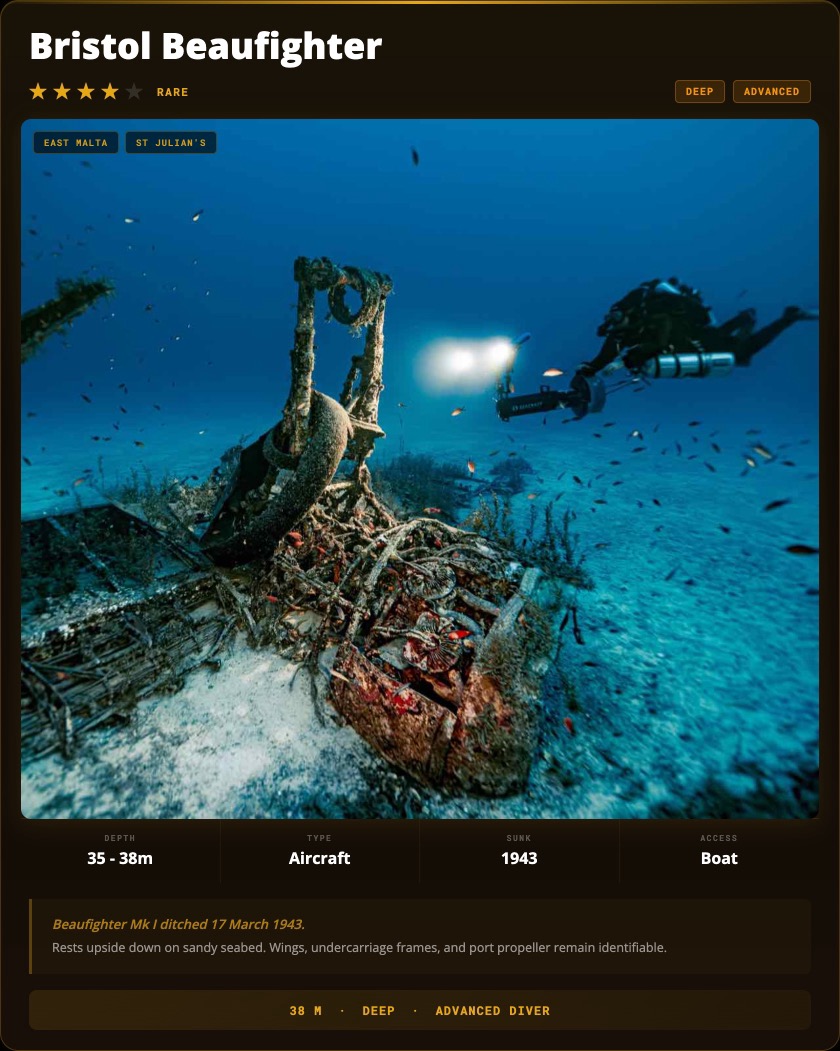
A Bristol Beaufighter Mk I rests upside down on a sandy seabed approximately 900 metres off St Julian's Point. Ditched on 17 March 1943 following mechanical failure shortly after takeoff, both crew survived. Wings, undercarriage frames and the port propeller remain identifiable on this deep, boat-access-only wreck.
The Beaufighter's inverted position creates an unusual visual encounter: descending to the sandy bottom, divers first see the smooth belly of a WWII aircraft overhead. Both Bristol Hercules engine cowlings point upward and are largely intact. The undercarriage legs are visible, retracted against the belly. Marine growth is dense; the aircraft functions as an artificial reef supporting blennies, gobies, and several resident morays. Flat sandy bottom prevents silt disturbance on calm days. A natural pairing with the Um El Faroud or the Blenheim Bomber for a full Malta wreck day.

The aircraft lies completely upside down, with the fuselage largely buried in sand. The underside of the wings is visible from above, and the undercarriage frames protrude from the seabed with the rubber of the original tyres long deteriorated.
The port engine remains attached and the propeller blades are intact, the most recognisable single feature of the wreck. The starboard engine side is more heavily buried. Getting close to propeller level requires descending to maximum depth.
The twin-boom wing layout of the Beaufighter spans approximately 17.6 metres. The wing surfaces are largely intact and lie flat against the sandy bottom. Fin-fish use the cavities along the leading edges as shelter.
The wreck sits on open sandy seabed with no adjacent reef structure. Cuttlefish, sea bream and the occasional John Dory are recorded here. The bare bottom makes the silhouette of the inverted aircraft easy to read on the descent line.
| Month | Water Temp | Visibility | Conditions |
|---|---|---|---|
| Jan–Mar | 15°C | 15–20m | Calm, cold |
| Apr–Jun | 17–21°C | 20–25m | Warming, clear |
| Jul–Sep | 25–27°C | 20–25m | Peak season |
| Oct–Dec | 20–22°C | 18–22m | Settling seas |
Currents on this site are generally mild. The wreck sits in open water so surface conditions dictate whether the dive runs. Northwesterly swells can restrict access; diveshack monitors conditions before departure.
Boat only. The site lies approximately 900m offshore. Divers enter via giant stride or back-roll and descend on the shot line directly to the wreck. The line is collected before ascent.
5mm wetsuit sufficient June through October; drysuit or 7mm recommended in winter. A dive torch is useful for examining buried sections. Deploy SMB before ascending.
Advanced Open Water (or equivalent) certification is required. Maximum operating depth is 38m. All divers must demonstrate logged experience at depth before this site is allocated.
Bottom time at 38m is limited by no-decompression limits. Divers should plan for a maximum of 20–25 minutes at depth followed by a safety stop at 5m for 3 minutes. Computers are mandatory.
All divers descend and ascend on the shot line. Do not leave the line during descent in any swell or reduced visibility. The line is the primary reference for the safety stop and ascent rate control.
Every diver must carry and deploy a surface marker buoy before leaving the bottom. The site is in open water with boat traffic. The guide will signal when to begin the ascent sequence.
Stay within visual contact of your buddy throughout the dive. The open sandy bottom offers no shelter. Signal your buddy before approaching the buried fuselage section to avoid stirring up silt.
Entry into the buried fuselage is not permitted. The aircraft lies inverted and partially collapsed. External observation only. This is enforced on every guided dive; no exceptions are made.
diveshack Malta runs guided dives to the Bristol Beaufighter as a dedicated boat dive from Sliema. Groups are kept small and every dive is led by an SSI-certified divemaster with wreck experience. All diving equipment is provided.
Include this site in a package: