Dive Site Card
Collect the card.
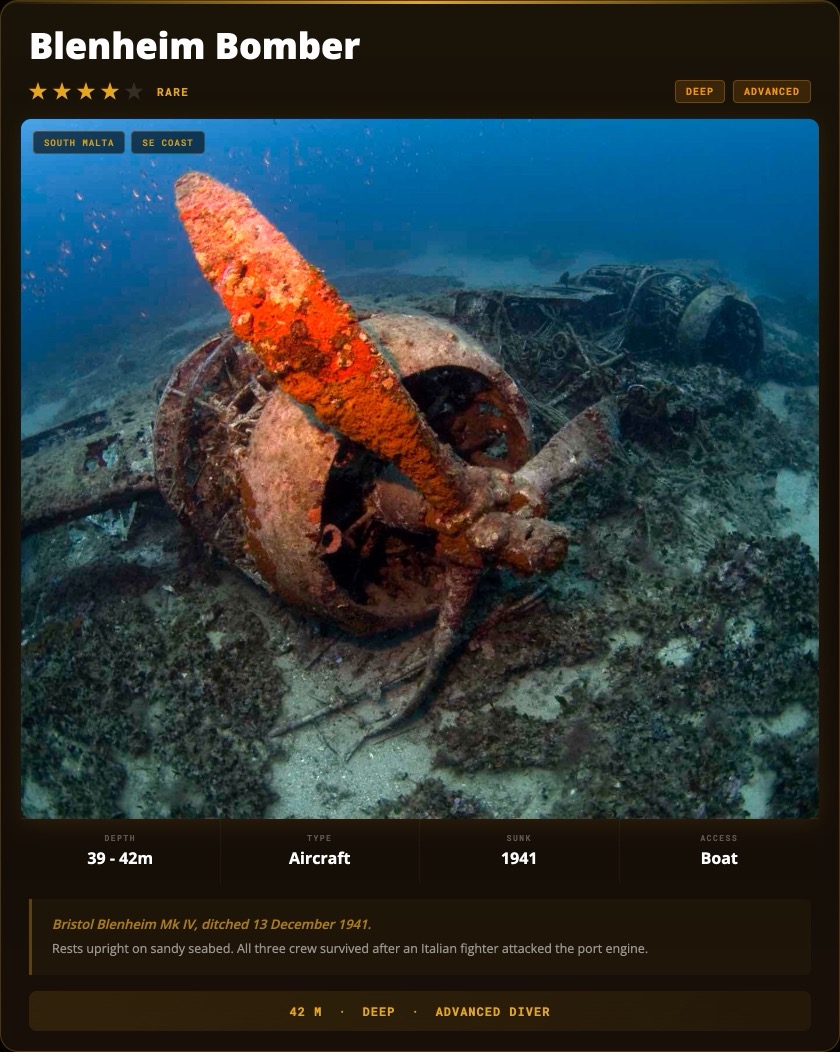
A Bristol Blenheim Mk IV light bomber rests upright on a sandy seabed off the SE coast of Malta. On 13 December 1941, returning damaged from a mission to Kefalonia after an Italian fighter attacked its port engine, the pilot ditched the aircraft near Malta and all three crew survived. The starboard engine retains a bent propeller; the rear fuselage has broken free and lies a few metres from the main airframe.
The Bristol Blenheim is a rare encounter with intact WWII aviation history at depth. The twin-engine light bomber retains its basic form: fuselage, both wings, tail assembly, and engine nacelles all identifiable. The rear fuselage has separated and lies a few metres to the side. Scorpionfish rest on the wing surfaces, conger eels inhabit the fuselage, and grouper patrol the perimeter. Penetration into the cockpit is possible for those trained and equipped. Plan for 15–20 minutes at depth with a decompression-capable computer. A natural pairing with the Um El Faroud for a full south Malta wreck day.

The Blenheim sits upright on sand, a distinctive profile for an aircraft wreck. The twin-engine layout and mid-wing configuration remain recognisable. The cockpit canopy is missing and the forward fuselage is open to the water.
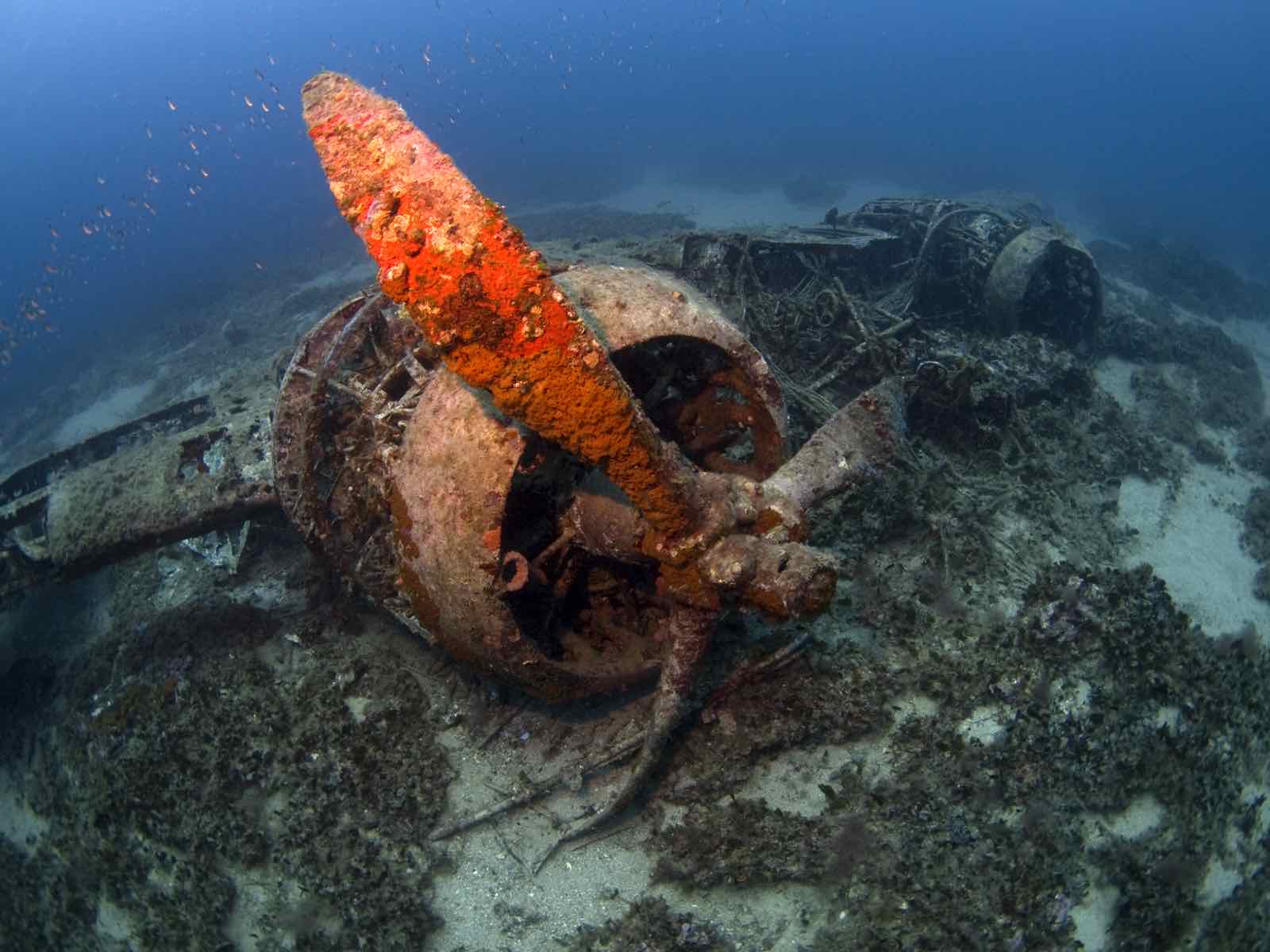
The starboard radial engine is intact and the propeller blades remain in place, though bent from the impact ditching. The port engine sustained the battle damage that brought the aircraft down and its propeller is missing entirely.
The aft section of the fuselage has separated from the main airframe and rests a few metres away on the sandy bottom. This makes the Blenheim a two-part site, and both sections reward close inspection. The tail gunner's position is partially accessible from outside.
The Blenheim's mid-mounted wings remain largely intact and span approximately 17 metres. Encrusting organisms have begun colonising the metal surfaces. Bream, wrasse and occasional grouper shelter around the airframe on most dives.
| Month | Water Temp | Visibility | Conditions |
|---|---|---|---|
| Jan–Mar | 15°C | 15–20m | Calm, cold |
| Apr–Jun | 17–21°C | 20–25m | Warming, clear |
| Jul–Sep | 25–27°C | 20–25m | Peak season |
| Oct–Dec | 20–22°C | 18–22m | Settling conditions |
The SE Malta coast can see localised current at depth. Conditions are checked on the day. The open sandy seabed gives no shelter from any surface surge, so this site may be stood down in poor weather.
Boat only. A shot line is placed directly over the wreck. Descend positively to depth; at 42m there is no time to waste on a slow descent. Exit is on the line with a 3-minute stop at 5m minimum.
5mm wetsuit June through October; 7mm or drysuit for winter dives. A dive computer is mandatory at this depth. Redundant air source recommended for divers operating at or near their open-circuit limits.
Advanced Open Water certification is the minimum for this site. At 42m, divers are operating at the limit of recreational no-decompression diving. diveshack reserves the right to restrict this site to divers with a verified deep dive record.
At 42m on air, the no-decompression limit is approximately 10 minutes. Plan the dive conservatively, start the ascent when any diver's computer reaches the pre-agreed limit, and add a mandatory 3-minute safety stop at 5m.
A personal dive computer is mandatory on this site. No exceptions. The guide carries a backup computer but cannot monitor individual NDL status for every diver. Each diver is responsible for their own decompression status.
Descend and ascend on the shot line only. At 42m in open water, losing reference on the ascent creates a serious decompression risk. The line is your rate-of-ascent control and safety stop reference point.
Every diver deploys an SMB before leaving the bottom. The SE coast of Malta is exposed to boat traffic. The guide signals the start of the ascent sequence; deploy your SMB at that point, not before.
The open fuselage sections are not for entry. The structure is partially collapsed and the depth leaves no margin for entanglement incidents. External observation of both airframe sections is achievable within a single dive.
diveshack Malta runs guided dives to the Blenheim Bomber as a dedicated boat dive. All divers are briefed on NDL planning and the two-section layout before entering the water. Full diving equipment is provided. Group sizes are kept small to allow adequate bottom time and individual attention at depth.
Include this site in a package: