Dasyatis pastinaca
Species Profile
Range
The common stingray ranges across the northeastern Atlantic and the entire Mediterranean basin, from the Strait of Gibraltar to the Levantine coast. It is the most frequently encountered ray species by divers in Maltese waters.
Sightings are logged by divers using our What Did You See? dive-log tool. View the full live sightings map.
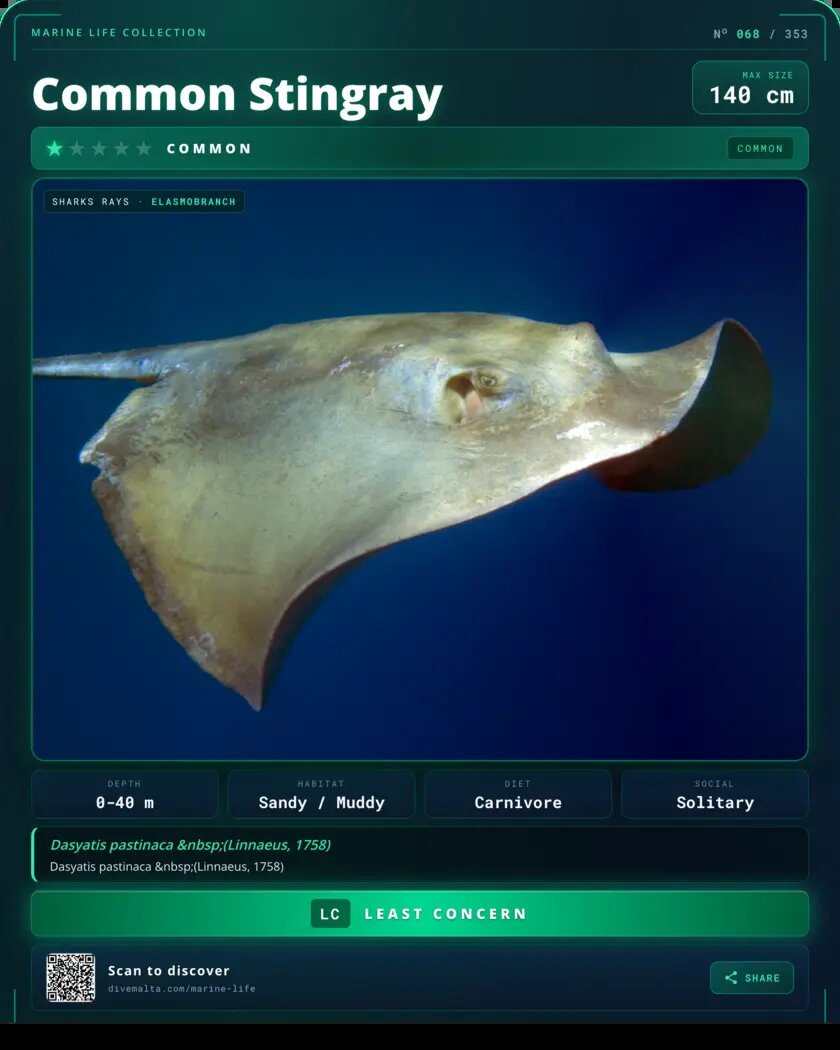
Sandy and muddy seabeds, particularly near reef margins and seagrass (Posidonia oceanica) meadow edges. During the day, stingrays bury themselves in the substrate with only the eyes and spiracles visible.
Most active at dusk and through the night. Daytime encounters are common on sandy channels adjacent to rocky reefs. Approach slowly from the front; never shadow from directly above.
Biology
An ambush predator. Buries itself in sand and waits for prey. Detects concealed fish and invertebrates using electroreceptors (ampullae of Lorenzini) that sense minute bioelectric fields.
Ambush predatorViviparous — gives birth to live young (aplacental viviparity). Litters of 4 to 9 pups. Gestation approximately 4 months. Newborn pups are fully formed and independent from birth.
ViviparousThe serrated, venomous tail spine is purely defensive. A stingray will not pursue a diver. Injuries occur almost exclusively when a ray is accidentally stepped on. Give wide berth; never shadow from above.
Defensive onlyDive with diveshack
Common Stingray favour sandy and muddy seabeds across the Maltese Islands, resting or foraging on the open bottom. The sites below offer consistent sandy habitat where encounters are reliable on guided dives with diveshack.
Common Stingray settle on the sunlit cave and outer reef system at 3–38m, often partially buried when resting between foraging bouts. Sandy areas around Ghar Lapsi are the most productive search zones.
View dive site ›Common Stingray settle on the sandy floor and posidonia meadows at 3–14m, often partially buried when resting between foraging bouts. Sandy areas around Blue Lagoon are the most productive search zones.
View dive site ›Common Stingray settle on the white sand channel and patrol vessel hull at 7–20m, often partially buried when resting between foraging bouts. Sandy areas around P31 Patrol Boat are the most productive search zones.
View dive site ›A sheltered cove with sandy patches between rocky outcrops. Stingrays are frequently spotted half-buried in the sand at 8–15 m, especially in the morning.
View dive site ›Sandy channels flanking the reef system are prime stingray habitat. Multiple rays are sometimes encountered on a single dive, resting between the arch and cave sections.
View dive site ›Population considered stable across the Mediterranean. Main threats are bycatch in demersal trawl fisheries and coastal habitat degradation. Protected under the Barcelona Convention Annex II.