Dive Site Card
Collect the card.
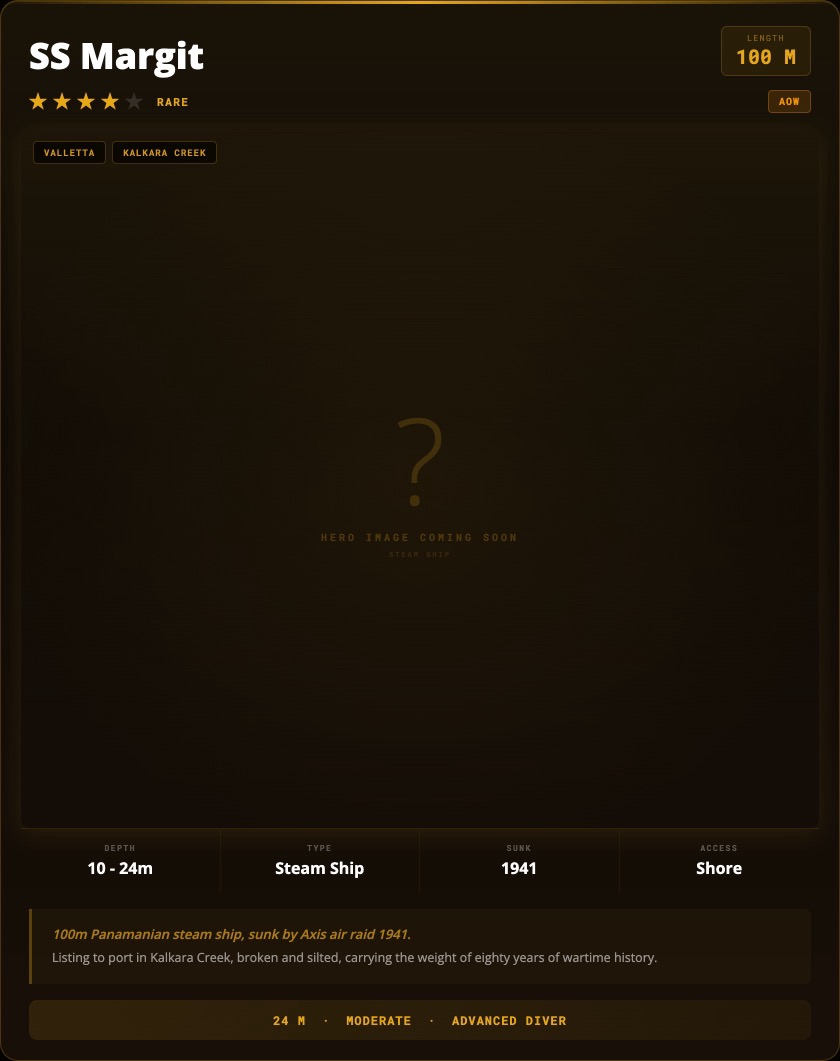
A 100-metre Panamanian steam passenger ship sunk by an Axis air raid on 19 April 1941. The Margit lies listing to port in Kalkara Creek on the eastern side of Grand Harbour, broken and silted, carrying the weight of eighty years of wartime history in water that rarely exceeds 10 metres visibility. The draw here is not the scenery. It is the scale, the stillness, and the knowledge of what happened above.
35°53'28"N · 14°31'20"E | Kalkara Creek, Grand Harbour, Valletta
The Margit sits with a pronounced list to port in the sheltered waters of Kalkara Creek. The wreck is quite broken, the result of both the sinking itself and subsequent explosives clearance, but the overall outline of a 100-metre steam ship remains legible across the silty bottom. Groupers have established a presence despite the limited visibility that characterises Grand Harbour diving. DSMB deployment is mandatory due to active boat traffic crossing the area above.

The main hull runs along the seabed listing noticeably to port. Although heavily broken, the original 100-metre length is traceable from bow to stern. Hull plating and structural ribs remain, though silt covers much of the lower sections.
Amidships, the collapsed machinery spaces still hold recognisable engine and boiler components. The scale of the engineering becomes apparent here, underlining the ship's role as a working passenger vessel rather than a naval craft.
Large groupers have claimed territory within the broken structure. Their presence is a reliable highlight on this wreck despite the reduced visibility of Grand Harbour. Patience and a torch are rewarded.
Upper decks and superstructure have largely collapsed or been removed, but fragments scatter across the sandy silt between 10 and 16 metres. Each piece is a tangible link to the ship's final moments on 19 April 1941.
| Month | Water Temp | Visibility | Conditions |
|---|---|---|---|
| Jan–Mar | 14–16°C | 5–8m | Good |
| Apr–Jun | 17–22°C | 6–10m | Good |
| Jul–Sep | 24–28°C | 5–12m | Good |
| Oct–Dec | 18–23°C | 5–10m | Good |
Visibility at SS Margit is consistently lower than most Maltese dive sites due to Grand Harbour silt and harbour activity. This is not a visibility dive. Set expectations accordingly and let the history and scale be the experience.
Grand Harbour silt means 5–12m is typical at best. Avoid heavy fin kicks near the bottom to prevent silt clouds. A good torch is essential for reading the wreck in reduced light.
Kalkara Creek sits within active Grand Harbour. Commercial vessels, ferries, and workboats operate in the area. DSMB deployment on ascent is mandatory, not optional. Ascend at the correct exit point.
5mm wetsuit year-round (7mm recommended Jan–Mar). Torch required. DSMB and spool mandatory. Dive computer required for all AOW-level dives to this depth.
Due to active boat traffic in Grand Harbour, a DSMB must be deployed before every ascent. This is non-negotiable. Carry a minimum 1.8m DSMB and a spool with at least 30m of line. Do not surface without it deployed.
Maximum depth of 24m requires Advanced Open Water certification as a minimum. Open Water divers must not attempt this site unsupervised. All participants must present valid certification before the dive.
The seabed is soft silt. Frog kicks or hovering technique is strongly recommended throughout the dive. Heavy fin kicks will destroy visibility within seconds and disorient the group. Maintain good buoyancy control before entering the water.
The wreck is quite broken and not suitable for penetration diving. Do not enter enclosed spaces within the structure. The broken nature of the hull creates entanglement and collapse risks. External exploration only.
With 5–12m visibility as the normal range, a torch is not optional on this site. Primary torch with a backup is the recommended minimum. The wreck interior and lower hull sections are very dark.
Shore entry is straightforward. Confirm the agreed entry and exit points before descending. Ascending away from the designated exit in an active harbour creates a serious hazard. Stay with the group and follow guide direction on ascent.
One message confirms your slot. We sort the briefing, the gas, and the boat. You just need to show up.