Depth
Sabella · Marine Life

Sabella Pavonina

Sabella pavonina

0-40m
Depth Range
Variable
Max Size
Mediterranean
Distribution
0-40m
Depth Range
Variable
Max Size
Sandy / Muddy
Habitat
Carnivore
Diet
Solitary
Social
LC
IUCN Status
Kingdom Animalia
Genus Sabella
Species pavonina

Identification & Biology

  • IdentificationA medium-sized tube worm with a fan-shaped crown of feathery tentacles (radioles) that often show striking banded patterns in brown, orange, and cream. The tube is soft, flexible, and made of mud and mucus. Smaller than the European fan worm.
  • SizeFan diameter up to 6 cm. Tube length up to 25 cm.
  • Social HabitCan be solitary or in groups, sometimes in dense beds. Lives permanently in its tube, extending the fan to feed.
  • HabitatSandy and muddy bottoms, sheltered bays, and estuaries. Often found in groups on soft substrates.
  • Depth0 to 30 m. Common in shallow, sheltered environments.
  • Feeds OnPlankton and suspended organic particles captured by the radioles.
  • DistributionEastern Atlantic from the North Sea to West Africa, and throughout the Mediterranean Sea. Common in Maltese waters.
  • DescriptionSabella pavonina is a smaller relative of the European fan worm, named for its peacock-like banded fan pattern. It often forms dense beds in sheltered bays and harbours, with hundreds of fans creating a garden-like display above the muddy substrate. Like all tube worms, it retracts rapidly when disturbed, but patient divers can observe the full beauty of its patterned fan.

Habitat & Distribution

Found across the Mediterranean, inhabiting sandy / muddy environments. Active from the surface down to 40m depth.

Where Malta divers have spotted this species

Loading…

Sightings are logged by divers using our What Did You See? dive-log tool. View the full live sightings map.

Detail

Preferred Environment

Sandy / Muddy habitats, typically at depths of 0-40m. Most commonly encountered by divers at the shallower end of its range.

Encounter Tips

Best approached slowly and calmly. Avoid casting shadows directly over the animal. Neutral buoyancy and patience increase encounter success significantly.
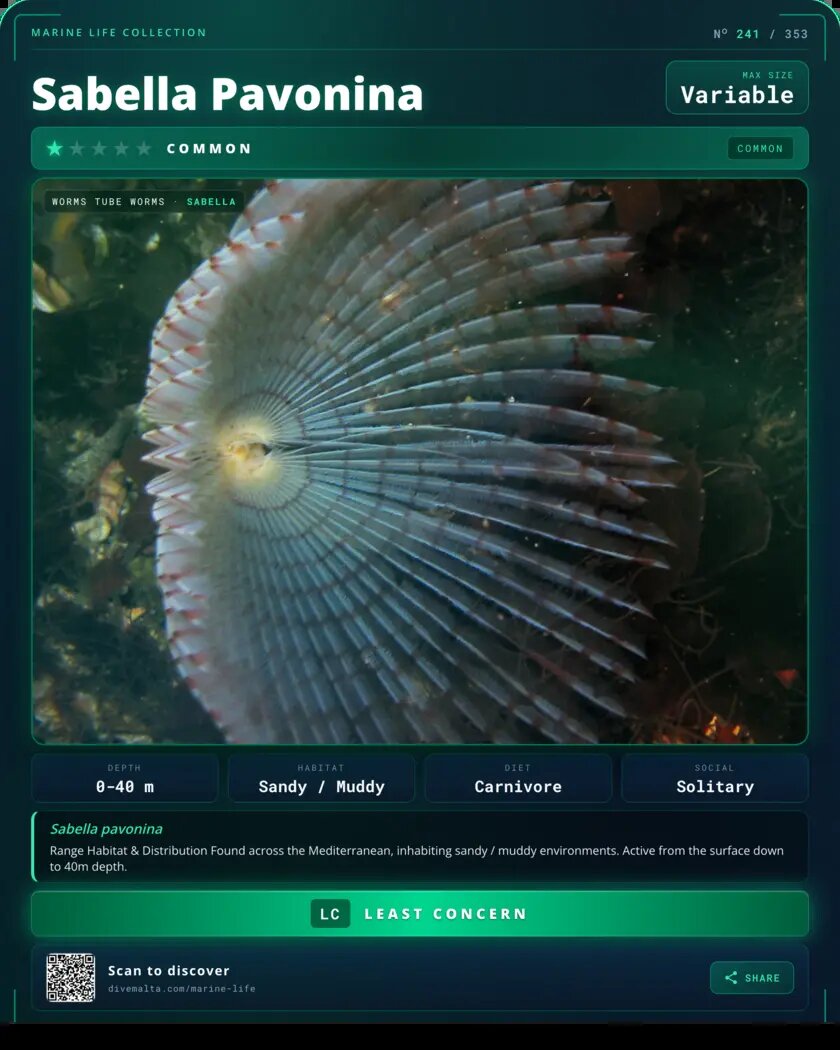
Sabella Pavonina species card

Behaviour & Diet

Feeding Strategy

Deploys a delicate fan of banded radioles that trap phytoplankton, detritus and bacteria from passing water currents. Ciliary action along each radiole sorts captured material and transports food particles toward the central mouth.

Filter feeder

Reproduction

Dioecious, with separate male and female individuals releasing gametes into the water column for external fertilisation. Planktonic trochophore larvae eventually settle and secrete a mucus tube that hardens with incorporated sediment.

Broadcast spawner

Behaviour & Defence

Possesses highly sensitive light-detecting cells along its radioles that trigger an extremely fast withdrawal reflex into the protective tube. The tube, constructed from mud and mucus, provides a durable shelter cemented to rock or sediment.

Rapid retraction

Where to Encounter in Malta

The following dive sites offer strong habitat match for Sabella pavonina. All are accessible on a guided dive with diveshack.

3-18m
Comino

Blue Lagoon

Extensive sandy floor with excellent visibility. A prime habitat for benthic species that shelter in the sandy channels.

View dive site ›
5-22m
South Malta

Ghar Lapsi

Sheltered cove with sandy patches between rocky outcrops. The sandy areas at 8-15m are rich in benthic marine life.

View dive site ›
8-30m
North Malta

Cirkewwa

Sandy channels flanking the reef system provide excellent habitat for bottom-dwelling species.

View dive site ›
IUCN Red List Least Concern

Conservation Status

This species is assessed as Least Concern on the IUCN Red List. Mediterranean populations face ongoing pressure from fishing activity, habitat degradation, and climate-driven changes to prey availability.

Source: iNaturalist Guide #888
by Lesley Clements (CC BY-SA)
diveshack Mediterranean Marine Life guide