Depth
Hermodice · Worms & Tube Worms

Bearded Fireworm

Hermodice carunculata

0-40m
Depth Range
Variable
Max Size
Mediterranean
Distribution
0-40m
Depth Range
Variable
Max Size
Reef & Open
Habitat
Carnivore
Diet
Solitary
Social
LC
IUCN Status
Kingdom Animalia
Phylum Annelida
Genus Hermodice
Species carunculata

Identification & Biology

  • IdentificationA large, strikingly coloured polychaete worm with a broad, segmented body. Orange-red to brown body with tufts of bright white, bristle-like chaetae (setae) along each side. The white bristles are brittle, venomous, and break off easily on contact, causing intense irritation.
  • SizeBody length up to 35 cm. Width up to 4 cm including bristles. One of the largest polychaete worms in the Mediterranean.
  • Social HabitSolitary or in small groups. Active predator and scavenger found roaming the reef, especially at night. Moves with a distinctive undulating motion.
  • HabitatRocky reefs, under boulders, and on mixed substrates. Found on a variety of hard and soft bottoms.
  • Depth0 to 40 m. Common in the shallows to about 20 m.
  • Feeds OnAnemones, small corals, other worms, dead fish, and organic detritus. An aggressive omnivore and scavenger.
  • DistributionMediterranean Sea and tropical/warm temperate Atlantic. Common in Maltese waters.
  • DescriptionHermodice carunculata is one animal that all Mediterranean divers should learn to recognise and avoid touching. The white bristles along its sides are hollow, venom-filled, and break off in the skin on contact, causing intense burning pain and irritation that can last for hours. The bristles are almost invisible once embedded in skin and are very difficult to remove. Despite this, the fireworm is a fascinating predator to observe from a safe distance.

Habitat & Distribution

Found across the Mediterranean, inhabiting reef & open environments. Active from the surface down to 40m depth.

Where Malta divers have spotted this species

Loading…

Sightings are logged by divers using our What Did You See? dive-log tool. View the full live sightings map.

Detail

Preferred Environment

Reef & Open habitats, typically at depths of 0-40m. Most commonly encountered by divers at the shallower end of its range.

Encounter Tips

Best approached slowly and calmly. Avoid casting shadows directly over the animal. Neutral buoyancy and patience increase encounter success significantly.
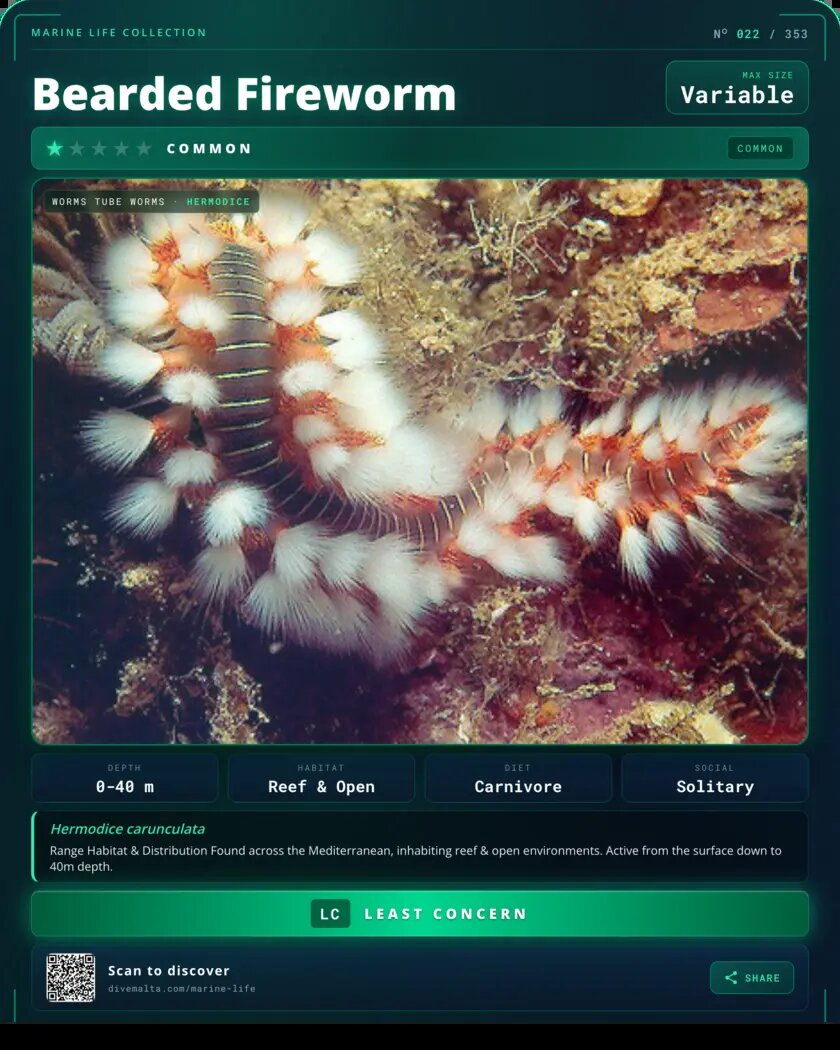
Bearded Fireworm species card

Behaviour & Diet

Feeding Strategy

An opportunistic omnivore that scavenges on dead fish, grazes on encrusting organisms and actively preys on anemones, small invertebrates and sponges. It uses a protrusible pharynx to engulf food items whole or tear off pieces of tissue.

Scavenger

Reproduction

During summer spawning events, males release luminescent sperm trails near the surface at dusk, which attract females to release their eggs. Fertilisation occurs externally and the resulting larvae are planktonic before settling on the seabed.

Broadcast spawner

Behaviour & Defence

Covered in bundles of hollow, brittle white chaetae (bristles) filled with a potent venom that breaks off and embeds in skin on contact. The resulting intense burning sensation and inflammation give the fireworm its common name.

Venomous bristles

Where to Encounter in Malta

The following dive sites offer strong habitat match for Hermodice carunculata. All are accessible on a guided dive with diveshack.

5-30m
North Malta

Cirkewwa

Rocky reef with caves, arches and ledges hosting a rich diversity of reef species.

View dive site ›
5-50m
Gozo

Blue Hole

One of the Med's most famous reef dive sites. Rocky walls and archways covered in life.

View dive site ›
18-36m
South Malta

Um El Faroud

The wreck lies on a sandy bottom surrounded by rocky reef -- a diverse habitat attracting reef species.

View dive site ›
IUCN Red List Least Concern

Conservation Status

This species is assessed as Least Concern on the IUCN Red List. Mediterranean populations face ongoing pressure from fishing activity, habitat degradation, and climate-driven changes to prey availability.

Source: iNaturalist Guide #888
by Lesley Clements (CC BY-SA)
diveshack Mediterranean Marine Life guide