Depth
Clavelina · Tunicates & Sea Squirts

Light-bulb Sea Squirt

Clavelina lepadiformis

0-40m
Depth Range
Variable
Max Size
Mediterranean
Distribution
0-40m
Depth Range
Variable
Max Size
Reef & Open
Habitat
Carnivore
Diet
Solitary
Social
LC
IUCN Status
Kingdom Animalia
Phylum Chordata
Subphylum Tunicata
Genus Clavelina
Species lepadiformis

Identification & Biology

  • IdentificationA colonial sea squirt with clusters of translucent, elongated individuals connected at their bases. Each individual is cylindrical and glass-like, with visible internal organs (particularly the gut loop) creating a light-bulb-like glow. Pale blue to white.
  • SizeIndividual zooids up to 2 cm tall. Clusters can contain dozens of individuals.
  • Social HabitColonial. Forms hanging clusters on overhangs, cave ceilings, and the undersides of rocks. Individual zooids are connected at the base by shared stolons.
  • HabitatShaded rocky surfaces, cave ceilings, overhangs, and pier undersides.
  • Depth1 to 50 m. Common on shaded surfaces throughout its depth range.
  • Feeds OnPlankton, bacteria, and organic particles filtered from the water through an internal mucus net.
  • DistributionEastern Atlantic from the British Isles to West Africa, and throughout the Mediterranean Sea. Common in Maltese waters.
  • DescriptionClavelina lepadiformis is one of the most beautiful invertebrates on Mediterranean reefs. The glass-like, translucent bodies of individual zooids, with their visible internal organs, create a striking display on dark cave walls and overhangs. Despite their simple appearance, sea squirts are chordates, more closely related to vertebrates than to any other invertebrate group. They possess a notochord (primitive backbone) in their larval stage.

Habitat & Distribution

Found across the Mediterranean, inhabiting reef & open environments. Active from the surface down to 40m depth.

Where Malta divers have spotted this species

Loading…

Sightings are logged by divers using our What Did You See? dive-log tool. View the full live sightings map.

Detail

Preferred Environment

Reef & Open habitats, typically at depths of 0-40m. Most commonly encountered by divers at the shallower end of its range.

Encounter Tips

Best approached slowly and calmly. Avoid casting shadows directly over the animal. Neutral buoyancy and patience increase encounter success significantly.
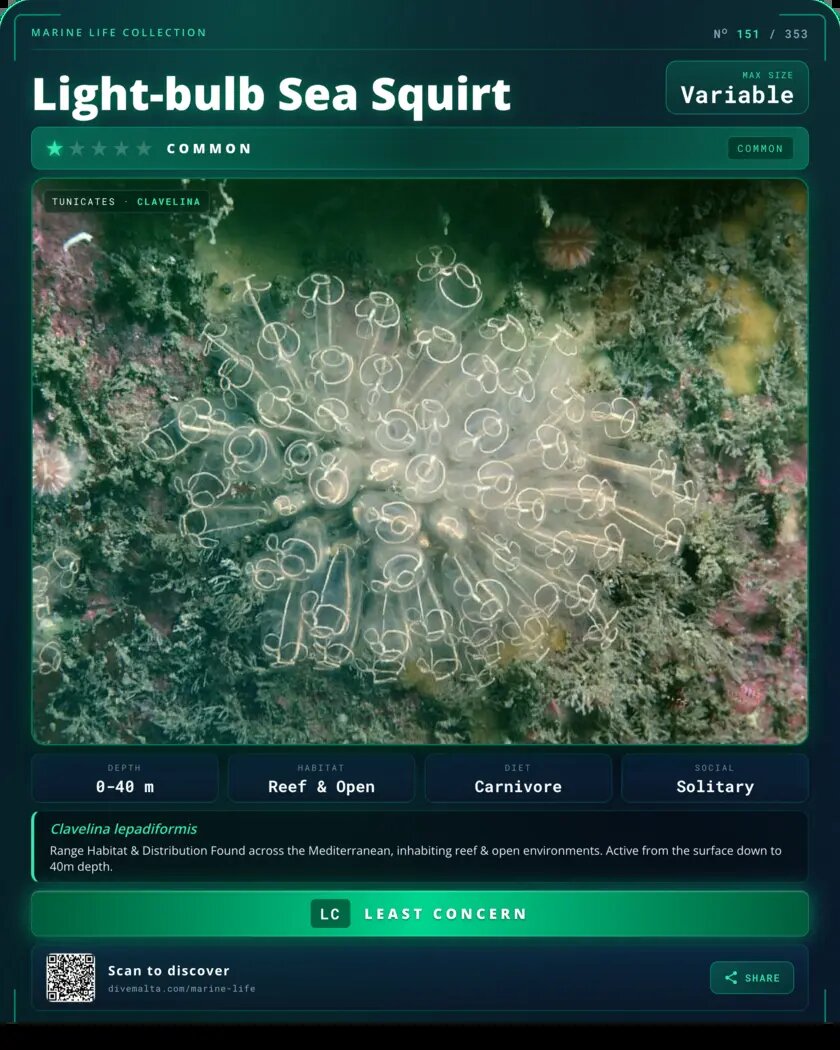
Light-bulb Sea Squirt species card

Behaviour & Diet

Feeding Strategy

Draws water in through its oral siphon, trapping phytoplankton, bacteria and fine detritus on a mucus net across its pharyngeal basket. Filtered water exits through the atrial siphon, and the animal can process several litres per hour.

Filter feeder

Reproduction

A hermaphrodite that releases both eggs and sperm into the water column, though self-fertilisation is typically prevented by timing differences. The tadpole-like larva swims briefly before settling head-first onto hard substrate and metamorphosing.

Broadcast spawner

Behaviour & Defence

Its translucent tunic contains mildly acidic compounds and vanadium-based blood cells that make it unpalatable to most fish. When disturbed, it contracts both siphons shut to protect its soft interior.

Chemical defence

Where to Encounter in Malta

The following dive sites offer strong habitat match for Clavelina lepadiformis. All are accessible on a guided dive with diveshack.

5-30m
North Malta

Cirkewwa

Rocky reef with caves, arches and ledges hosting a rich diversity of reef species.

View dive site ›
5-50m
Gozo

Blue Hole

One of the Med's most famous reef dive sites. Rocky walls and archways covered in life.

View dive site ›
18-36m
South Malta

Um El Faroud

The wreck lies on a sandy bottom surrounded by rocky reef -- a diverse habitat attracting reef species.

View dive site ›
IUCN Red List Least Concern

Conservation Status

This species is assessed as Least Concern on the IUCN Red List. Mediterranean populations face ongoing pressure from fishing activity, habitat degradation, and climate-driven changes to prey availability.

Source: iNaturalist Guide #888
by Lesley Clements (CC BY-SA)
diveshack Mediterranean Marine Life guide