Depth
Aplysina · Sponges

Yellow Cave Sponge

Aplysina cavernicola

0-3m
Depth Range
Variable
Max Size
Mediterranean
Distribution
0-3m
Depth Range
Variable
Max Size
Reef & Open
Habitat
Carnivore
Diet
Solitary
Social
LC
IUCN Status
Kingdom Animalia
Phylum Porifera
Genus Aplysina
Species cavernicola

Identification & Biology

  • IdentificationA bright yellow, irregularly lobed or encrusting sponge found exclusively in dark cave environments. The surface is smooth to slightly rough with scattered oscula. The vivid yellow colour is striking against dark cave walls.
  • SizeColonies can spread over 30 cm or more. Lobes up to 10 cm thick.
  • Social HabitSessile. Strictly cave-dwelling. Found only in dark or very dimly lit environments. Produces chemical compounds that are toxic to many predators.
  • HabitatDark caves and deep overhangs. Strictly sciaphilic (shade-loving). Does not tolerate direct light.
  • Depth10 to 80 m. Found in cave environments throughout this depth range.
  • Feeds OnBacteria, microalgae, and dissolved organic matter filtered from the water.
  • DistributionMediterranean Sea and adjacent eastern Atlantic. Present in Maltese caves.
  • DescriptionAplysina cavernicola is one of the signature species of Mediterranean cave habitats. Its brilliant yellow colour is unmistakable and is one of the most vivid colours found inside caves. The species produces aerothionin and other brominated compounds that make it distasteful to most predators. These same compounds are being studied for potential pharmaceutical applications, including anti-cancer and antimicrobial properties.

Habitat & Distribution

Found across the Mediterranean, inhabiting reef & open environments. Active from the surface down to 3m depth.

Where Malta divers have spotted this species

Loading…

Sightings are logged by divers using our What Did You See? dive-log tool. View the full live sightings map.

Detail

Preferred Environment

Reef & Open habitats, typically at depths of 0-3m. Most commonly encountered by divers at the shallower end of its range.

Encounter Tips

Best approached slowly and calmly. Avoid casting shadows directly over the animal. Neutral buoyancy and patience increase encounter success significantly.
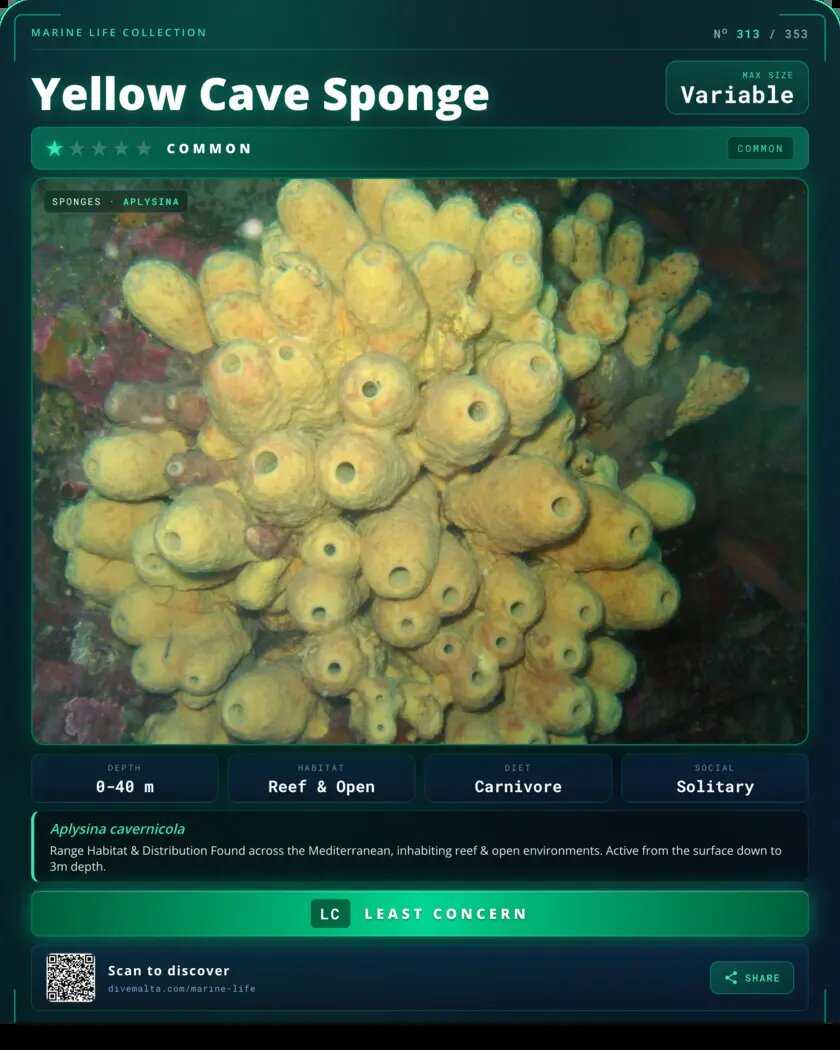
Yellow Cave Sponge species card

Behaviour & Diet

Feeding Strategy

Filters ultra-fine particles including bacteria and dissolved organic matter from the still water inside caves and crevices. Adapted to very low water flow, relying on its own choanocyte-driven pumping rather than ambient current.

Filter feeder

Reproduction

Reproduces sexually with internal fertilisation and broods larvae before releasing them. Larvae are negatively phototactic, seeking dark surfaces to settle on, which perpetuates the species' cave-dwelling habit.

Brooding

Behaviour & Defence

Produces cytotoxic aerothionin and related bromotyrosine alkaloids that strongly deter predation. Its deep-cave habitat also provides physical protection from most grazing species.

Toxic compounds

Where to Encounter in Malta

The following dive sites offer strong habitat match for Aplysina cavernicola. All are accessible on a guided dive with diveshack.

5-30m
North Malta

Cirkewwa

Rocky reef with caves, arches and ledges hosting a rich diversity of reef species.

View dive site ›
5-50m
Gozo

Blue Hole

One of the Med's most famous reef dive sites. Rocky walls and archways covered in life.

View dive site ›
18-36m
South Malta

Um El Faroud

The wreck lies on a sandy bottom surrounded by rocky reef -- a diverse habitat attracting reef species.

View dive site ›
IUCN Red List Least Concern

Conservation Status

This species is assessed as Least Concern on the IUCN Red List. Mediterranean populations face ongoing pressure from fishing activity, habitat degradation, and climate-driven changes to prey availability.

Source: iNaturalist Guide #888
by Lesley Clements (CC BY-SA)
diveshack Mediterranean Marine Life guide