Depth
Agelas · Sponges

Orange Lobed Sponge

Agelas oroides

0-40m
Depth Range
Variable
Max Size
Mediterranean
Distribution
0-40m
Depth Range
Variable
Max Size
Reef & Open
Habitat
Carnivore
Diet
Solitary
Social
LC
IUCN Status
Kingdom Animalia
Phylum Porifera
Genus Agelas
Species oroides

Identification & Biology

  • IdentificationA massive, rounded to irregularly lobed sponge with a rough, knobbly orange surface. The texture is firm and dense. Large oscula (water outlet holes) are scattered across the surface. One of the more common large sponges in the Mediterranean.
  • SizeDiameter up to 30 cm. Individual lobes can be 10 to 15 cm across.
  • Social HabitSessile. Found on rocky walls and in caves. Produces chemical compounds that deter predators and prevent other organisms from settling on its surface.
  • HabitatRocky reefs, walls, caves, and overhangs. Prefers shaded positions with good water flow.
  • Depth5 to 100 m. Common between 10 and 50 m.
  • Feeds OnBacteria, microalgae, and dissolved organic matter filtered from the water.
  • DistributionMediterranean Sea and adjacent eastern Atlantic. Common in Maltese waters.
  • DescriptionAgelas oroides is one of the most frequently encountered large sponges on Maltese rocky reefs. Its rough, orange surface and irregular shape make it a familiar landmark for regular divers. Like many sponges, it produces bioactive chemical compounds that are of interest to pharmaceutical research. Several anti-inflammatory and antimicrobial substances have been isolated from this species.

Habitat & Distribution

Found across the Mediterranean, inhabiting reef & open environments. Active from the surface down to 40m depth.

Where Malta divers have spotted this species

Loading…

Sightings are logged by divers using our What Did You See? dive-log tool. View the full live sightings map.

Detail

Preferred Environment

Reef & Open habitats, typically at depths of 0-40m. Most commonly encountered by divers at the shallower end of its range.

Encounter Tips

Best approached slowly and calmly. Avoid casting shadows directly over the animal. Neutral buoyancy and patience increase encounter success significantly.
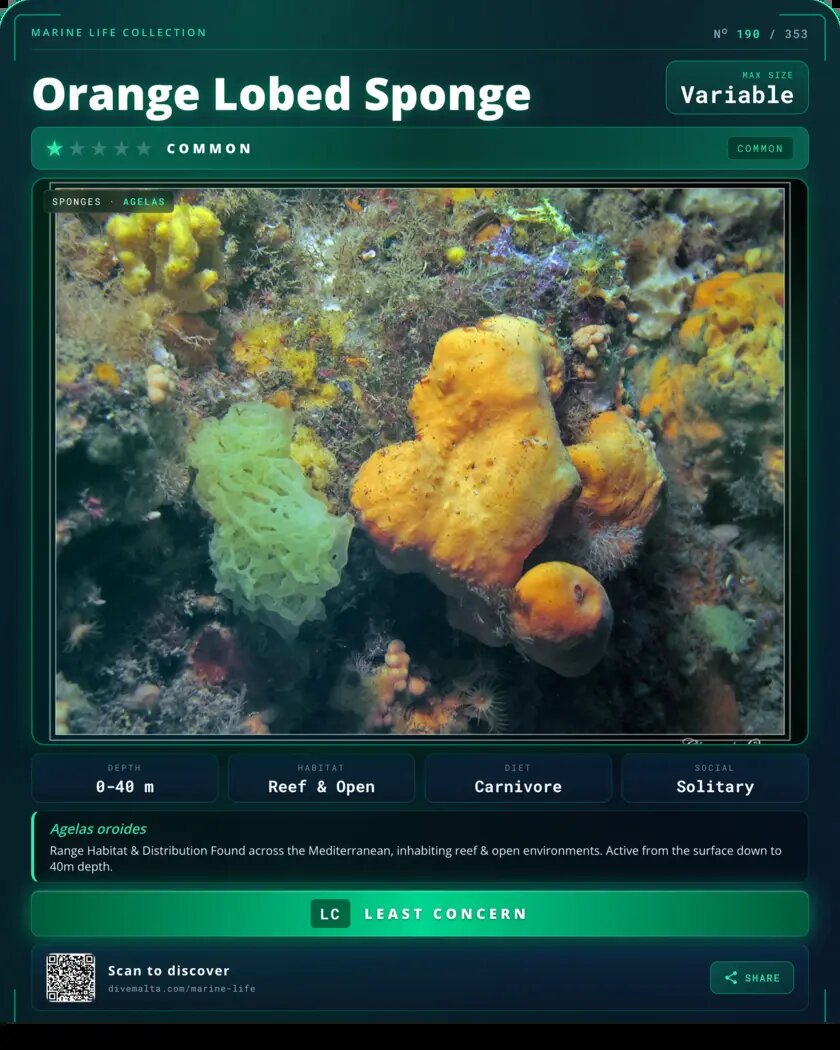
Orange Lobed Sponge species card

Behaviour & Diet

Feeding Strategy

Filters bacteria and picoplankton from seawater circulated through an internal aquiferous system powered by flagellated choanocyte chambers. It favours sheltered spots with moderate current where food supply is consistent.

Filter feeder

Reproduction

A viviparous sponge that broods embryos internally until parenchymella larvae are mature enough for release. Larvae settle on nearby hard substrate, often within hours of being expelled.

Brooding

Behaviour & Defence

Produces oroidin and related bromopyrrole alkaloids that are highly toxic to fish and invertebrate predators. These compounds also have antifouling properties, keeping the sponge surface free of epibionts.

Toxic compounds

Where to Encounter in Malta

The following dive sites offer strong habitat match for Agelas oroides. All are accessible on a guided dive with diveshack.

5-30m
North Malta

Cirkewwa

Rocky reef with caves, arches and ledges hosting a rich diversity of reef species.

View dive site ›
5-50m
Gozo

Blue Hole

One of the Med's most famous reef dive sites. Rocky walls and archways covered in life.

View dive site ›
18-36m
South Malta

Um El Faroud

The wreck lies on a sandy bottom surrounded by rocky reef -- a diverse habitat attracting reef species.

View dive site ›
IUCN Red List Least Concern

Conservation Status

This species is assessed as Least Concern on the IUCN Red List. Mediterranean populations face ongoing pressure from fishing activity, habitat degradation, and climate-driven changes to prey availability.

Source: iNaturalist Guide #888
by Lesley Clements (CC BY-SA)
diveshack Mediterranean Marine Life guide