Spongia officinalis
Sponge
Range
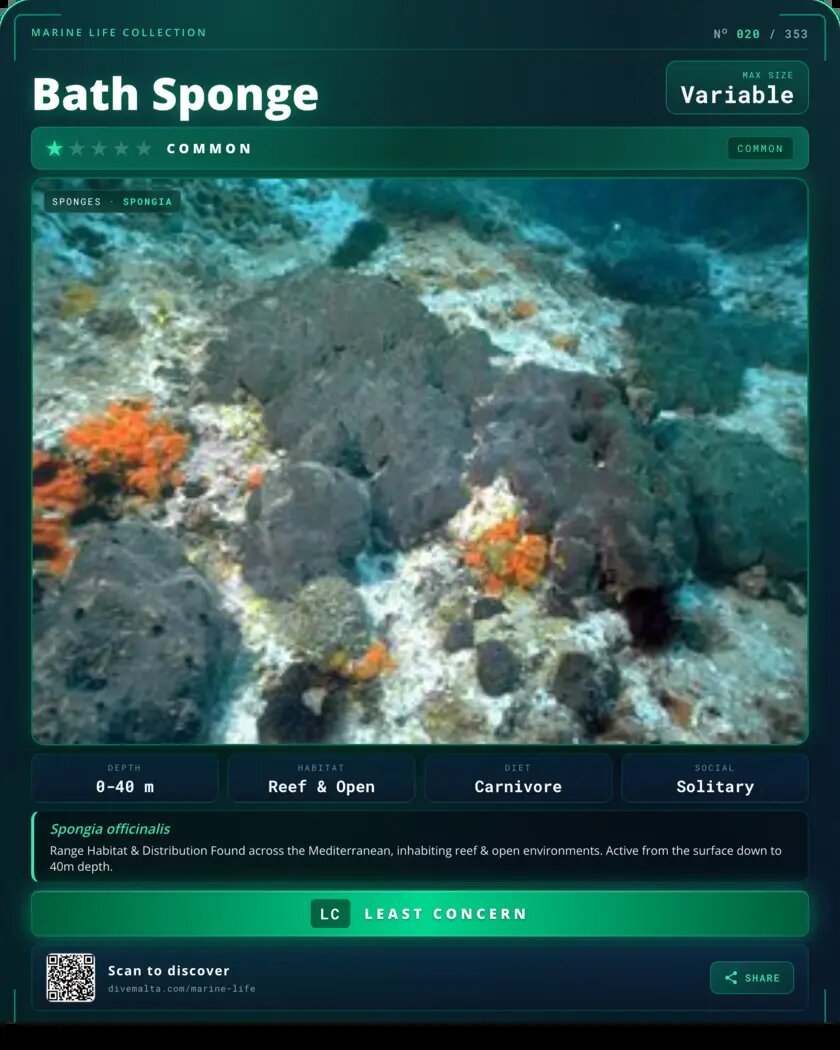
Found across the Mediterranean, inhabiting reef & open environments. Active from the surface down to 40m depth.
Sightings are logged by divers using our What Did You See? dive-log tool. View the full live sightings map.
Reef & Open habitats, typically at depths of 0-40m. Most commonly encountered by divers at the shallower end of its range.
Best approached slowly and calmly. Avoid casting shadows directly over the animal. Neutral buoyancy and patience increase encounter success significantly.
Biology
Filters bacteria, dissolved organic matter and microscopic particles from seawater drawn through thousands of tiny pores called ostia. A single adult can process several hundred litres of water per day.
Filter feederReproduces both sexually, releasing sperm into the water column for neighbouring sponges to capture, and asexually through fragmentation. Larvae settle on rocky substrates after a brief planktonic phase.
Broadcast spawnerProduces bioactive secondary metabolites including terpenes and brominated compounds that deter most predators. Its elastic, compressible skeleton also makes it difficult for grazers to tear apart.
Chemical defenceDive with diveshack
The following dive sites offer strong habitat match for Spongia officinalis. All are accessible on a guided dive with diveshack.
Rocky reef with caves, arches and ledges hosting a rich diversity of reef species.
View dive site ›One of the Med's most famous reef dive sites. Rocky walls and archways covered in life.
View dive site ›The wreck lies on a sandy bottom surrounded by rocky reef -- a diverse habitat attracting reef species.
View dive site ›This species is assessed as Least Concern on the IUCN Red List. Mediterranean populations face ongoing pressure from fishing activity, habitat degradation, and climate-driven changes to prey availability.