Depth
Heptranchias · Sharks & Rays

Sharpnose Sevengill Shark

Heptranchias perlo

100 - 1000 m
Depth Range
140 cm
Max Size
Mediterranean
Distribution
100 - 1000 m
Depth Range
140 cm
Max Size
Deep Water
Habitat
Predator
Diet
Solitary
Social
NT
IUCN Status
Rare
Sighting Likelihood
KingdomAnimalia
PhylumChordata
ClassElasmobranchii
GenusHeptranchias
Speciesperlo

Identification & Biology

  • IdentificationA slender, small deep-water shark with a narrow, sharply pointed snout and seven gill slits on each side. Large, fluorescent green eyes adapted for deep-water vision. A single dorsal fin positioned far back on the body. Grey to olive-brown with a paler underside.
  • SizeUp to 140 cm total length. Most adults are between 80 and 110 cm.
  • Social HabitSolitary. A rarely encountered deep-water predator that is poorly studied across most of its range.
  • HabitatDeep continental and insular slopes, on or near the bottom. Found over both soft and hard substrates.
  • Depth27 to 1000 m. Most common between 200 and 600 m.
  • Feeds OnSmall bony fish, squid, octopus, shrimp, and other crustaceans.
  • DistributionWorldwide in tropical and warm temperate deep waters. Present in the deep Mediterranean, including waters around Malta.
  • DescriptionHeptranchias perlo is one of only two living shark species with seven gill slits (the other being the broadnose sevengill shark). Like the sixgill shark, this is a primitive species whose anatomy has changed little over hundreds of millions of years. It is rarely encountered and poorly understood. Listed as Near Threatened by the IUCN.

Habitat & Distribution

A deep-water species found from 100 to over 1000 m depth across the Mediterranean basin. Inhabits continental slopes and submarine canyons. Occasionally recorded shallower at night when it may migrate vertically.

Where Malta divers have spotted this species

Loading…

Sightings are logged by divers using our What Did You See? dive-log tool. View the full live sightings map.

Detail

Preferred Environment

Deep continental shelf edges and upper slopes, submarine canyons, and seamount flanks. Prefers areas close to the seabed but also makes pelagic excursions. Found over both soft and hard substrates at depth.

Encounter Tips

Not typically encountered by recreational divers due to its deep habitat. Occasionally captured by deep-sea fisheries. Sightings near the surface are extremely rare and usually involve disoriented or injured individuals.
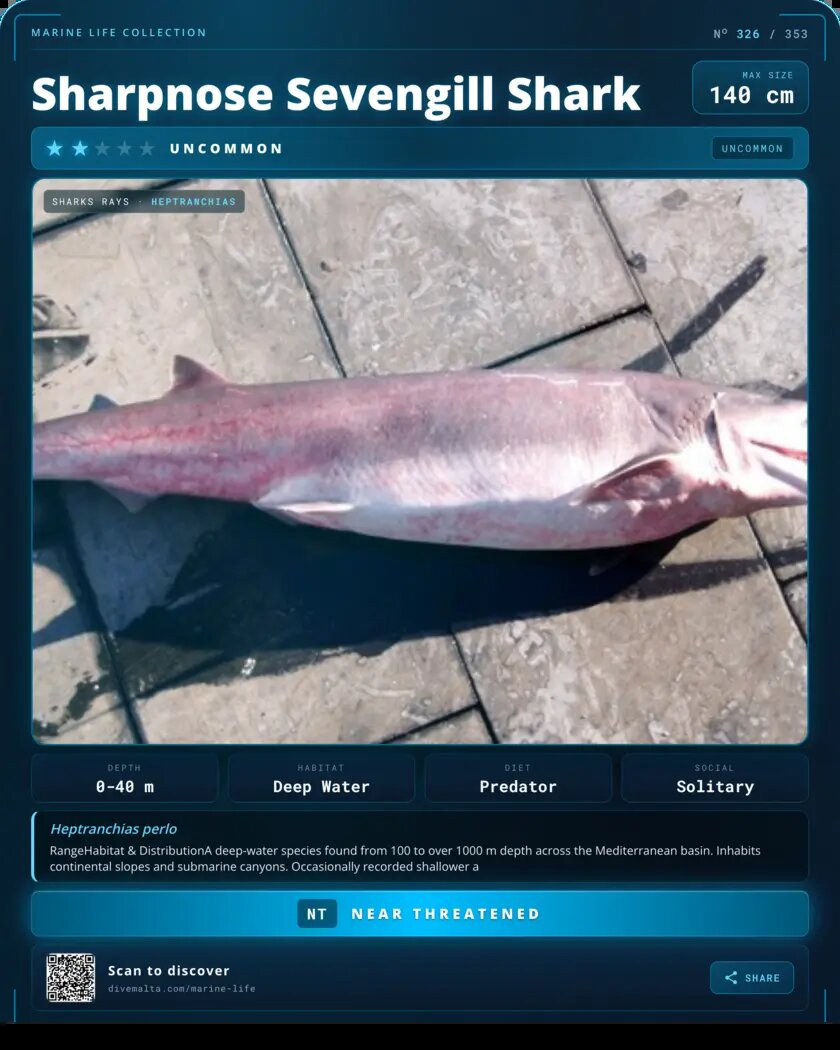
Sharpnose Sevengill Shark species card

Where to Encounter in Malta

Dive sites where Heptranchias perlo may be encountered will be added as sighting data is collected.

IUCN Red ListNear Threatened

Conservation Status

This species is assessed as Near Threatened on the IUCN Red List. Mediterranean populations face ongoing pressure from fishing activity, habitat degradation, and climate-driven changes.

Source: IUCN Red List
diveshack Mediterranean Marine Life guide