Depth
Carcharias · Sharks & Rays

Sand Tiger Shark

Carcharias taurus

1-190m
Depth Range
3.2m
Max Size
Mediterranean
Distribution
1-190m
Depth Range
3.2m
Max Size
Reef / Sandy
Habitat
Carnivore
Diet
Small groups
Social
CR
IUCN Status
Very Rare
Sighting Likelihood
Kingdom Animalia
Phylum Chordata
Class Elasmobranchii
Genus Carcharias
Species taurus

Identification & Biology

  • IdentificationA large, heavy-bodied shark with a flattened, conical snout and long, narrow teeth that protrude from the mouth even when closed, giving it a fierce appearance. Brownish-grey on top with scattered darker spots on the flanks. Two dorsal fins of roughly equal size.
  • SizeCommonly 2 to 2.5 m. Maximum recorded length 3.2 m and weight up to 160 kg.
  • Social HabitOften seen in small groups near wrecks and rocky reefs. Despite its threatening appearance, it is generally docile and slow-moving. The only shark known to gulp air at the surface to maintain neutral buoyancy.
  • HabitatSandy-bottomed coastal waters, rocky reefs, shipwrecks, caves, and offshore shoals.
  • Depth1 to 190 m. Typically between 15 and 40 m in coastal environments.
  • Feeds OnBony fish (herring, snappers, eels), small sharks, rays, squid, crabs, and lobsters.
  • DistributionWorldwide in warm temperate and tropical coastal waters. In the Mediterranean, historically recorded but now extremely rare.
  • DescriptionCarcharias taurus is often considered one of the best wreck-diving sharks in the world due to its habit of aggregating around structures. However, in the Mediterranean it has been reduced to near-extinction by fishing. Its low reproductive rate (only two pups per litter, with embryos cannibalising siblings in the womb) makes recovery extremely slow. Listed as Critically Endangered in the Mediterranean by the IUCN.

Habitat & Distribution

Inhabits shallow coastal waters, sandy bays, and rocky reef areas in the Mediterranean. Historically found around the central and western Mediterranean basin, but sightings have become exceptionally rare due to severe population decline.

Where Malta divers have spotted this species

Loading…

Sightings are logged by divers using our What Did You See? dive-log tool. View the full live sightings map.

Detail

Preferred Environment

Prefers shallow inshore waters with sandy or rocky substrates, often near caves, overhangs, and shipwrecks. Tends to hover motionless near the seabed, using gulped air in the stomach to maintain neutral buoyancy.

Encounter Tips

Best approached slowly and calmly. Avoid casting shadows directly over the animal. Neutral buoyancy and patience increase encounter success significantly.
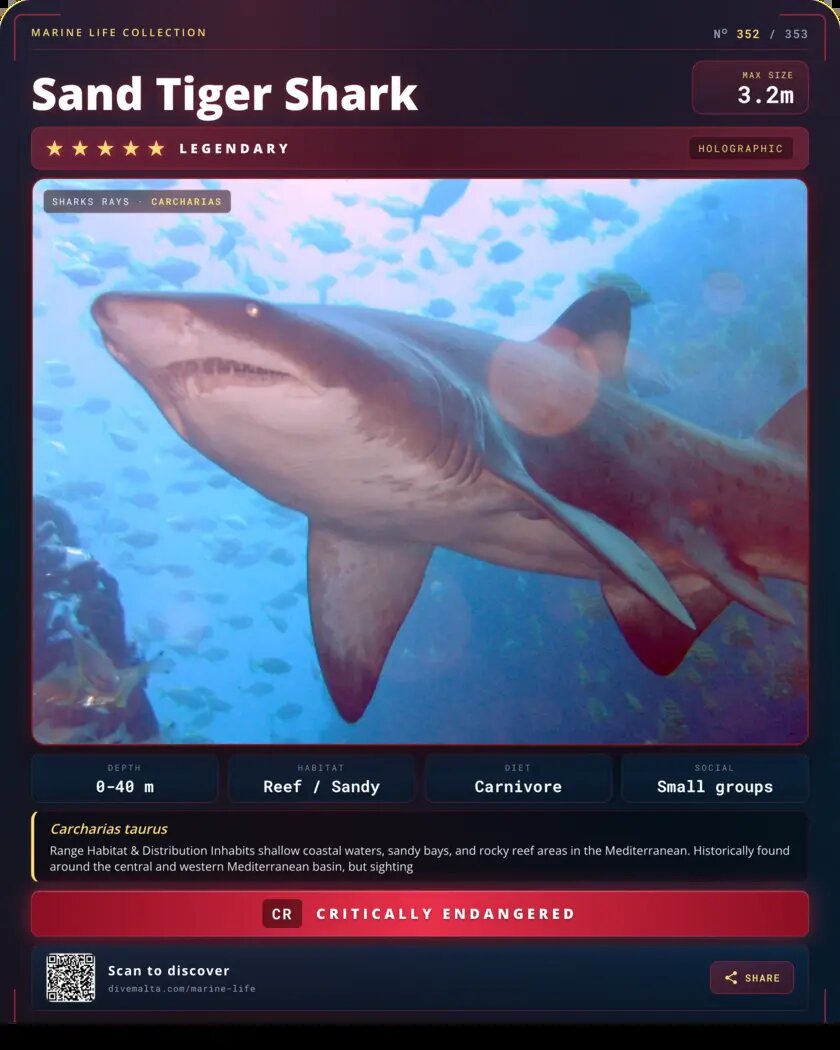
Sand Tiger Shark species card

Behaviour & Diet

Feeding Strategy

Feeds primarily on bony fish, small sharks, rays, squid, and crustaceans. Hunts with slow, deliberate movements, often cornering prey against reef structures or the seabed.

Ambush predator

Reproduction

Ovoviviparous with intrauterine cannibalism -- the dominant embryo in each uterus consumes its siblings. Produces only two pups per litter after a 9-12 month gestation.

Intrauterine cannibalism

Behaviour & Defence

Despite its fearsome appearance, it is generally placid and non-aggressive toward divers. When threatened, it may display a characteristic posture with arched back and lowered pectoral fins.

Threat display

Where to Encounter in Malta

Dive sites where Carcharias taurus may be encountered will be added as sighting data is collected.

IUCN Red List Critically Endangered

Conservation Status

This species is assessed as Critically Endangered on the IUCN Red List. Mediterranean populations face ongoing pressure from fishing activity, habitat degradation, and climate-driven changes.

Source: IUCN Red List
diveshack Mediterranean Marine Life guide