Depth
Bathytoshia · Sharks & Rays

Roughtail Stingray

Bathytoshia centroura

0-300m
Depth Range
2.2m
Max Size
Mediterranean
Distribution
0-300m
Depth Range
2.2m
Max Size
Sandy / Muddy
Habitat
Carnivore
Diet
Solitary
Social
LC
IUCN Status
Low
Sighting Likelihood
Kingdom Animalia
Phylum Chordata
Class Elasmobranchii
Genus Bathytoshia
Species centroura

Identification & Biology

  • IdentificationOne of the largest stingrays in the Atlantic and Mediterranean. Has a broad, rounded disc and a long, heavy tail covered in rough, thorn-like denticles. Dark brown to olive on top, pale underneath. The tail carries one or more large venomous barbs.
  • SizeDisc width up to 220 cm. Total length up to 260 cm. Weight up to 300 kg.
  • Social HabitMostly solitary. Rests on sandy or muddy bottoms during the day, sometimes partially buried. More active at night.
  • HabitatSandy and muddy bottoms on the continental shelf. Coastal waters, bays, and estuaries.
  • Depth0 to 270 m. Most common between 10 and 50 m in the Mediterranean.
  • Feeds OnBony fish, crabs, lobsters, bivalves, squid, and worms found on or buried in the seabed.
  • DistributionWestern Atlantic from Massachusetts to southern Brazil, and eastern Atlantic from the Bay of Biscay to Angola, including the Mediterranean Sea.
  • DescriptionBathytoshia centroura is a massive stingray that can weigh as much as a large adult human. The thorny denticles covering its tail are the source of its common name and make it easy to distinguish from other Mediterranean stingrays. It is rarely encountered by divers but is occasionally caught by fishers. Listed as Vulnerable in the Mediterranean by the IUCN.

Habitat & Distribution

Found on sandy and muddy seabeds across the Mediterranean continental shelf, from shallow coastal waters to around 300m depth. More commonly recorded in the western Mediterranean, though distribution is patchy throughout the basin.

Where Malta divers have spotted this species

Loading…

Sightings are logged by divers using our What Did You See? dive-log tool. View the full live sightings map.

Detail

Preferred Environment

Prefers soft substrates on the continental shelf, especially sandy and muddy flats where it can bury itself. Often found near the mouths of rivers and in sheltered bays with fine sediment.

Encounter Tips

Best approached slowly and calmly. Avoid casting shadows directly over the animal. Neutral buoyancy and patience increase encounter success significantly.
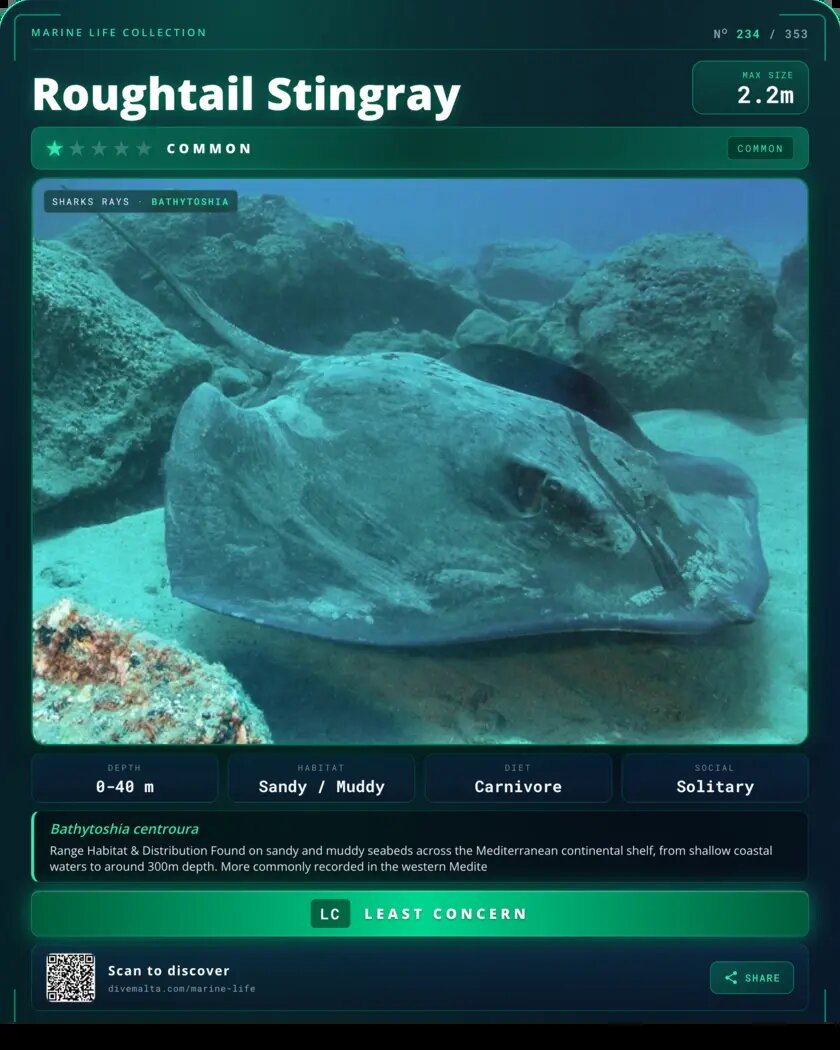
Roughtail Stingray species card

Behaviour & Diet

Feeding Strategy

Feeds on bottom-dwelling crustaceans, bivalve molluscs, worms, and small fish. Excavates prey from the sediment by flapping its disc and using directed jets of water to uncover buried organisms.

Bottom excavator

Reproduction

Viviparous with histotrophy -- embryos are initially nourished by a yolk sac, then receive additional nutrition from uterine secretions. Litters of 4-6 pups are born after a gestation of several months.

Viviparous

Behaviour & Defence

Equipped with a large venomous barb on its tail capable of inflicting serious wounds. Typically docile and prefers to flee, but will use the tail spine defensively if cornered or accidentally trodden on.

Venomous barb

Where to Encounter in Malta

Dive sites where Bathytoshia centroura may be encountered will be added as sighting data is collected.

IUCN Red List Least Concern

Conservation Status

This species is assessed as Least Concern on the IUCN Red List. Mediterranean populations face ongoing pressure from fishing activity, habitat degradation, and climate-driven changes.

Source: IUCN Red List
diveshack Mediterranean Marine Life guide