Depth
Pteroplatytrygon · Sharks & Rays

Pelagic Stingray

Pteroplatytrygon violacea

0-381m
Depth Range
80cm DW
Max Size
Mediterranean
Distribution
0-381m
Depth Range
80cm DW
Max Size
Pelagic
Habitat
Carnivore
Diet
Solitary
Social
LC
IUCN Status
Low
Sighting Likelihood
KingdomAnimalia
PhylumChordata
ClassElasmobranchii
GenusPteroplatytrygon
Speciesviolacea

Identification & Biology

  • IdentificationThe only stingray that lives entirely in open water rather than on the seabed. Has a distinctive wedge-shaped disc that is dark purple to violet-brown on top and slightly paler underneath. The tail is long and whip-like with a venomous barb.
  • SizeDisc width up to 80 cm. Total length including tail up to 160 cm.
  • Social HabitCan be solitary or in small groups. Found swimming freely in open water rather than resting on the bottom. Sometimes associated with floating debris or current lines.
  • HabitatOpen ocean (pelagic). Unique among stingrays in being a full-time open-water species. Rarely approaches the coast.
  • Depth0 to 381 m. Usually in the upper 100 m of the water column.
  • Feeds OnJellyfish, planktonic crustaceans, squid, and small pelagic fish.
  • DistributionWorldwide in tropical and warm temperate oceans. Present throughout the Mediterranean, especially in the warmer southern and eastern basins.
  • DescriptionPteroplatytrygon violacea is a remarkable stingray that has completely abandoned the bottom-dwelling lifestyle of its relatives. It spends its entire life swimming in open water, often far from shore. The deep violet colouring is distinctive and unlike any other Mediterranean ray. It is regularly caught as bycatch in pelagic longline fisheries. Listed as Least Concern globally by the IUCN.

Habitat & Distribution

Inhabits open oceanic waters from the surface to around 381 m depth. Unlike all other stingrays, it is fully pelagic and does not rest on the seabed.

Where Malta divers have spotted this species

Loading…

Sightings are logged by divers using our What Did You See? dive-log tool. View the full live sightings map.

Detail

Preferred Environment

Found in warm, open oceanic waters far from the coast. Occasionally approaches the surface at night and may be encountered near offshore islands and seamounts.

Encounter Tips

Best approached slowly and calmly. Avoid casting shadows directly over the animal. Neutral buoyancy and patience increase encounter success significantly.
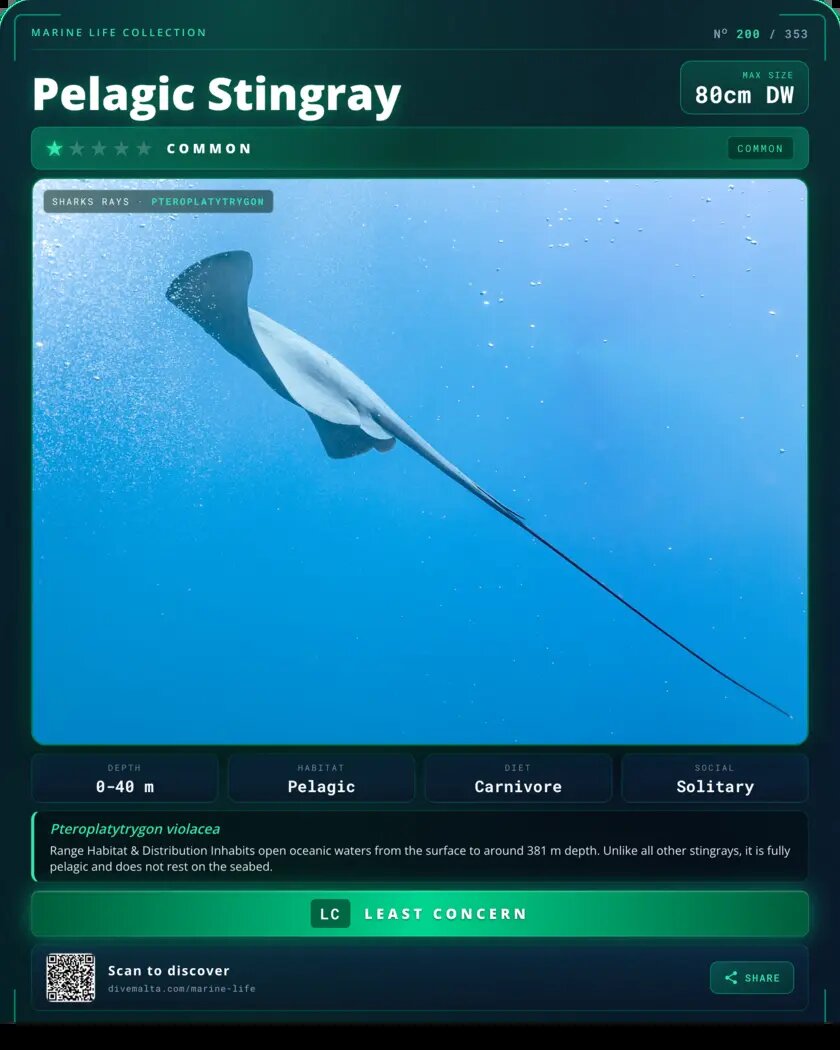
Pelagic Stingray species card

Behaviour & Diet

Feeding Strategy

Feeds on jellyfish, squid, octopus, crustaceans, and small pelagic fish in the open water column. Hunts actively rather than waiting on the seabed like benthic rays.

Open-water hunter

Reproduction

Viviparous with uterine nourishment (histotrophy). Females produce 4-13 pups per litter after a gestation of several months. Young are born fully developed.

Live bearer

Behaviour & Defence

The long tail carries a venomous serrated spine capable of inflicting serious wounds. The dark colouration provides camouflage against the deep blue ocean when viewed from above.

Venomous spine

Where to Encounter in Malta

Dive sites where Pteroplatytrygon violacea may be encountered will be added as sighting data is collected.

IUCN Red ListLeast Concern

Conservation Status

This species is assessed as Least Concern on the IUCN Red List. Mediterranean populations face ongoing pressure from fishing activity, habitat degradation, and climate-driven changes.

Source: IUCN Red List
diveshack Mediterranean Marine Life guide