Dipturus oxyrinchus
Elasmobranch
Range
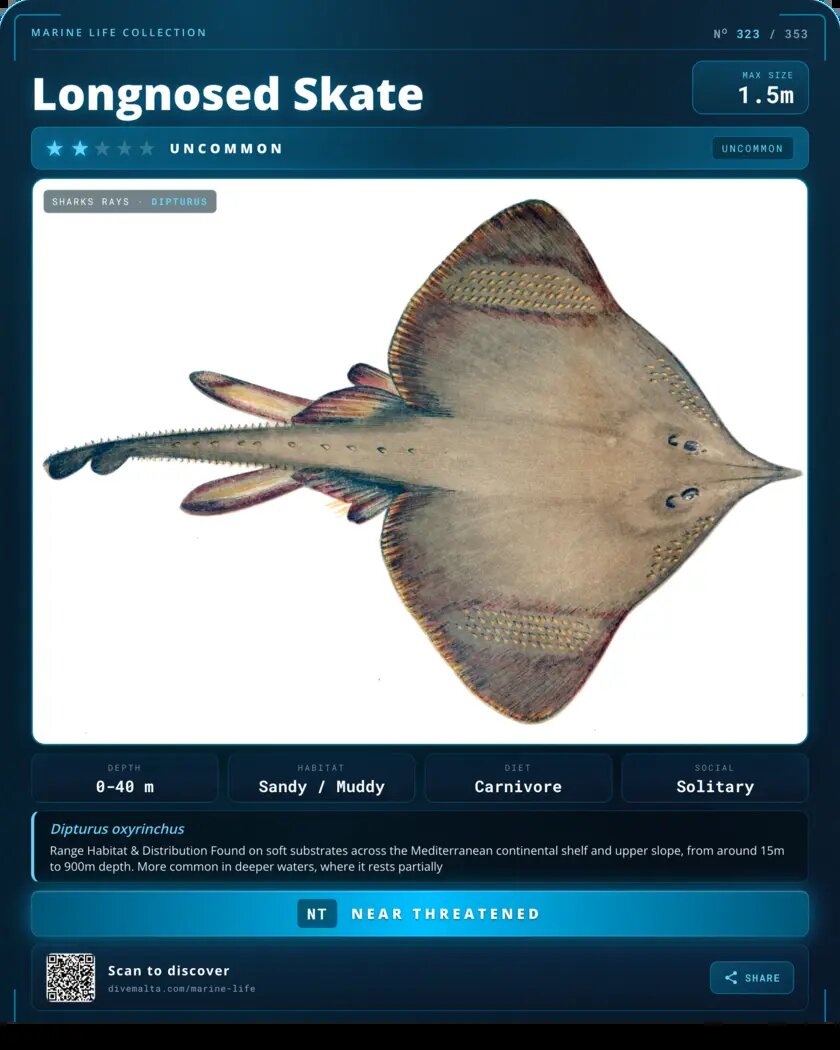
Found on soft substrates across the Mediterranean continental shelf and upper slope, from around 15m to 900m depth. More common in deeper waters, where it rests partially buried on muddy or sandy bottoms.
Sightings are logged by divers using our What Did You See? dive-log tool. View the full live sightings map.
Prefers sandy and muddy seabeds on the outer continental shelf and upper slope. Rests on the bottom during the day, often partially covered by sediment, becoming more active at night to forage.
Best approached slowly and calmly. Avoid casting shadows directly over the animal. Neutral buoyancy and patience increase encounter success significantly.
Biology
Feeds on bottom-dwelling fish, crustaceans, and cephalopods. Detects prey using electroreceptors in its snout, then pins items against the seabed with its broad disc before consuming them.
Benthic predatorOviparous, depositing large, rectangular egg cases with pointed horns onto the seabed. Each case holds a single embryo that takes several months to develop. Females produce relatively few eggs per year.
OviparousRelies on camouflage as its primary defence, lying motionless on the seabed and partially burying itself in sediment. When disturbed, it lifts off the bottom and swims away with undulating disc movements.
CamouflageDive with diveshack
Dive sites where Dipturus oxyrinchus may be encountered will be added as sighting data is collected.
This species is assessed as Near Threatened on the IUCN Red List. Mediterranean populations face ongoing pressure from fishing activity, habitat degradation, and climate-driven changes.