Depth
Scyliorhinus · Sharks, Rays & Cartilaginous Fish

Lesser Spotted Dogfish

Scyliorhinus canicula

0-100m
Depth Range
Up to 1 m, usually 5
Max Size
Mediterranean, E A
Distribution
0-100m
Depth Range
Up to 1 m, usual
Max Size
Sandy / Muddy
Habitat
Carnivore
Diet
Solitary
Social
LC
IUCN Status
Kingdom Animalia
Genus Scyliorhinus
Species canicula

Identification & Biology

  • IdentificationSmall, sharks with a slender shaped body with a blunt head. The two dorsal fins are located towards the tail end of the body. The texture of their skin is rough, similar to the coarseness of sandpaper. The nostrils are located on the underside of the snout and are connected to the mouth by a curved groove. The underside is a lighter greyish-white colour and the upper side is greyish-brown with darker spots. Dorsal colour is sandy and tightly tan, with numerous small spots and dark brown or nearly black in colour
  • SizeUp to 1 m, usually 50 to 70 cm
  • Social HabitHabitat: Sandy, gravelly or muddy bottoms
  • HabitatSandy, gravelly or muddy bottoms
  • DepthFound primarily in shallow water but found down to 100 m
  • Feeds OnWide range of food, such as, molluscs, echinoderms, polychaetes, crustaceans, sipunculids and tunicate but decapod crustaceans and fishes are their main food
  • DistributionMediterranean, E Atlantic
  • Description Scyliorhinus canicula is a small, bottom-dwelling catshark reaching around 80 cm in length, easily recognised by its sandy-brown skin covered in numerous small dark spots and two nasal flaps that do not reach the mouth. Common on rocky and sandy seabeds around Malta from 5 to 100 metres, it is frequently encountered by divers resting in caves and under ledges during the day.

Habitat & Distribution

Sandy, gravelly or muddy bottoms

Where Malta divers have spotted this species

Loading…

Sightings are logged by divers using our What Did You See? dive-log tool. View the full live sightings map.

Detail

Preferred Environment

Sandy / Muddy habitats, typically at depths of 0-100m. Most commonly encountered by divers at the shallower end of its range.

Encounter Tips

Best approached slowly and calmly. Avoid casting shadows directly over the animal. Neutral buoyancy and patience increase encounter success significantly.
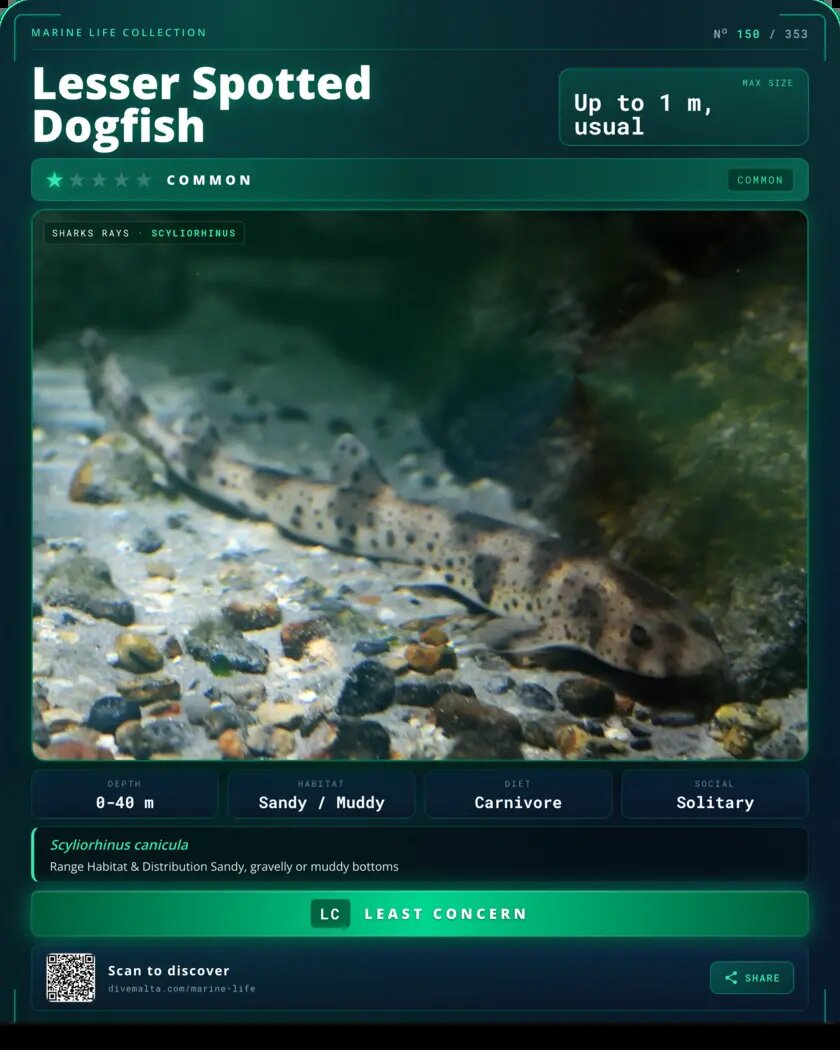
Lesser Spotted Dogfish species card

Behaviour & Diet

Feeding Strategy

Wide range of food, such as, molluscs, echinoderms, polychaetes, crustaceans, sipunculids and tunicate but decapod crustaceans and fishes are their main food

Carnivore

Where to Encounter in Malta

The following dive sites offer strong habitat match for Scyliorhinus canicula. All are accessible on a guided dive with diveshack.

3-18m
Comino

Blue Lagoon

Extensive sandy floor with excellent visibility. A prime habitat for benthic species that shelter in the sandy channels.

View dive site ›
5-22m
South Malta

Ghar Lapsi

Sheltered cove with sandy patches between rocky outcrops. The sandy areas at 8-15m are rich in benthic marine life.

View dive site ›
8-30m
North Malta

Cirkewwa

Sandy channels flanking the reef system provide excellent habitat for bottom-dwelling species.

View dive site ›
IUCN Red List Least Concern

Conservation Status

This species is assessed as Least Concern on the IUCN Red List. Mediterranean populations face ongoing pressure from fishing activity, habitat degradation, and climate-driven changes to prey availability.

Source: iNaturalist Guide #888
by Lesley Clements (CC BY-SA)
diveshack Mediterranean Marine Life guide