Depth
Dalatias · Sharks & Rays

Kitefin Shark

Dalatias licha

200-1800m
Depth Range
180cm
Max Size
Mediterranean
Distribution
200-1800m
Depth Range
180cm
Max Size
Deep water
Habitat
Carnivore
Diet
Solitary
Social
VU
IUCN Status
Rare
Sighting Likelihood
KingdomAnimalia
PhylumChordata
ClassElasmobranchii
GenusDalatias
Specieslicha

Identification & Biology

  • IdentificationA stocky, dark brown to black deep-water shark with thick lips, large green eyes, and short gill slits. The lower jaw has large, triangular cutting teeth while the upper teeth are narrow and pointed. Two small, spineless dorsal fins.
  • SizeUp to 160 cm total length. Most adults are between 100 and 130 cm.
  • Social HabitSolitary or in small groups. The largest known bioluminescent vertebrate, capable of producing a faint blue-green glow from photophores covering the belly and flanks.
  • HabitatDeep continental and insular slopes, on or near the bottom. Occasionally in mid-water.
  • Depth200 to 1800 m. Most common between 200 and 600 m.
  • Feeds OnOther sharks, bony fish, squid, crustaceans, and polychaete worms. Known to take cookie-cutter-style bites from larger animals including other sharks and marine mammals.
  • DistributionWorldwide in tropical and warm temperate deep waters. Present throughout the deep Mediterranean, including waters around Malta.
  • DescriptionDalatias licha made international headlines in 2021 when scientists confirmed it as the largest known bioluminescent vertebrate. The blue-green glow produced by photophores on its underside is thought to serve as counter-illumination camouflage, masking its silhouette from predators below. Listed as Vulnerable by the IUCN due to deep-water trawl bycatch.

Habitat & Distribution

A deep-water species found from 200 to 1800 m, most common between 300 and 600 m. Inhabits the benthopelagic zone over the continental and insular slopes.

Where Malta divers have spotted this species

Loading…

Sightings are logged by divers using our What Did You See? dive-log tool. View the full live sightings map.

Detail

Preferred Environment

Prefers deep-water slope habitats and submarine canyons. Occasionally ventures into mid-water to feed, but is primarily found near the seabed.

Encounter Tips

Best approached slowly and calmly. Avoid casting shadows directly over the animal. Neutral buoyancy and patience increase encounter success significantly.
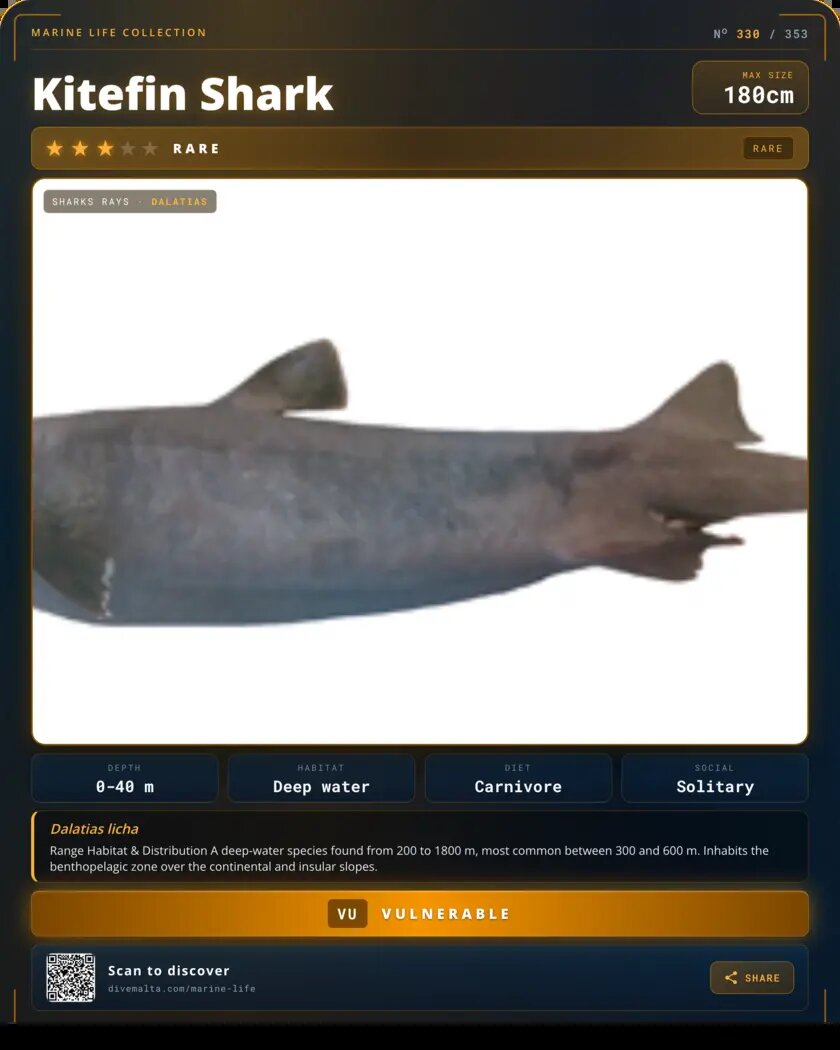
Kitefin Shark species card

Behaviour & Diet

Feeding Strategy

A versatile predator that feeds on deep-water fish, squid, crustaceans, and other sharks. The powerful lower teeth can gouge chunks from prey larger than itself.

Bite-and-gouge predator

Reproduction

Ovoviviparous, producing litters of 10-16 pups. Reproductive cycle is slow, and gestation is believed to last around two years.

Slow reproducer

Behaviour & Defence

Bioluminescence may serve as counter-illumination camouflage, masking its silhouette from predators below. Its rough skin and stocky build also provide physical defence.

Bioluminescent camo

Where to Encounter in Malta

Dive sites where Dalatias licha may be encountered will be added as sighting data is collected.

IUCN Red ListVulnerable

Conservation Status

This species is assessed as Vulnerable on the IUCN Red List. Mediterranean populations face ongoing pressure from fishing activity, habitat degradation, and climate-driven changes.

Source: IUCN Red List
diveshack Mediterranean Marine Life guide