Depth
Carcharhinus · Sharks & Rays

Dusky Shark

Carcharhinus obscurus

0-400m
Depth Range
420cm
Max Size
Mediterranean
Distribution
0-400m
Depth Range
420cm
Max Size
Pelagic / Coastal
Habitat
Carnivore
Diet
Solitary
Social
EN
IUCN Status
Very Rare
Sighting Likelihood
KingdomAnimalia
PhylumChordata
ClassElasmobranchii
GenusCarcharhinus
Speciesobscurus

Identification & Biology

  • IdentificationA large, stocky requiem shark with a broadly rounded snout, a subtle interdorsal ridge, and a low first dorsal fin that starts behind the trailing edge of the pectoral fins. Grey-bronze on top fading to white underneath. No bold markings.
  • SizeCommonly 2.5 to 3 m. Maximum recorded length 4.2 m and weight up to 347 kg.
  • Social HabitMigratory, following warm water seasonally. Can form loose aggregations but is mostly solitary. Extremely slow to mature and reproduce, making it highly vulnerable to fishing pressure.
  • HabitatContinental shelves and offshore waters. Found over sandy bottoms, near reef edges, and in open water.
  • Depth0 to 400 m. Typically between 20 and 200 m.
  • Feeds OnBony fish (including reef fish and schooling pelagics), smaller sharks, rays, squid, octopus, and crustaceans.
  • DistributionWorldwide in warm temperate and tropical seas. In the Mediterranean, historically recorded from the western and central basins. Now very rare.
  • DescriptionCarcharhinus obscurus is one of the slowest-reproducing sharks known, not reaching sexual maturity until around 20 years of age. This makes even low levels of fishing pressure devastating to populations. In the Mediterranean it is extremely rare and listed as Endangered by the IUCN. Any sighting would be notable.

Habitat & Distribution

Ranges from the surface to 400 m depth across continental shelves and oceanic waters. Undertakes long-distance seasonal migrations following warm water masses.

Where Malta divers have spotted this species

Loading…

Sightings are logged by divers using our What Did You See? dive-log tool. View the full live sightings map.

Detail

Preferred Environment

Found over the continental shelf and shelf edge, from shallow coastal bays to open oceanic environments. Occasionally enters shallow waters but prefers deeper offshore areas.

Encounter Tips

Best approached slowly and calmly. Avoid casting shadows directly over the animal. Neutral buoyancy and patience increase encounter success significantly.
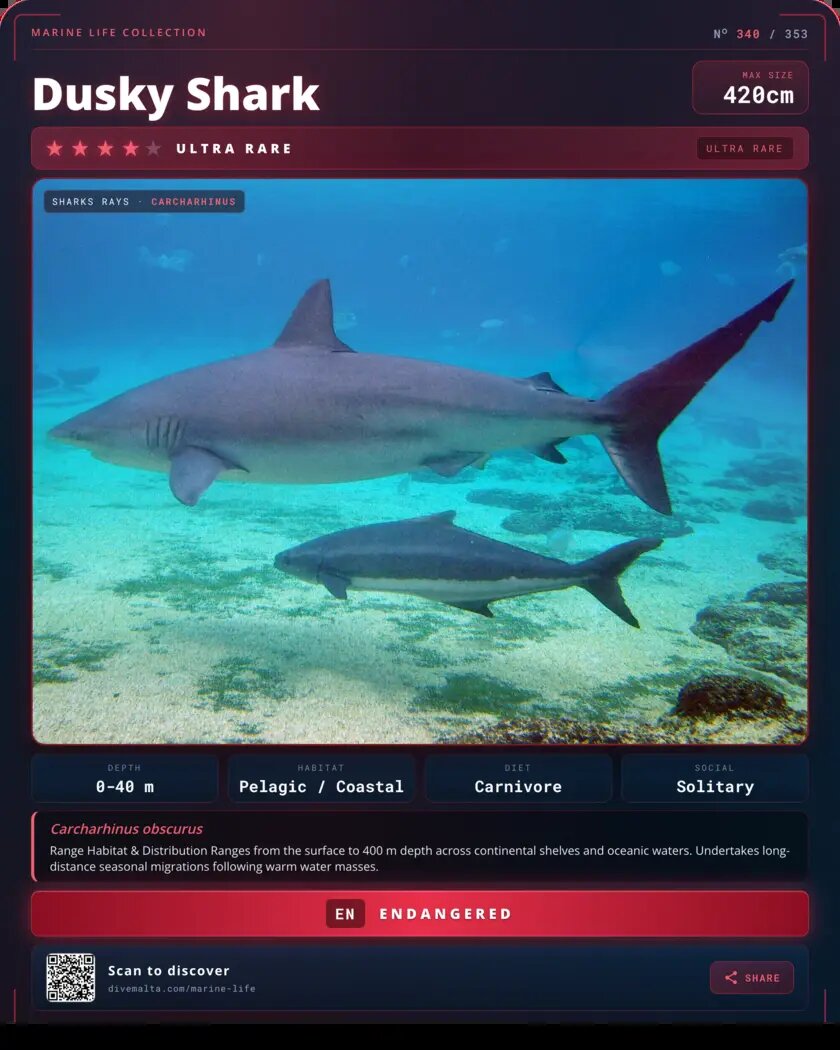
Dusky Shark species card

Behaviour & Diet

Feeding Strategy

An apex predator feeding on bony fish, smaller sharks, rays, cephalopods, and crustaceans. Uses its powerful jaws and serrated teeth to tackle large prey.

Apex predator

Reproduction

Viviparous with a yolk-sac placenta. Gestation lasts around 22 months with litters of 3-14 pups. Females reproduce only every 2-3 years, making recovery from population declines extremely slow.

Live bearer -- slow reproducer

Behaviour & Defence

Adults have few natural predators due to their size. Juveniles may fall prey to larger sharks. Threat displays include exaggerated swimming motions.

Size dominance

Where to Encounter in Malta

Dive sites where Carcharhinus obscurus may be encountered will be added as sighting data is collected.

IUCN Red List Endangered

Conservation Status

This species is assessed as Endangered on the IUCN Red List. Mediterranean populations face ongoing pressure from fishing activity, habitat degradation, and climate-driven changes.

Source: IUCN Red List
diveshack Mediterranean Marine Life guide