Depth
Myliobatis · Sharks & Rays

Common Eagle Ray

Myliobatis aquila

1 - 100 m
Depth Range
180 cm DW
Max Size
Mediterranean
Distribution
1 - 100 m
Depth Range
180 cm DW
Max Size
Sandy Bottoms
Habitat
Predator
Diet
Solitary / Groups
Social
CR
IUCN Status
Moderate
Sighting Likelihood
KingdomAnimalia
PhylumChordata
ClassElasmobranchii
GenusMyliobatis
Speciesaquila

Identification & Biology

  • IdentificationA large ray with angular, pointed pectoral fins that give it a distinctive wing shape. The head has a protruding, duck-bill-shaped snout. Olive-brown to dark grey on top, white underneath. The tail is very long and whip-like with one or more venomous spines near the base.
  • SizeDisc width up to 150 cm. Total length including tail can exceed 2.5 m. Weight up to 14 kg.
  • Social HabitCan be solitary or found in small groups. Sometimes forms larger aggregations during mating season. Swims with graceful, bird-like wingbeats through the water column.
  • HabitatSandy and muddy bays, seagrass meadows, and open water near the coast. Spends time both cruising in mid-water and foraging on the seabed.
  • Depth1 to 300 m. Most commonly seen between 5 and 30 m in coastal waters.
  • Feeds OnCrabs, bivalves (mussels and clams), gastropods, and small fish. Uses powerful crushing tooth plates to crack open hard-shelled prey.
  • DistributionEastern Atlantic from the British Isles to South Africa, and throughout the Mediterranean Sea. Regularly seen in Maltese waters.
  • DescriptionMyliobatis aquila is one of the most elegant rays a diver can encounter in Malta, often seen gliding effortlessly over sandy seabeds or Posidonia meadows. It feeds by rooting through sand to uncover buried shellfish, leaving distinctive feeding pits. The venomous tail spine is used only in self-defence. Listed as Critically Endangered in the Mediterranean by the IUCN.

Habitat & Distribution

Found over sandy bottoms from very shallow water to about 100 m depth across the Mediterranean. Often seen gliding over sandy areas near reef edges and around Posidonia meadow clearings.

Where Malta divers have spotted this species

Loading…

Sightings are logged by divers using our What Did You See? dive-log tool. View the full live sightings map.

Detail

Preferred Environment

Sandy and muddy bottoms, often adjacent to rocky reefs and seagrass meadows. Frequents sheltered bays and open sandy areas. Rests on the seabed and cruises at mid-water height above the substrate.

Encounter Tips

Watch for the distinctive silhouette gliding over sandy areas. Often encountered cruising at mid-water over sand flats. Can also be found resting partially buried in sand, though this is less common than with stingrays.
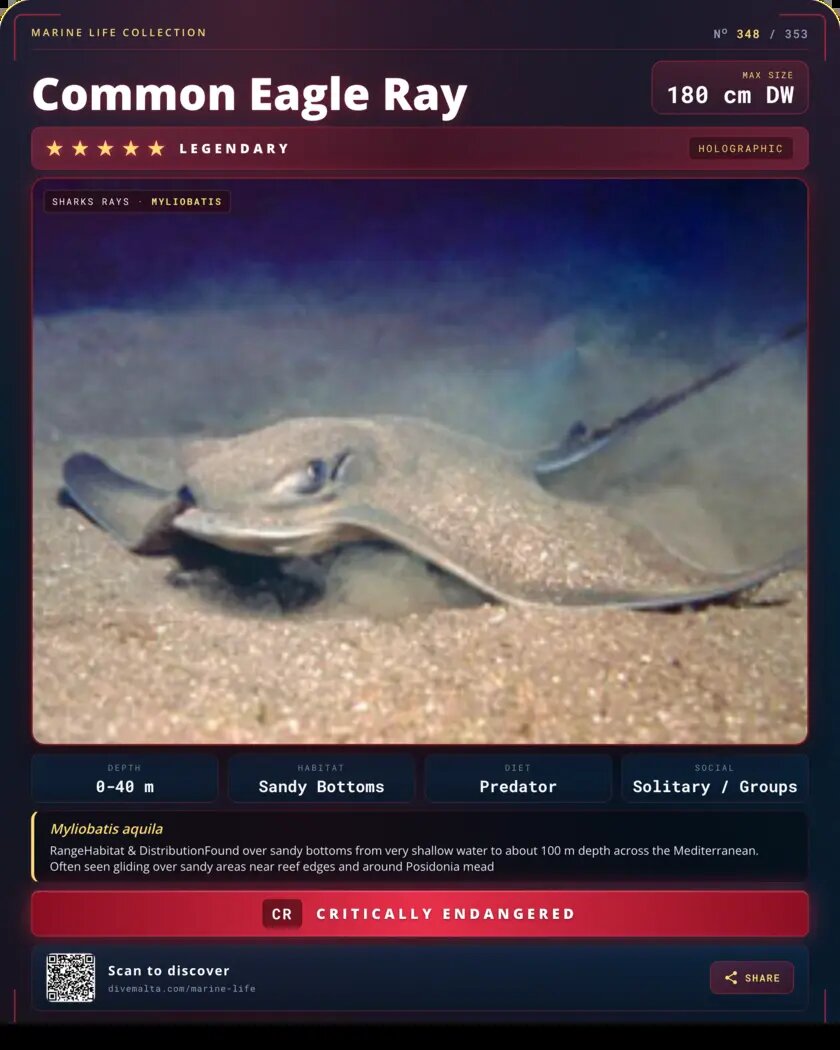
Common Eagle Ray species card

Where to Encounter in Malta

Dive sites where Myliobatis aquila may be encountered will be added as sighting data is collected.

IUCN Red ListCritically Endangered

Conservation Status

This species is assessed as Critically Endangered on the IUCN Red List. Mediterranean populations face ongoing pressure from fishing activity, habitat degradation, and climate-driven changes.

Source: IUCN Red List
diveshack Mediterranean Marine Life guide