Cetorhinus maximus
Elasmobranch
Range
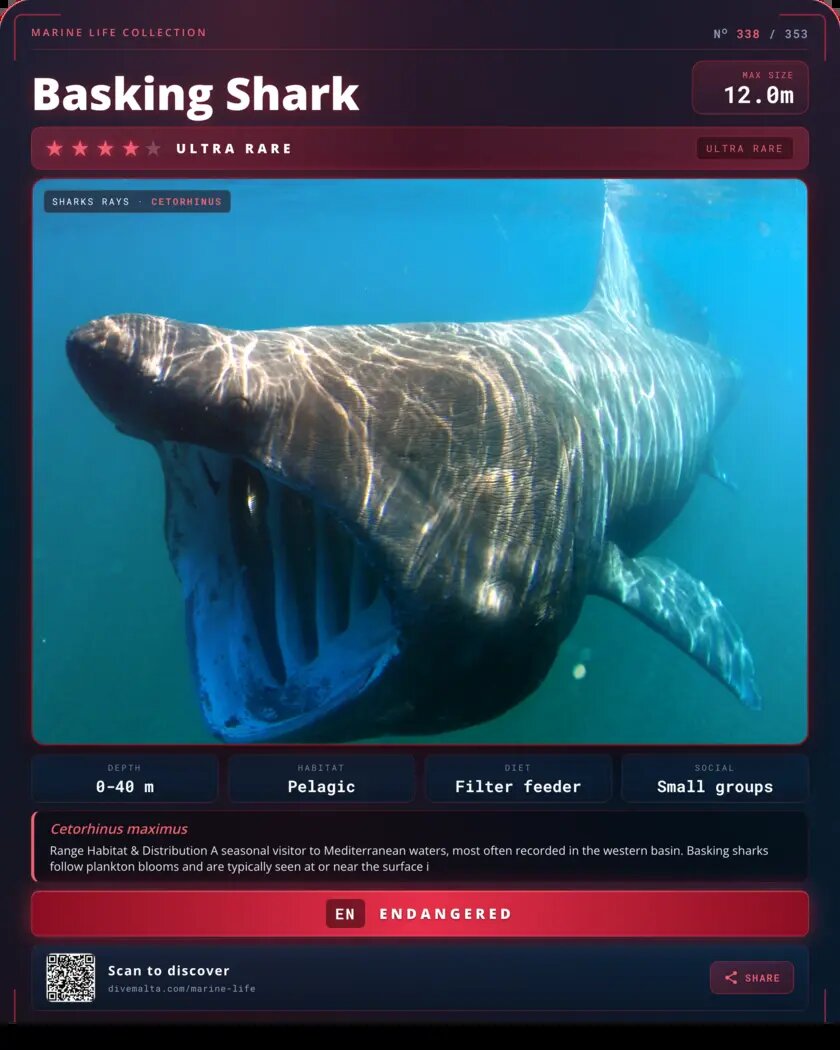
A seasonal visitor to Mediterranean waters, most often recorded in the western basin. Basking sharks follow plankton blooms and are typically seen at or near the surface in productive coastal waters during warmer months.
Sightings are logged by divers using our What Did You See? dive-log tool. View the full live sightings map.
Favours temperate, plankton-rich surface waters along continental shelves and near thermal fronts where zooplankton concentrates. Despite surface feeding habits, tracking data shows deep dives to several hundred metres between feeding bouts.
Best approached slowly and calmly. Avoid casting shadows directly over the animal. Neutral buoyancy and patience increase encounter success significantly.
Biology
A passive ram filter feeder that swims slowly forward with its mouth wide open, straining zooplankton, fish eggs, and small crustaceans through its gill rakers. Can filter over 2,000 tonnes of water per hour.
Ram filter feederOvoviviparous, with very little known about its reproductive biology. Gestation is estimated at 1-3 years. Litter sizes are thought to be small, and embryos likely practise oophagy.
OvoviviparousCompletely harmless to humans despite its immense size. When disturbed, it simply ceases feeding and submerges. Breaching behaviour has been observed but its purpose remains unclear.
Passive giantDive with diveshack
Dive sites where Cetorhinus maximus may be encountered will be added as sighting data is collected.
This species is assessed as Endangered on the IUCN Red List. Mediterranean populations face ongoing pressure from fishing activity, habitat degradation, and climate-driven changes.