Depth
Padina · Plants, Algae & Seagrass

Peacock's Tail

Padina pavonica

0-40m
Depth Range
Variable
Max Size
Mediterranean
Distribution
0-40m
Depth Range
Variable
Max Size
Reef & Open
Habitat
Photosynthetic
Diet
Meadow-forming
Social
LC
IUCN Status
Kingdom Plantae
Division Tracheophyta
Genus Padina
Species pavonica

Identification & Biology

  • IdentificationA small, fan-shaped brown alga with distinctive concentric bands of lighter and darker brown running across the blade, resembling a peacock's tail feather. The blade is thin, flat, and slightly curled at the edges. Often covered in a fine white calcareous deposit.
  • SizeBlade height up to 15 cm. Width up to 8 cm.
  • Social HabitFound in groups on rocky surfaces in shallow water. The banded pattern is caused by alternating zones of reproductive and vegetative growth.
  • HabitatShallow rocky reefs, tide pools, and any hard surface in well-lit water.
  • Depth0 to 20 m. Most common between 1 and 10 m.
  • Feeds OnPhotosynthetic. Produces food from sunlight through photosynthesis.
  • DistributionWorldwide in warm and temperate seas. Common throughout the Mediterranean and on all Maltese rocky shores.
  • DescriptionPadina pavonica is one of the most distinctive and commonly encountered algae in Malta. Its fan-shaped blade with concentric banding is easy to recognise in tide pools and on shallow reefs. The white calcareous coating on the surface makes it one of the few algae that contribute to calcium carbonate production. It is an important primary producer and food source for herbivorous fish and sea urchins.

Habitat & Distribution

Found across the Mediterranean, inhabiting reef & open environments. Active from the surface down to 40m depth.

Where Malta divers have spotted this species

Loading…

Sightings are logged by divers using our What Did You See? dive-log tool. View the full live sightings map.

Detail

Preferred Environment

Reef & Open habitats, typically at depths of 0-40m. Most commonly encountered by divers at the shallower end of its range.

Encounter Tips

Best approached slowly and calmly. Avoid casting shadows directly over the animal. Neutral buoyancy and patience increase encounter success significantly.
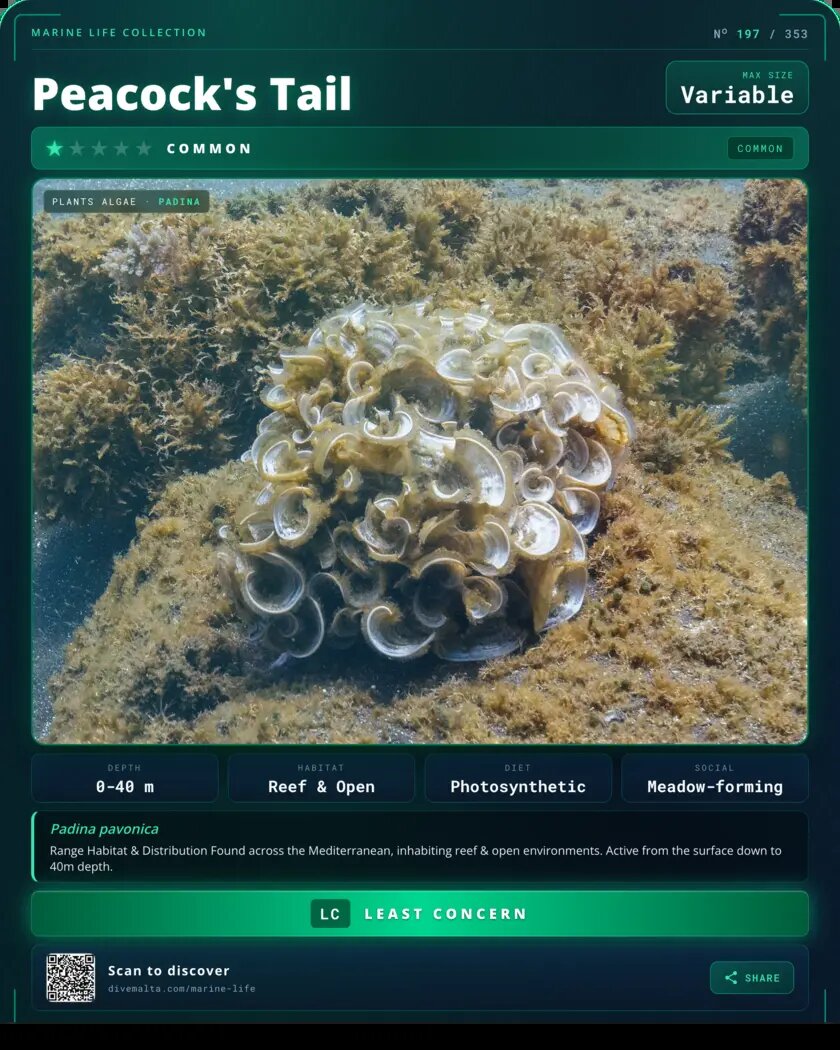
Peacock's Tail species card

Behaviour & Diet

Feeding Strategy

Produces energy through photosynthesis using sunlight penetrating the water column. Forms dense meadows that are critical nursery habitat and oxygen producers for the Mediterranean ecosystem.

Photosynthetic

Reproduction

Reproduces vegetatively and sexually. Vegetative growth is the dominant strategy; sexual reproduction is seasonal and infrequent.

Seasonal spawning

Behaviour & Defence

Posidonia and other Mediterranean seagrasses form protected meadows under EU Habitats Directive. These habitats are sensitive to anchor damage, trawling, and water quality. Recreational divers should avoid contact with the meadow.

Defensive

Where to Encounter in Malta

The following dive sites offer strong habitat match for Padina pavonica. All are accessible on a guided dive with diveshack.

5-30m
North Malta

Cirkewwa

Rocky reef with caves, arches and ledges hosting a rich diversity of reef species.

View dive site ›
5-50m
Gozo

Blue Hole

One of the Med's most famous reef dive sites. Rocky walls and archways covered in life.

View dive site ›
18-36m
South Malta

Um El Faroud

The wreck lies on a sandy bottom surrounded by rocky reef -- a diverse habitat attracting reef species.

View dive site ›
IUCN Red List Least Concern

Conservation Status

This species is assessed as Least Concern on the IUCN Red List. Mediterranean populations face ongoing pressure from fishing activity, habitat degradation, and climate-driven changes to prey availability.

Source: iNaturalist Guide #888
by Lesley Clements (CC BY-SA)
diveshack Mediterranean Marine Life guide