Depth
Pteria · Molluscs (Octopus, Nudibranchs & Shellfish)

Wing Oyster

Pteria hirundo

60-70m
Depth Range
Variable
Max Size
Mediterranean
Distribution
60-70m
Depth Range
Variable
Max Size
Open Water
Habitat
Carnivore
Diet
Solitary
Social
LC
IUCN Status
Kingdom Animalia
Phylum Mollusca
Genus Pteria
Species hirundo

Identification & Biology

  • IdentificationA thin-shelled bivalve with an elongated, wing-like shape. The shell is translucent to pale brown, fragile, and flattened. It attaches to hard surfaces by byssus threads, often on gorgonian branches or other upright structures.
  • SizeShell length up to 8 cm along the longest axis.
  • Social HabitSolitary or in small groups. Attaches to elevated structures such as gorgonian sea fans, hydroids, and wire corals to access better water flow for filter feeding.
  • HabitatRocky reefs, particularly on gorgonian fans, sea whips, and other upright organisms that project into the current.
  • Depth10 to 80 m. Most common between 20 and 50 m.
  • Feeds OnPlankton and suspended organic particles filtered from the water.
  • DistributionEastern Atlantic and throughout the Mediterranean Sea. Present in Maltese waters.
  • DescriptionPteria hirundo is an elegant bivalve that takes advantage of elevated positions on the reef by attaching itself to gorgonian sea fans and other upright organisms. This places it in a better flow of plankton-rich water than it would receive on the rock surface below. The thin, translucent shell is fragile and easily damaged, so it relies on its elevated, hard-to-reach position for protection from predators.

Habitat & Distribution

Found across the Mediterranean, inhabiting open water environments. Active from the surface down to 70m depth.

Where Malta divers have spotted this species

Loading…

Sightings are logged by divers using our What Did You See? dive-log tool. View the full live sightings map.

Detail

Preferred Environment

Open Water habitats, typically at depths of 60-70m. Most commonly encountered by divers at the shallower end of its range.

Encounter Tips

Best approached slowly and calmly. Avoid casting shadows directly over the animal. Neutral buoyancy and patience increase encounter success significantly.
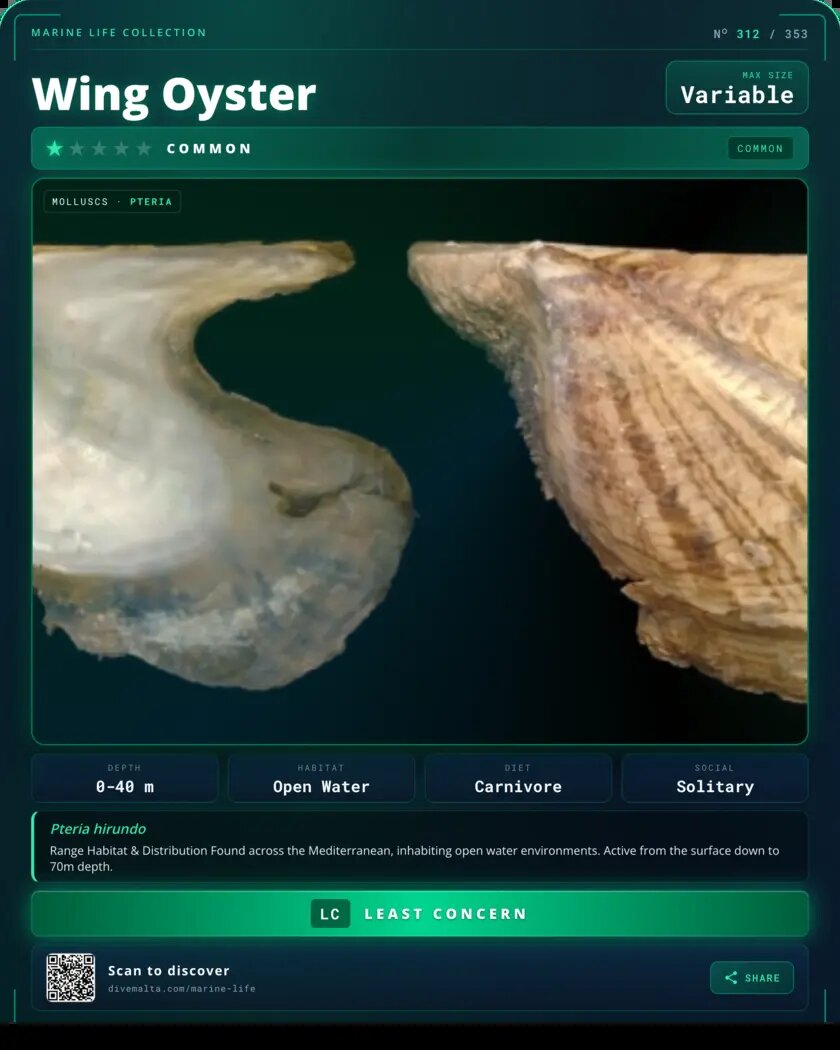
Wing Oyster species card

Behaviour & Diet

Feeding Strategy

A sessile filter feeder that cements itself to rocky surfaces. It draws water through its slightly gaping valves to capture phytoplankton and fine organic particles.

Filter feeder

Reproduction

Releases eggs and sperm into the water column for external fertilisation. Planktonic larvae drift for several weeks before settling and permanently attaching to hard substrate.

Broadcast spawner

Behaviour & Defence

Its flattened, irregularly shaped shell closely resembles the rocky surface it grows on, providing excellent camouflage. Heavy encrustation by other organisms adds to the disguise.

Camouflage

Where to Encounter in Malta

The following dive sites offer strong habitat match for Pteria hirundo. All are accessible on a guided dive with diveshack.

0-30m
Comino

Blue Lagoon

Open water around Comino is a known passage for pelagic species, especially in summer.

View dive site ›
5-30m
North Malta

Cirkewwa

The channel crossing at Cirkewwa draws pelagic species following currents from the open sea.

View dive site ›
18-36m
South Malta

Um El Faroud

The open reef beyond the wreck is visited by pelagic and semi-pelagic species on feeding runs.

View dive site ›
IUCN Red List Least Concern

Conservation Status

This species is assessed as Least Concern on the IUCN Red List. Mediterranean populations face ongoing pressure from fishing activity, habitat degradation, and climate-driven changes to prey availability.

Source: iNaturalist Guide #888
by Lesley Clements (CC BY-SA)
diveshack Mediterranean Marine Life guide