Depth
Phalium · Molluscs (Octopus, Nudibranchs & Shellfish)

Scotch Bonnet

Phalium granulatum

0-40m
Depth Range
Variable
Max Size
Mediterranean
Distribution
0-40m
Depth Range
Variable
Max Size
Reef & Open
Habitat
Carnivore
Diet
Solitary
Social
LC
IUCN Status
Kingdom Animalia
Phylum Mollusca
Genus Phalium
Species granulatum

Identification & Biology

  • IdentificationA medium-sized sea snail with a rounded, globular shell featuring fine spiral grooves and a thickened outer lip. Pale cream to tan with faint brown bands. The shell shape resembles a Scottish tam-o-shanter bonnet.
  • SizeShell length up to 10 cm.
  • Social HabitSolitary. Burrows through soft sediment searching for its prey. A specialised predator of sea urchins.
  • HabitatSandy and muddy bottoms, particularly in areas with sea urchin populations.
  • Depth5 to 100 m. Most common between 10 and 50 m.
  • Feeds OnSea urchins, which it attacks by secreting acid to dissolve the shell before consuming the soft tissue inside.
  • DistributionEastern Atlantic and throughout the Mediterranean Sea. Present in Maltese waters.
  • DescriptionPhalium granulatum is one of the few predators capable of attacking sea urchins. It locates its prey by chemical detection, then mounts the urchin and secretes sulphuric acid from a specialised gland to dissolve a hole in the shell. This chemical attack allows it to feed on the soft interior without being injured by the urchin's spines. An elegant solution to an otherwise formidable prey.

Habitat & Distribution

Found across the Mediterranean, inhabiting reef & open environments. Active from the surface down to 40m depth.

Where Malta divers have spotted this species

Loading…

Sightings are logged by divers using our What Did You See? dive-log tool. View the full live sightings map.

Detail

Preferred Environment

Reef & Open habitats, typically at depths of 0-40m. Most commonly encountered by divers at the shallower end of its range.

Encounter Tips

Best approached slowly and calmly. Avoid casting shadows directly over the animal. Neutral buoyancy and patience increase encounter success significantly.
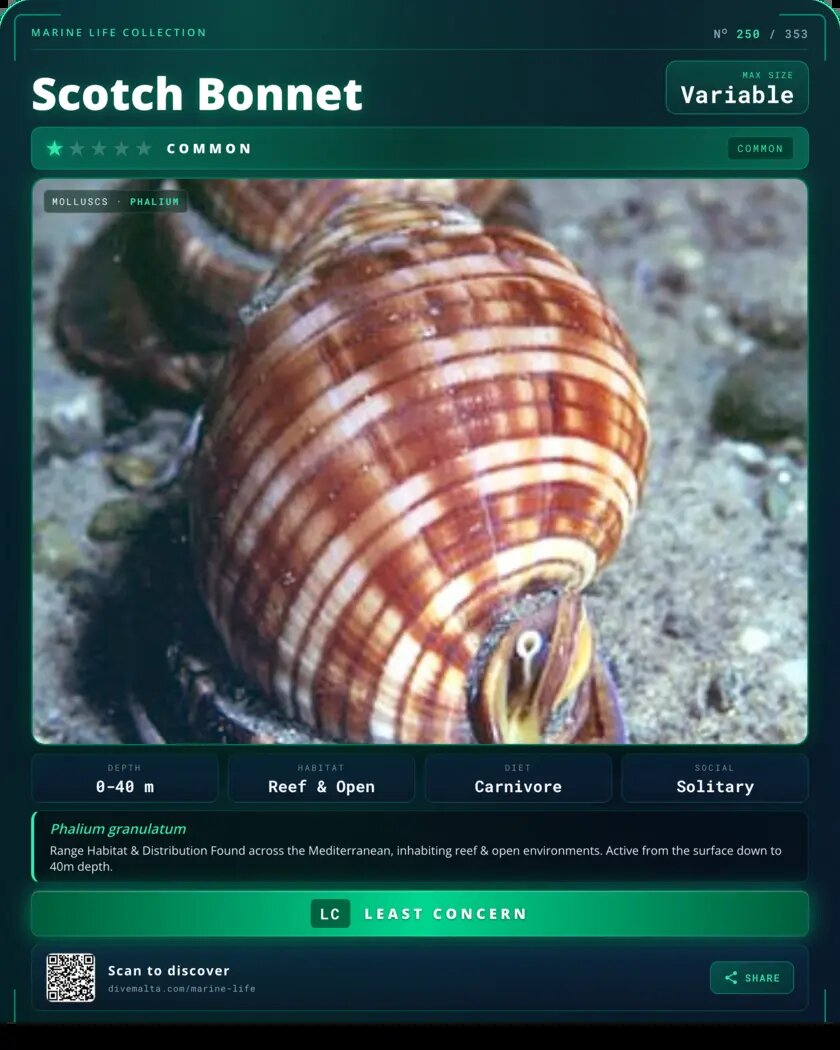
Scotch Bonnet species card

Behaviour & Diet

Feeding Strategy

A specialised predator of sea urchins and sand dollars. It secretes sulphuric acid to dissolve the urchin's test, then inserts its proboscis to consume the internal tissues.

Echinoderm predator

Reproduction

Females attach tower-shaped egg capsules in neat rows on sandy substrate. Each capsule contains numerous eggs that develop directly into crawling juveniles.

Egg capsules

Behaviour & Defence

Retreats into its robust, helmet-shaped shell when threatened. The shell's thick outer lip and solid construction provide strong resistance against crushing predators.

Shell retreat

Where to Encounter in Malta

The following dive sites offer strong habitat match for Phalium granulatum. All are accessible on a guided dive with diveshack.

5-30m
North Malta

Cirkewwa

Rocky reef with caves, arches and ledges hosting a rich diversity of reef species.

View dive site ›
5-50m
Gozo

Blue Hole

One of the Med's most famous reef dive sites. Rocky walls and archways covered in life.

View dive site ›
18-36m
South Malta

Um El Faroud

The wreck lies on a sandy bottom surrounded by rocky reef -- a diverse habitat attracting reef species.

View dive site ›
IUCN Red List Least Concern

Conservation Status

This species is assessed as Least Concern on the IUCN Red List. Mediterranean populations face ongoing pressure from fishing activity, habitat degradation, and climate-driven changes to prey availability.

Source: iNaturalist Guide #888
by Lesley Clements (CC BY-SA)
diveshack Mediterranean Marine Life guide