Depth
Arca · Molluscs (Octopus, Nudibranchs & Shellfish)

Noah's Ark shell

Arca noae

0-60m
Depth Range
Variable
Max Size
Mediterranean
Distribution
0-60m
Depth Range
Variable
Max Size
Reef & Open
Habitat
Carnivore
Diet
Solitary
Social
LC
IUCN Status
Kingdom Animalia
Phylum Mollusca
Genus Arca
Species noae

Identification & Biology

  • IdentificationA bivalve with an elongated, rectangular shell that is dark brown to black, covered in a distinctive hairy periostracum (outer shell layer). The shell shape is said to resemble the hull of a boat, giving it its common name. Often found in dense clusters.
  • SizeShell length up to 9 cm.
  • Social HabitGregarious. Attaches to hard surfaces in clusters using byssus threads (strong protein filaments). Forms dense beds on suitable substrates.
  • HabitatRocky reefs, boulders, and any hard substrate in shallow to moderate water. Often found in crevices and on overhangs.
  • Depth0 to 50 m. Most common between 2 and 25 m.
  • Feeds OnPlankton and suspended organic particles filtered from the water.
  • DistributionEastern Atlantic and throughout the Mediterranean Sea. Common in Maltese waters.
  • DescriptionArca noae takes its name from the biblical Ark of Noah, with its boat-shaped shell supposedly resembling the hull of a vessel. It is a common sight on Maltese reefs, often forming small clusters in crevices and on the undersides of overhangs. The dark, hairy periostracum covering the shell makes it distinctive even when encrusted with other organisms. It is occasionally harvested for food in parts of the Mediterranean.

Habitat & Distribution

Found across the Mediterranean, inhabiting reef & open environments. Active from the surface down to 60m depth.

Where Malta divers have spotted this species

Loading…

Sightings are logged by divers using our What Did You See? dive-log tool. View the full live sightings map.

Detail

Preferred Environment

Reef & Open habitats, typically at depths of 0-60m. Most commonly encountered by divers at the shallower end of its range.

Encounter Tips

Best approached slowly and calmly. Avoid casting shadows directly over the animal. Neutral buoyancy and patience increase encounter success significantly.
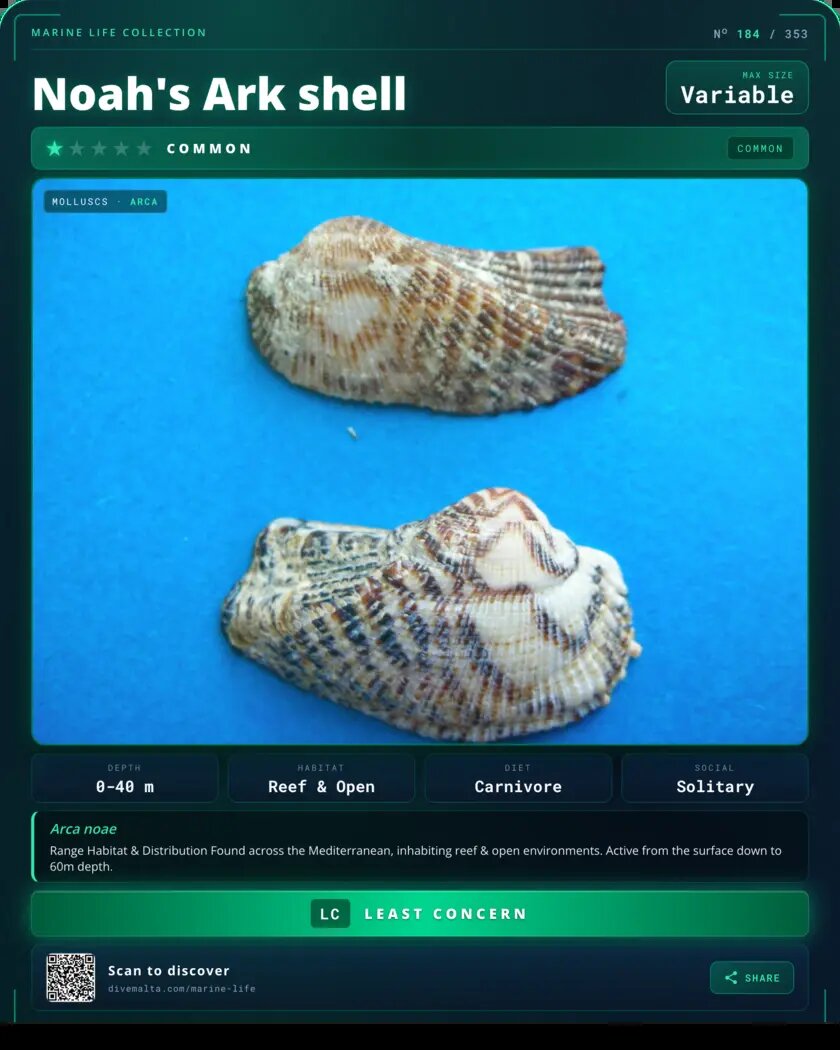
Noah's Ark shell species card

Behaviour & Diet

Feeding Strategy

A sessile filter feeder that anchors to rock with tough byssal threads. It pumps water over its gills to trap phytoplankton and suspended organic matter.

Filter feeder

Reproduction

Releases gametes into the water column for external fertilisation during summer months. Planktonic larvae settle and attach to hard substrates using byssus.

Broadcast spawner

Behaviour & Defence

Attaches firmly to rocks with a dense mat of byssal threads, making it very difficult for predators to detach. Its thick, ridged shell adds physical protection.

Byssal anchor

Where to Encounter in Malta

The following dive sites offer strong habitat match for Arca noae. All are accessible on a guided dive with diveshack.

5-30m
North Malta

Cirkewwa

Rocky reef with caves, arches and ledges hosting a rich diversity of reef species.

View dive site ›
5-50m
Gozo

Blue Hole

One of the Med's most famous reef dive sites. Rocky walls and archways covered in life.

View dive site ›
18-36m
South Malta

Um El Faroud

The wreck lies on a sandy bottom surrounded by rocky reef -- a diverse habitat attracting reef species.

View dive site ›
IUCN Red List Least Concern

Conservation Status

This species is assessed as Least Concern on the IUCN Red List. Mediterranean populations face ongoing pressure from fishing activity, habitat degradation, and climate-driven changes to prey availability.

Source: iNaturalist Guide #888
by Lesley Clements (CC BY-SA)
diveshack Mediterranean Marine Life guide