Depth
Hypselodoris · Molluscs (Octopus, Nudibranchs & Shellfish)

Giant Doris

Hypselodoris picta

0-40m
Depth Range
Variable
Max Size
Mediterranean
Distribution
0-40m
Depth Range
Variable
Max Size
Reef & Open
Habitat
Carnivore
Diet
Solitary
Social
LC
IUCN Status
Kingdom Animalia
Phylum Mollusca
Genus Hypselodoris
Species picta

Identification & Biology

  • IdentificationA large, oval-bodied nudibranch with a broad, flat mantle covered in a dense pattern of brown, white, and blue spots and patches. A ring of feathery gills surrounds the rear of the body. The rhinophores (head tentacles) are club-shaped.
  • SizeBody length up to 15 cm. One of the largest nudibranchs in the Mediterranean.
  • Social HabitSolitary. Slow-moving. Often found on or near the sponges it feeds on. Lays distinctive spiral-coiled egg ribbons.
  • HabitatRocky reefs and walls where sponges grow, particularly Petrosia ficiformis.
  • Depth5 to 50 m. Most common between 10 and 35 m.
  • Feeds OnSponges, particularly Petrosia ficiformis (the stony sponge). Feeds by rasping tissue from the sponge surface.
  • DistributionMediterranean Sea and adjacent eastern Atlantic. Common in Maltese waters wherever its sponge prey grows.
  • DescriptionHypselodoris picta is the giant of Mediterranean nudibranchs and one of the most photographed marine invertebrates in the region. Its colourful spotted pattern varies between individuals, and no two are exactly alike. Look for it on or near large, dark sponges on rocky walls. The coiled egg ribbons it lays on rock surfaces are also distinctive and a good indicator that the species is present nearby.

Habitat & Distribution

Found across the Mediterranean, inhabiting reef & open environments. Active from the surface down to 40m depth.

Where Malta divers have spotted this species

Loading…

Sightings are logged by divers using our What Did You See? dive-log tool. View the full live sightings map.

Detail

Preferred Environment

Reef & Open habitats, typically at depths of 0-40m. Most commonly encountered by divers at the shallower end of its range.

Encounter Tips

Best approached slowly and calmly. Avoid casting shadows directly over the animal. Neutral buoyancy and patience increase encounter success significantly.
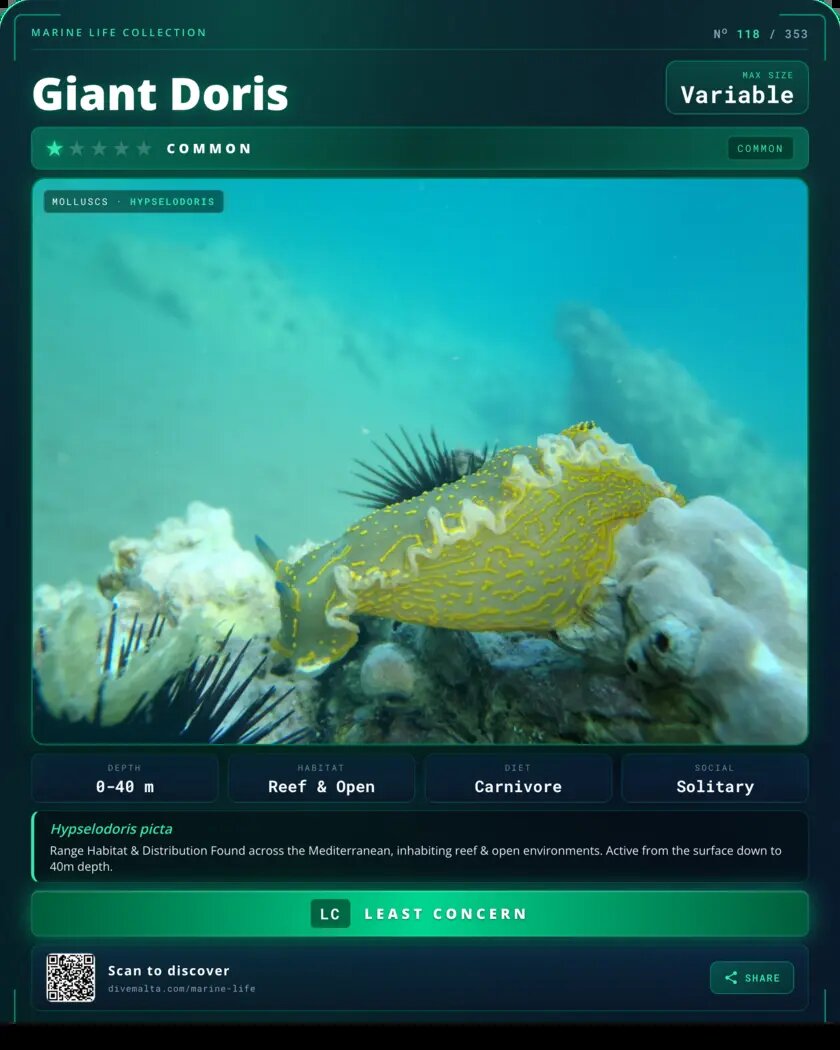
Giant Doris species card

Behaviour & Diet

Feeding Strategy

Feeds on encrusting sponges, rasping tissue with a broad radula. It can consume large areas of sponge colony and may concentrate toxic sponge metabolites in its tissues.

Sponge feeder

Reproduction

A simultaneous hermaphrodite that lays a broad, ruffled egg ribbon in a spiral on rocky substrate. Embryos develop within the ribbon and hatch as planktonic veligers.

Hermaphrodite

Behaviour & Defence

Sequesters distasteful chemical compounds from the sponges it eats, making its own flesh toxic and unpalatable to most fish predators.

Chemical defence

Where to Encounter in Malta

The following dive sites offer strong habitat match for Hypselodoris picta. All are accessible on a guided dive with diveshack.

5-30m
North Malta

Cirkewwa

Rocky reef with caves, arches and ledges hosting a rich diversity of reef species.

View dive site ›
5-50m
Gozo

Blue Hole

One of the Med's most famous reef dive sites. Rocky walls and archways covered in life.

View dive site ›
18-36m
South Malta

Um El Faroud

The wreck lies on a sandy bottom surrounded by rocky reef -- a diverse habitat attracting reef species.

View dive site ›
IUCN Red List Least Concern

Conservation Status

This species is assessed as Least Concern on the IUCN Red List. Mediterranean populations face ongoing pressure from fishing activity, habitat degradation, and climate-driven changes to prey availability.

Source: iNaturalist Guide #888
by Lesley Clements (CC BY-SA)
diveshack Mediterranean Marine Life guide