Depth
Brissus · Echinoderms (Starfish, Urchins & Brittle Stars)

Groove Burrowing Urchin

Brissus unicolor

0-40m
Depth Range
Variable
Max Size
Mediterranean
Distribution
0-40m
Depth Range
Variable
Max Size
Reef & Open
Habitat
Carnivore
Diet
Solitary
Social
LC
IUCN Status
Kingdom Animalia
Phylum Echinodermata
Genus Brissus
Species unicolor

Identification & Biology

  • IdentificationA large, heart-shaped sea urchin (irregular urchin) with a domed upper surface and a flattened base. Covered in short, dense, fine spines that give it a velvety appearance. Pale yellow to tan in colour. Unlike regular urchins, it lacks the typical spherical shape.
  • SizeTest length up to 9 cm. One of the larger burrowing urchins in the Mediterranean.
  • Social HabitSolitary. Lives buried in soft sediment, maintaining a burrow through which it draws oxygenated water. Rarely seen on the surface.
  • HabitatSandy and muddy bottoms where it can burrow. Requires deep, soft sediment.
  • Depth5 to 200 m. Most common between 10 and 50 m.
  • Feeds OnOrganic particles and detritus in the sediment. A deposit feeder that processes buried organic material.
  • DistributionEastern Atlantic and throughout the Mediterranean Sea. Present in Maltese waters on suitable sandy substrates.
  • DescriptionBrissus unicolor is a burrowing urchin that spends its life beneath the sand surface, rarely seen by divers unless exposed by currents or dredging. Its heart-shaped test is distinctive and is sometimes found washed up on beaches. The fine, velvety spines help it move through sediment and maintain its burrow walls. It plays an important role in bioturbation, mixing and aerating seabed sediments.

Habitat & Distribution

Found across the Mediterranean, inhabiting reef & open environments. Active from the surface down to 40m depth.

Where Malta divers have spotted this species

Loading…

Sightings are logged by divers using our What Did You See? dive-log tool. View the full live sightings map.

Detail

Preferred Environment

Reef & Open habitats, typically at depths of 0-40m. Most commonly encountered by divers at the shallower end of its range.

Encounter Tips

Best approached slowly and calmly. Avoid casting shadows directly over the animal. Neutral buoyancy and patience increase encounter success significantly.
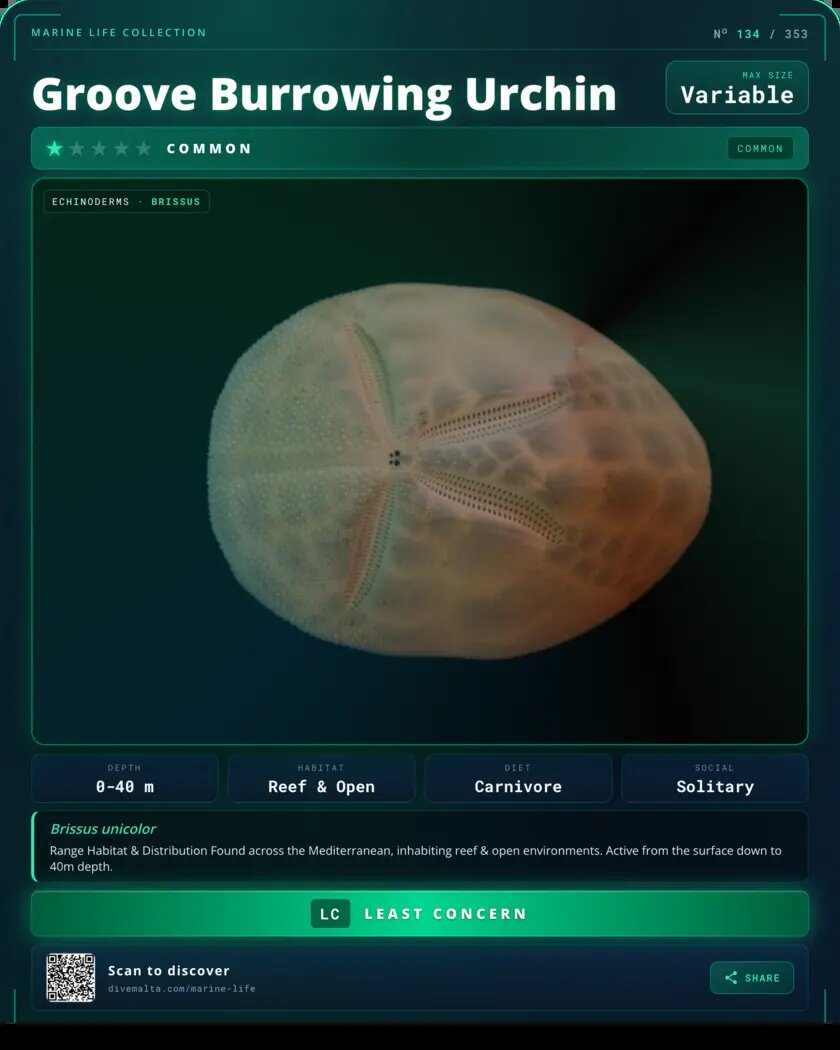
Groove Burrowing Urchin species card

Behaviour & Diet

Behaviour & Defence

Protected by sharp spines that deter predators. Handle with care -- spines can cause injury even after death.

Defensive

Where to Encounter in Malta

The following dive sites offer strong habitat match for Brissus unicolor. All are accessible on a guided dive with diveshack.

5-30m
North Malta

Cirkewwa

Rocky reef with caves, arches and ledges hosting a rich diversity of reef species.

View dive site ›
5-50m
Gozo

Blue Hole

One of the Med's most famous reef dive sites. Rocky walls and archways covered in life.

View dive site ›
18-36m
South Malta

Um El Faroud

The wreck lies on a sandy bottom surrounded by rocky reef -- a diverse habitat attracting reef species.

View dive site ›
IUCN Red List Least Concern

Conservation Status

This species is assessed as Least Concern on the IUCN Red List. Mediterranean populations face ongoing pressure from fishing activity, habitat degradation, and climate-driven changes to prey availability.

Source: iNaturalist Guide #888
by Lesley Clements (CC BY-SA)
diveshack Mediterranean Marine Life guide