Depth
Ophiothrix · Echinoderms (Starfish, Urchins & Brittle Stars)

Common Brittlestar

Ophiothrix fragilis

0-40m
Depth Range
Variable
Max Size
Mediterranean
Distribution
0-40m
Depth Range
Variable
Max Size
Reef & Open
Habitat
Carnivore
Diet
Solitary
Social
LC
IUCN Status
Kingdom Animalia
Phylum Echinodermata
Genus Ophiothrix
Species fragilis

Identification & Biology

  • IdentificationA small, delicate brittle star with a round central disc and five thin, spiny arms that break easily when handled (hence the common name). Colour is highly variable, ranging from grey, brown, and olive to red, orange, and banded patterns.
  • SizeDisc diameter up to 2 cm. Arm span up to 12 cm.
  • Social HabitHighly gregarious. Found in dense aggregations of hundreds or thousands of individuals, often carpeting the surfaces of sponges, rocks, and other organisms. Arms extend into the current to trap food.
  • HabitatRocky reefs, sponges, and any hard surface with good water flow. Often found covering the surfaces of large sponges.
  • Depth0 to 350 m. Common from the shallows to moderate depths.
  • Feeds OnSuspended organic particles and plankton trapped by mucus on the arm spines. A suspension feeder.
  • DistributionEastern Atlantic from Norway to West Africa, and throughout the Mediterranean Sea. Common in Maltese waters.
  • DescriptionOphiothrix fragilis can occur in spectacular densities, sometimes carpeting entire sponge surfaces with a writhing mass of spiny arms. Each arm is held up into the water current, trapping tiny food particles on sticky mucus between the spines. The arms are extremely fragile and break off readily, but they regenerate quickly. The colour variation between individuals is remarkable.

Habitat & Distribution

Found across the Mediterranean, inhabiting reef & open environments. Active from the surface down to 40m depth.

Where Malta divers have spotted this species

Loading…

Sightings are logged by divers using our What Did You See? dive-log tool. View the full live sightings map.

Detail

Preferred Environment

Reef & Open habitats, typically at depths of 0-40m. Most commonly encountered by divers at the shallower end of its range.

Encounter Tips

Best approached slowly and calmly. Avoid casting shadows directly over the animal. Neutral buoyancy and patience increase encounter success significantly.
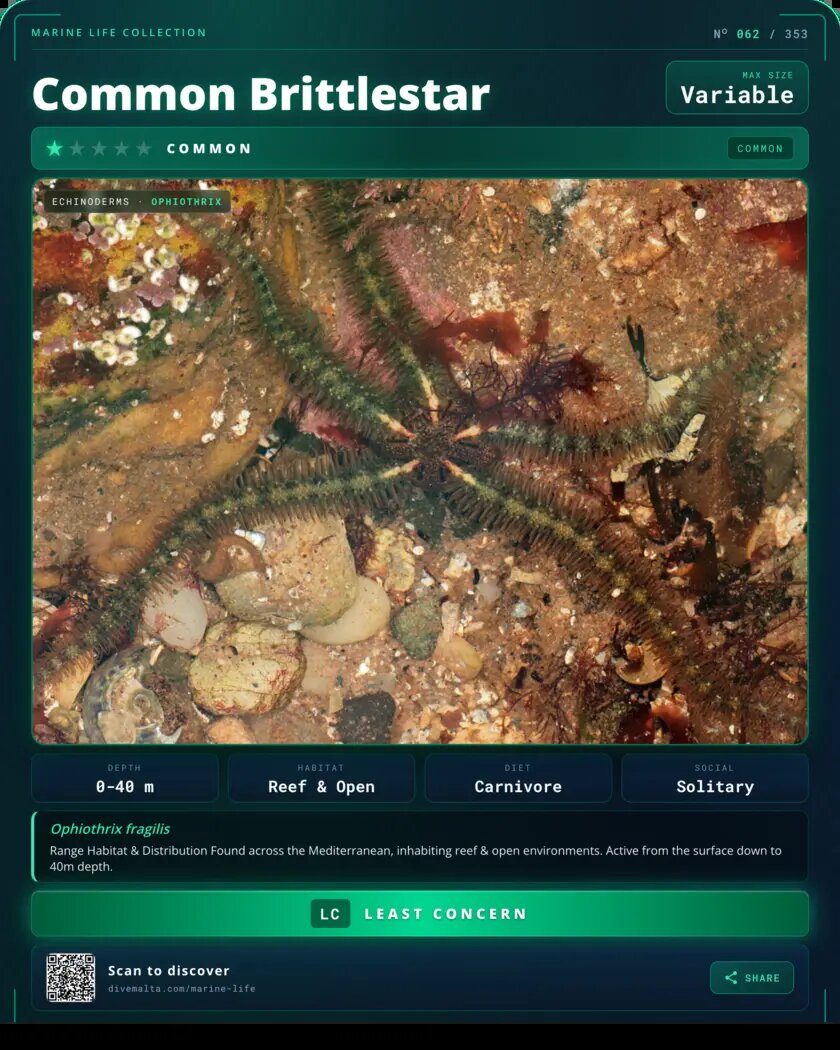
Common Brittlestar species card

Behaviour & Diet

Feeding Strategy

Flexible arms sweep the substrate surface to collect detritus, small organisms, and organic particles. Also suspension feeds by raising arms into the current in areas with moderate flow.

Deposit feeder

Reproduction

Sexes are separate and spawning is synchronised, with gametes released into the water column. Larvae develop as planktonic ophioplutei before settling.

Broadcast spawner

Behaviour & Defence

Autotomises arms readily when seized, leaving the detached limb writhing as a distraction while the animal escapes. Arms regenerate completely within weeks to months.

Autotomy

Where to Encounter in Malta

The following dive sites offer strong habitat match for Ophiothrix fragilis. All are accessible on a guided dive with diveshack.

5-30m
North Malta

Cirkewwa

Rocky reef with caves, arches and ledges hosting a rich diversity of reef species.

View dive site ›
5-50m
Gozo

Blue Hole

One of the Med's most famous reef dive sites. Rocky walls and archways covered in life.

View dive site ›
18-36m
South Malta

Um El Faroud

The wreck lies on a sandy bottom surrounded by rocky reef -- a diverse habitat attracting reef species.

View dive site ›
IUCN Red List Least Concern

Conservation Status

This species is assessed as Least Concern on the IUCN Red List. Mediterranean populations face ongoing pressure from fishing activity, habitat degradation, and climate-driven changes to prey availability.

Source: iNaturalist Guide #888
by Lesley Clements (CC BY-SA)
diveshack Mediterranean Marine Life guide