Depth
Arbacia · Echinoderms (Starfish, Urchins & Brittle Stars)

Black sea urchin

Arbacia lixula

0-30m
Depth Range
Variable
Max Size
Mediterranean
Distribution
0-30m
Depth Range
Variable
Max Size
Rocky Reef
Habitat
Carnivore
Diet
Solitary
Social
LC
IUCN Status
Kingdom Animalia
Phylum Echinodermata
Genus Arbacia
Species lixula

Identification & Biology

  • IdentificationA medium-sized sea urchin with a flattened, dome-shaped test (shell) covered in short, dense, dark purple to black spines. The spines are blunt-tipped and relatively uniform in length. The mouth is on the underside, equipped with a five-toothed feeding apparatus called Aristotle's lantern.
  • SizeTest diameter up to 6 cm (excluding spines). Total diameter with spines up to 10 cm.
  • Social HabitGregarious. Often found in dense aggregations on rocky surfaces, sometimes creating barren zones where all algae have been grazed. Active day and night.
  • HabitatRocky reefs and hard substrates, particularly in shallow, well-lit areas. One of the dominant grazers on Mediterranean rocky reefs.
  • Depth0 to 30 m. Most abundant between 1 and 15 m.
  • Feeds OnCoralline algae, encrusting organisms, and biofilm scraped from rock surfaces. A powerful grazer that can create and maintain urchin barrens.
  • DistributionEastern Atlantic from the Azores to the Mediterranean and West Africa. Very common in Maltese waters.
  • DescriptionArbacia lixula is a dominant grazer on Maltese rocky reefs. In areas where predators such as fish and octopus are scarce, its populations can explode and strip rocks bare of all algal growth, creating grey, barren patches known as urchin barrens. Its ecological impact on Mediterranean reef communities is significant and well studied.

Habitat & Distribution

Found across the Mediterranean, inhabiting rocky reef environments. Active from the surface down to 30m depth.

Where Malta divers have spotted this species

Loading…

Sightings are logged by divers using our What Did You See? dive-log tool. View the full live sightings map.

Detail

Preferred Environment

Rocky Reef habitats, typically at depths of 0-30m. Most commonly encountered by divers at the shallower end of its range.

Encounter Tips

Best approached slowly and calmly. Avoid casting shadows directly over the animal. Neutral buoyancy and patience increase encounter success significantly.
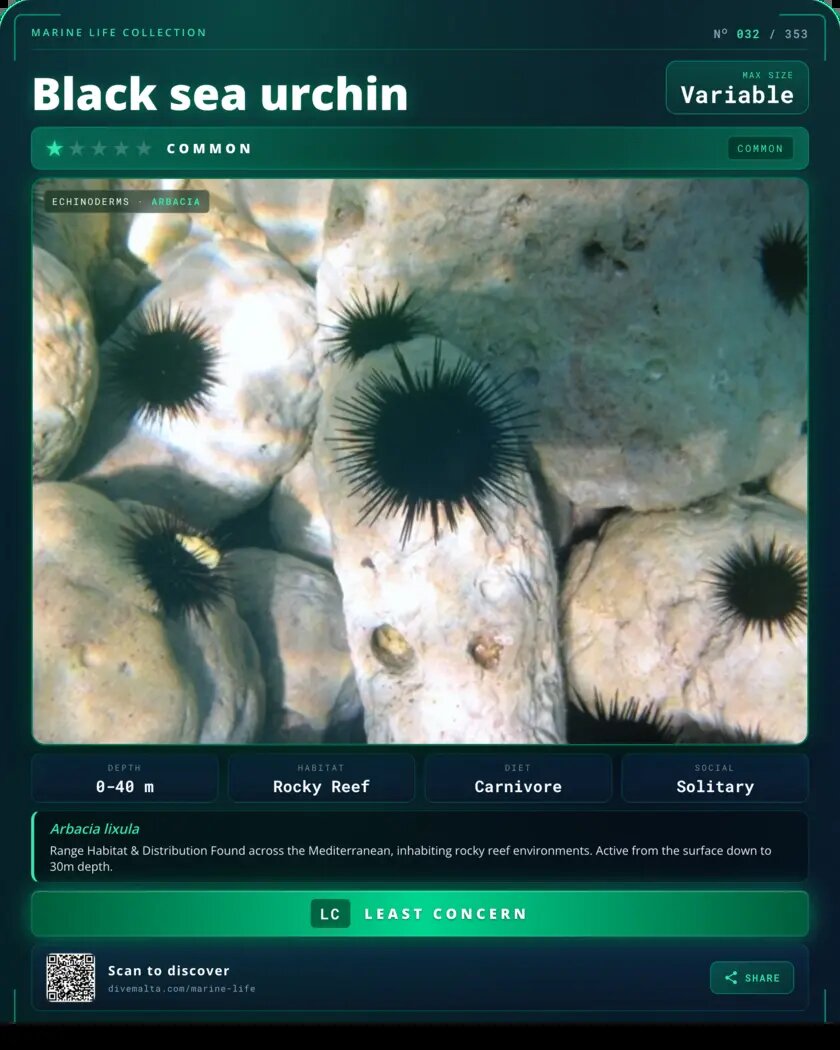
Black sea urchin species card

Behaviour & Diet

Feeding Strategy

Herbivorous grazer that scrapes algae and biofilm from rocky surfaces using its powerful Aristotle's lantern. An important ecological species that helps prevent algal overgrowth on rocky substrates.

Algal grazer

Reproduction

Broadcast spawner with separate sexes, releasing millions of gametes into the water during spring and summer. Fertilisation is external and larvae develop through a planktonic pluteus stage.

Broadcast spawner

Behaviour & Defence

Long, sharp spines inflict painful puncture wounds and deter most predators effectively. Wedges into rock crevices using its spines and tube feet for a firm grip.

Spiny armour

Where to Encounter in Malta

The following dive sites offer strong habitat match for Arbacia lixula. All are accessible on a guided dive with diveshack.

5-30m
North Malta

Cirkewwa

Rocky reef with caves, arches and ledges hosting a rich diversity of reef species.

View dive site ›
5-50m
Gozo

Blue Hole

One of the Med's most famous reef dive sites. Rocky walls and archways covered in life.

View dive site ›
18-36m
South Malta

Um El Faroud

The wreck lies on a sandy bottom surrounded by rocky reef -- a diverse habitat attracting reef species.

View dive site ›
IUCN Red List Least Concern

Conservation Status

This species is assessed as Least Concern on the IUCN Red List. Mediterranean populations face ongoing pressure from fishing activity, habitat degradation, and climate-driven changes to prey availability.

Source: iNaturalist Guide #888
by Lesley Clements (CC BY-SA)
diveshack Mediterranean Marine Life guide