Depth
Astrospartus · Marine Life

Astrospartus Mediterraneus

Astrospartus mediterraneus

0-40m
Depth Range
Variable
Max Size
Mediterranean
Distribution
0-40m
Depth Range
Variable
Max Size
Reef & Open
Habitat
Carnivore
Diet
Solitary
Social
LC
IUCN Status
Kingdom Animalia
Genus Astrospartus
Species mediterraneus

Identification & Biology

  • IdentificationA large, extraordinary-looking brittle star with five main arms that branch repeatedly into hundreds of coiling tendrils, forming a basket-like net. Brown to orange-tan in colour. When feeding, the arms unfurl into the current to trap plankton. When resting, it curls into a tight ball.
  • SizeArm span up to 70 cm when fully extended. One of the most impressive echinoderms in the Mediterranean.
  • Social HabitSolitary. Nocturnal feeder that curls into a compact ball during the day, often wrapped around gorgonian branches or wedged into crevices. Unfurls at night to feed.
  • HabitatRocky reefs, gorgonian sea fans, and areas with good current flow. Typically found perched on elevated positions to maximise plankton capture.
  • Depth15 to 800 m. Most commonly encountered by divers between 25 and 60 m.
  • Feeds OnZooplankton and small organic particles trapped in its branching arm net. A passive suspension feeder.
  • DistributionMediterranean Sea and eastern Atlantic. Present in Maltese waters, mainly on deeper rocky reefs.
  • DescriptionAstrospartus mediterraneus is one of the most spectacular invertebrates a diver can encounter in Malta. By day it is easily missed, tightly curled into a fist-sized ball on a gorgonian branch. By night it transforms, spreading its hundreds of branching tendrils into the current like a living fishing net. Finding one unfurled is a memorable night-diving experience.

Habitat & Distribution

Found across the Mediterranean, inhabiting reef & open environments. Active from the surface down to 40m depth.

Where Malta divers have spotted this species

Loading…

Sightings are logged by divers using our What Did You See? dive-log tool. View the full live sightings map.

Detail

Preferred Environment

Reef & Open habitats, typically at depths of 0-40m. Most commonly encountered by divers at the shallower end of its range.

Encounter Tips

Best approached slowly and calmly. Avoid casting shadows directly over the animal. Neutral buoyancy and patience increase encounter success significantly.
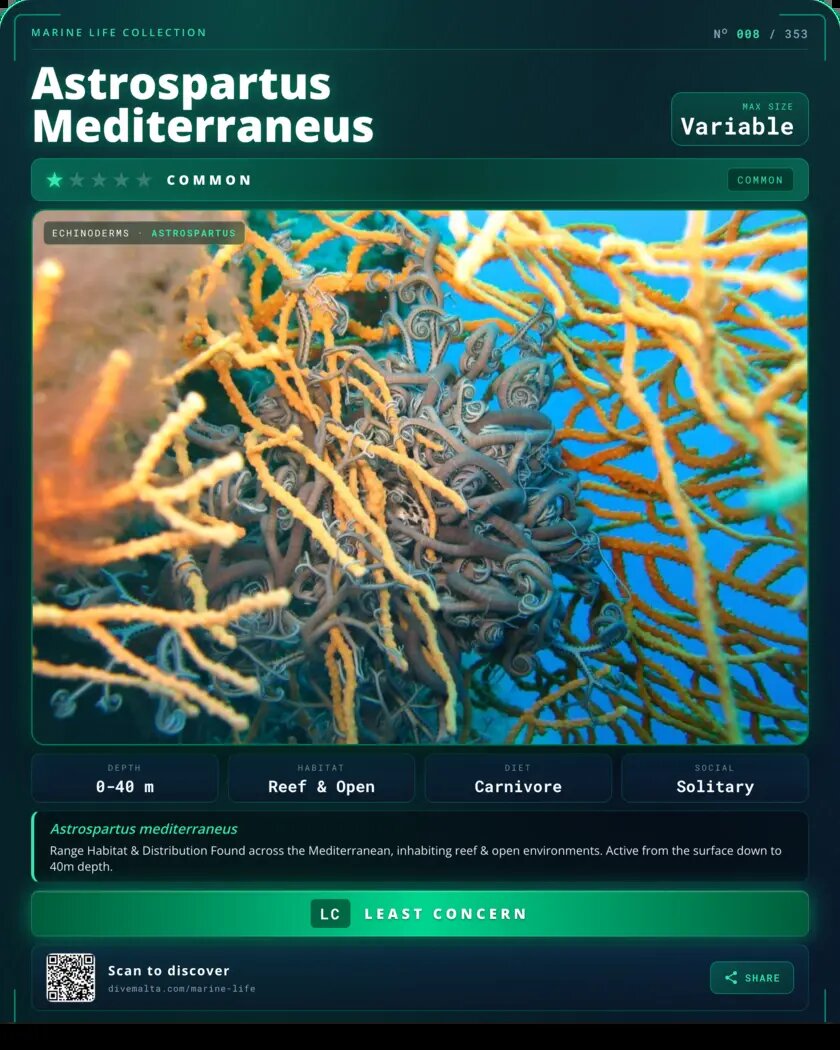
Astrospartus Mediterraneus species card

Behaviour & Diet

Feeding Strategy

Nocturnal suspension feeder that unfurls its branching arms into the current to trap plankton and fine organic particles. Arms curl inward to transfer captured food to the central mouth.

Suspension feeder

Reproduction

Sexes are separate, with gametes released into the water column for external fertilisation. Larvae undergo a planktonic phase before settling on suitable hard substrates.

Broadcast spawner

Behaviour & Defence

Coils its branching arms into a tight ball when disturbed, making it difficult for predators to grasp. Its deep habitat on vertical walls and overhangs provides additional protection from casual predators.

Arm coiling

Where to Encounter in Malta

The following dive sites offer strong habitat match for Astrospartus mediterraneus. All are accessible on a guided dive with diveshack.

5-30m
North Malta

Cirkewwa

Rocky reef with caves, arches and ledges hosting a rich diversity of reef species.

View dive site ›
5-50m
Gozo

Blue Hole

One of the Med's most famous reef dive sites. Rocky walls and archways covered in life.

View dive site ›
18-36m
South Malta

Um El Faroud

The wreck lies on a sandy bottom surrounded by rocky reef -- a diverse habitat attracting reef species.

View dive site ›
IUCN Red List Least Concern

Conservation Status

This species is assessed as Least Concern on the IUCN Red List. Mediterranean populations face ongoing pressure from fishing activity, habitat degradation, and climate-driven changes to prey availability.

Source: iNaturalist Guide #888
by Lesley Clements (CC BY-SA)
diveshack Mediterranean Marine Life guide