Depth
Gnathophyllum · Crustaceans (Crabs, Shrimps & Lobsters)

Spotted Bumblebee Shrimp

Gnathophyllum elegans

0-40m
Depth Range
Variable
Max Size
Mediterranean
Distribution
0-40m
Depth Range
Variable
Max Size
Reef & Open
Habitat
Carnivore
Diet
Solitary
Social
LC
IUCN Status
Kingdom Animalia
Phylum Arthropoda
Class Malacostraca
Genus Gnathophyllum
Species elegans

Identification & Biology

  • IdentificationA tiny, strikingly patterned shrimp with a yellow body covered in dark brown to black spots, giving it a bumblebee-like appearance. The legs and claws are banded yellow and dark brown. One of the smallest and most beautiful shrimp in the Mediterranean.
  • SizeBody length up to 2.5 cm. One of the smallest decapod crustaceans in the region.
  • Social HabitSolitary or in pairs. Found in close association with sea urchins, feeding on their tube feet. Very shy and difficult to observe without patience.
  • HabitatRocky reefs and anywhere sea urchins are present. Lives among the spines of sea urchins, particularly Diadema and Arbacia species.
  • Depth1 to 30 m. Most commonly found in the shallows where urchin populations are densest.
  • Feeds OnTube feet, pedicellariae, and other soft tissue of sea urchins. One of the few animals that specialise in eating urchin appendages.
  • DistributionMediterranean Sea and adjacent eastern Atlantic. Present in Maltese waters wherever sea urchins are abundant.
  • DescriptionGnathophyllum elegans is a jewel of the Mediterranean macro world. Its bold yellow-and-black pattern warns predators that it shelters among the venomous spines of sea urchins. Despite its tiny size, it is a specialised predator of urchin tube feet, nipping off these soft appendages without triggering the urchin's defensive responses. A prized find for underwater photographers.

Habitat & Distribution

Found across the Mediterranean, inhabiting reef & open environments. Active from the surface down to 40m depth.

Where Malta divers have spotted this species

Loading…

Sightings are logged by divers using our What Did You See? dive-log tool. View the full live sightings map.

Detail

Preferred Environment

Reef & Open habitats, typically at depths of 0-40m. Most commonly encountered by divers at the shallower end of its range.

Encounter Tips

Best approached slowly and calmly. Avoid casting shadows directly over the animal. Neutral buoyancy and patience increase encounter success significantly.
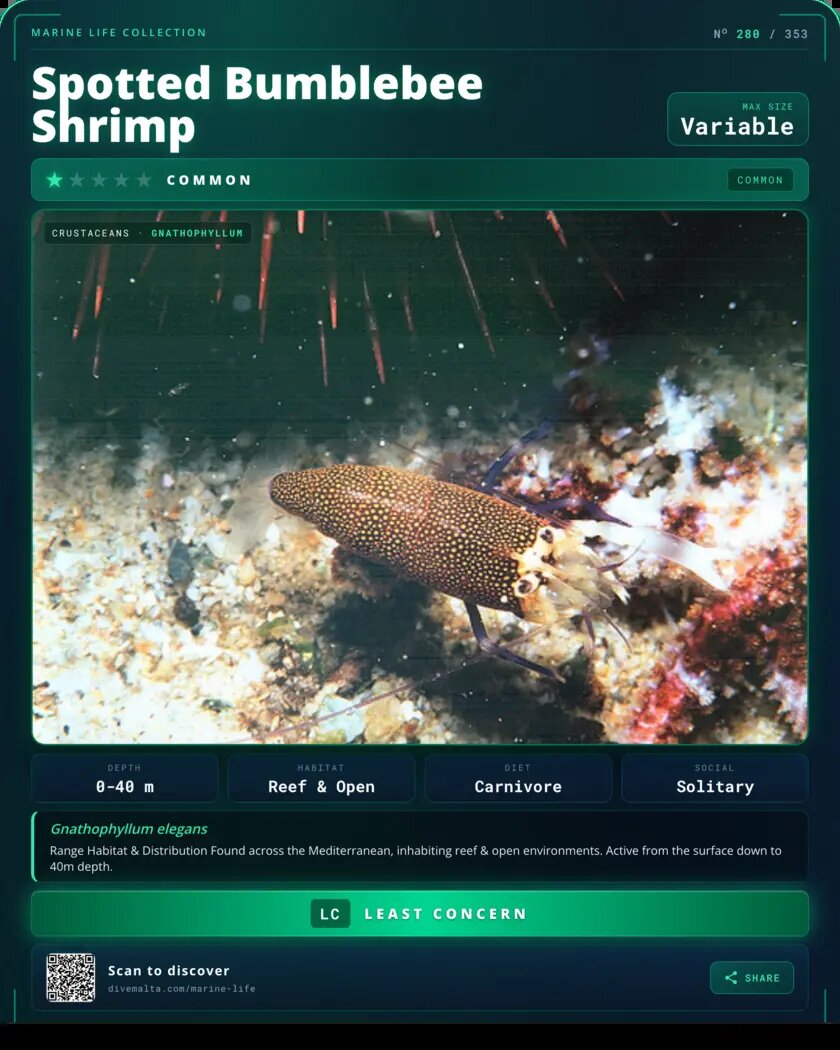
Spotted Bumblebee Shrimp species card

Behaviour & Diet

Feeding Strategy

Specialised micro-predator that feeds on the tube feet of echinoderms, particularly sea urchins and starfish. Uses its small chelipeds to snip individual tube feet.

Echinoderm parasite

Reproduction

Females carry small egg clutches beneath the abdomen. Breeding details remain poorly documented due to the species' cryptic habits.

Egg carrier

Behaviour & Defence

Its tiny size, typically under 2 cm, and striking banded pattern help it avoid detection among the spines of its sea urchin hosts. Remains closely associated with echinoderms for shelter.

Commensal hiding

Where to Encounter in Malta

The following dive sites offer strong habitat match for Gnathophyllum elegans. All are accessible on a guided dive with diveshack.

5-30m
North Malta

Cirkewwa

Rocky reef with caves, arches and ledges hosting a rich diversity of reef species.

View dive site ›
5-50m
Gozo

Blue Hole

One of the Med's most famous reef dive sites. Rocky walls and archways covered in life.

View dive site ›
18-36m
South Malta

Um El Faroud

The wreck lies on a sandy bottom surrounded by rocky reef -- a diverse habitat attracting reef species.

View dive site ›
IUCN Red List Least Concern

Conservation Status

This species is assessed as Least Concern on the IUCN Red List. Mediterranean populations face ongoing pressure from fishing activity, habitat degradation, and climate-driven changes to prey availability.

Source: iNaturalist Guide #888
by Lesley Clements (CC BY-SA)
diveshack Mediterranean Marine Life guide