Depth
Calappa · Marine Life

Shamefaced Crab

Calappa granulata

15-20m
Depth Range
Variable
Max Size
C. granulata vit s
Distribution
15-20m
Depth Range
Variable
Max Size
Rocky Reef
Habitat
Carnivore
Diet
Solitary
Social
LC
IUCN Status
Kingdom Animalia
Genus Calappa
Species granulata

Identification & Biology

  • IdentificationA distinctive round-bodied crab with a smooth, domed carapace and enormous flattened claws that it holds in front of its face like a shield, giving it its common name. Pale pink to cream with reddish-brown patches. The claws are much larger than the body.
  • SizeCarapace width up to 11 cm. The claws add significantly to the overall width.
  • Social HabitSolitary and nocturnal. Buries itself almost completely in sand during the day, with only the eyes and antennae visible. Emerges at night to feed.
  • HabitatSandy and muddy bottoms, sometimes near the base of rocky reefs. Requires soft substrate for burying.
  • Depth5 to 400 m. Most common between 10 and 100 m.
  • Feeds OnSea urchins, gastropod snails, bivalves, and hermit crabs. Uses its powerful claws to crack open hard-shelled prey.
  • DistributionEastern Atlantic from Portugal to Angola, and throughout the Mediterranean Sea. Present in Maltese waters on suitable sandy substrates.
  • DescriptionCalappa granulata is one of the more unusual crabs in the Mediterranean, easily recognised by its habit of holding its oversized claws flat against its face. This posture protects the vulnerable mouthparts and gives the animal a box-like profile. Finding one during the day requires sharp eyes, as they bury almost completely in sand with only a faint outline visible. Night dives reveal them roaming the sandy plains.

Habitat & Distribution

Found across C. granulata vit sur les fonds meubles sablo-vaseux et détritiques du plateau continental, jusqu’à 400 mètres de profondeur. Il est possible de l'observer exceptionnellement en plongée à partir de 15-20 mètres en exploration nocturne. Le jour, il reste enfoui dans le substrat et reste inactif. Cette espèce est présente en Atlantique Est, des côtes mauritaniennes au sud jusqu’au Portug

Where Malta divers have spotted this species

Loading…

Sightings are logged by divers using our What Did You See? dive-log tool. View the full live sightings map.

Detail

Preferred Environment

Rocky Reef habitats, typically at depths of 15-20m. Most commonly encountered by divers at the shallower end of its range.

Encounter Tips

Best approached slowly and calmly. Avoid casting shadows directly over the animal. Neutral buoyancy and patience increase encounter success significantly.
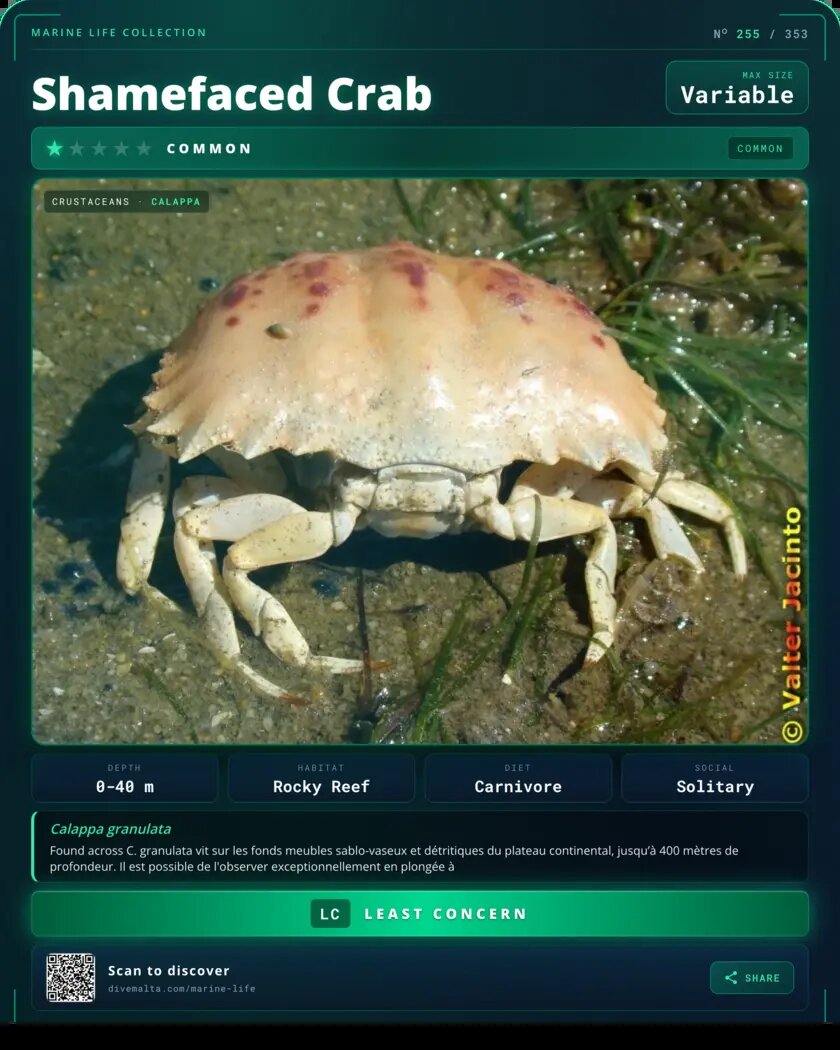
Shamefaced Crab species card

Behaviour & Diet

Feeding Strategy

Predator of molluscs, particularly bivalves and gastropods, which it cracks open with its powerful chelipeds. Forages at night on sandy and muddy substrates.

Mollusc crusher

Reproduction

Females carry egg masses beneath the abdomen during spring and early summer. Larvae are released into the water column for planktonic development.

Seasonal spawning

Behaviour & Defence

Buries itself in sandy sediment during the day, leaving only its eyes exposed. Its flattened chelipeds fold tightly against the face, forming a shield-like barrier.

Burrowing

Where to Encounter in Malta

The following dive sites offer strong habitat match for Calappa granulata. All are accessible on a guided dive with diveshack.

5-30m
North Malta

Cirkewwa

Rocky reef with caves, arches and ledges hosting a rich diversity of reef species.

View dive site ›
5-50m
Gozo

Blue Hole

One of the Med's most famous reef dive sites. Rocky walls and archways covered in life.

View dive site ›
18-36m
South Malta

Um El Faroud

The wreck lies on a sandy bottom surrounded by rocky reef -- a diverse habitat attracting reef species.

View dive site ›
IUCN Red List Least Concern

Conservation Status

This species is assessed as Least Concern on the IUCN Red List. Mediterranean populations face ongoing pressure from fishing activity, habitat degradation, and climate-driven changes to prey availability.

Source: iNaturalist Guide #888
by Lesley Clements (CC BY-SA)
diveshack Mediterranean Marine Life guide