Depth
Chthamalus · Crustaceans (Crabs, Shrimps & Lobsters)

Poli's Stellate Barnacle

Chthamalus stellatus

0-40m
Depth Range
Variable
Max Size
Mediterranean
Distribution
0-40m
Depth Range
Variable
Max Size
Rocky Reef
Habitat
Carnivore
Diet
Solitary
Social
LC
IUCN Status
Kingdom Animalia
Phylum Arthropoda
Class Malacostraca
Genus Chthamalus
Species stellatus

Identification & Biology

  • IdentificationA small, conical barnacle with a star-shaped opening at the top formed by overlapping shell plates. Greyish-white to brown. Forms dense colonies on wave-exposed rock surfaces. Each individual is encased in a ring of six calcareous plates.
  • SizeShell diameter up to 1 cm. Forms colonies covering large areas of rock.
  • Social HabitColonial. Settles in dense aggregations on intertidal rock, competing for space with other barnacles and algae. Filter feeds by extending feathery appendages (cirri) into the water.
  • HabitatIntertidal and upper subtidal zones on exposed rocky shores. One of the dominant organisms of the Mediterranean splash zone.
  • DepthIntertidal to 1 m. Occupies the upper shore, above most other sessile invertebrates.
  • Feeds OnPlankton and suspended organic particles filtered from the water using feathery leg-like appendages called cirri.
  • DistributionEastern Atlantic from the British Isles to West Africa, and throughout the Mediterranean Sea. Abundant on all Maltese rocky shores.
  • DescriptionChthamalus stellatus is one of the most abundant and overlooked animals on Maltese rocky shores. The white crusts visible on wave-splashed rocks are dense colonies of this barnacle. Despite appearances, barnacles are crustaceans related to crabs and shrimp. They cement themselves permanently to rock as juveniles and spend their entire adult lives filter feeding from within their protective shell.

Habitat & Distribution

Found across the Mediterranean, inhabiting rocky reef environments. Active from the surface down to 40m depth.

Where Malta divers have spotted this species

Loading…

Sightings are logged by divers using our What Did You See? dive-log tool. View the full live sightings map.

Detail

Preferred Environment

Rocky Reef habitats, typically at depths of 0-40m. Most commonly encountered by divers at the shallower end of its range.

Encounter Tips

Best approached slowly and calmly. Avoid casting shadows directly over the animal. Neutral buoyancy and patience increase encounter success significantly.
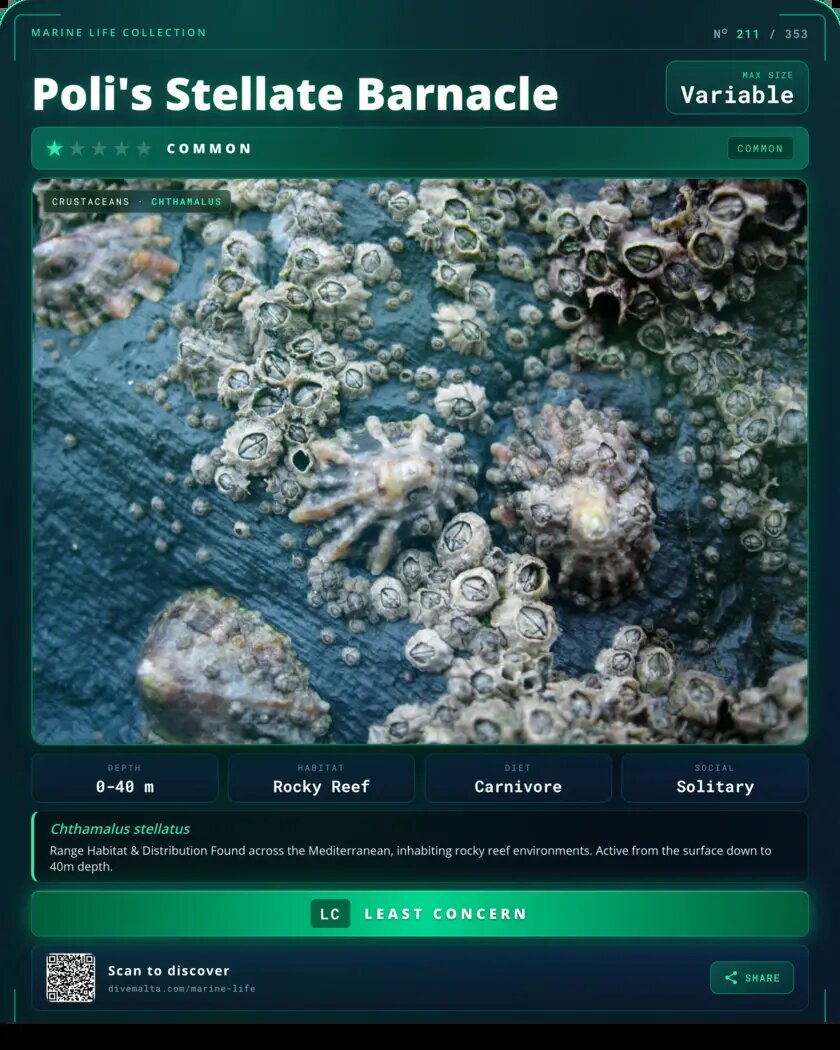
Poli's Stellate Barnacle species card

Behaviour & Diet

Feeding Strategy

Suspension feeder that extends feathery cirri from its shell to capture plankton and fine organic particles from the water column. Feeding activity increases with water flow.

Filter feeder

Reproduction

A simultaneous hermaphrodite that cross-fertilises with neighbours using one of the longest penises relative to body size in the animal kingdom. Fertilised eggs are brooded inside the shell before nauplius larvae are released.

Brooding hermaphrodite

Behaviour & Defence

Enclosed within hard, star-shaped calcareous plates that resist desiccation and physical damage. Closes its opercular plates tightly when exposed to air or disturbed.

Hard shell

Where to Encounter in Malta

The following dive sites offer strong habitat match for Chthamalus stellatus. All are accessible on a guided dive with diveshack.

5-30m
North Malta

Cirkewwa

Rocky reef with caves, arches and ledges hosting a rich diversity of reef species.

View dive site ›
5-50m
Gozo

Blue Hole

One of the Med's most famous reef dive sites. Rocky walls and archways covered in life.

View dive site ›
18-36m
South Malta

Um El Faroud

The wreck lies on a sandy bottom surrounded by rocky reef -- a diverse habitat attracting reef species.

View dive site ›
IUCN Red List Least Concern

Conservation Status

This species is assessed as Least Concern on the IUCN Red List. Mediterranean populations face ongoing pressure from fishing activity, habitat degradation, and climate-driven changes to prey availability.

Source: iNaturalist Guide #888
by Lesley Clements (CC BY-SA)
diveshack Mediterranean Marine Life guide