Depth
Homarus · Crustaceans (Crabs, Shrimps & Lobsters)

European lobster

Homarus gammarus

0-40m
Depth Range
Variable
Max Size
Mediterranean
Distribution
0-40m
Depth Range
Variable
Max Size
Reef & Open
Habitat
Carnivore
Diet
Solitary
Social
LC
IUCN Status
Kingdom Animalia
Phylum Arthropoda
Class Malacostraca
Genus Homarus
Species gammarus

Identification & Biology

  • IdentificationA large, powerfully built lobster with a dark blue to navy body, two massive front claws of unequal size (one for crushing, one for cutting), and long red antennae. The carapace is smooth and rounded. Colour changes to bright orange-red when cooked.
  • SizeBody length up to 60 cm. Weight up to 6 kg, though most are smaller. Claws can account for a large portion of body weight.
  • Social HabitSolitary and territorial. Lives in a burrow or crevice and defends it aggressively. Mainly nocturnal, emerging to hunt at night.
  • HabitatRocky reefs, boulder fields, and any hard substrate with crevices and holes for shelter. Avoids open sandy areas.
  • Depth0 to 150 m. Most common between 5 and 50 m.
  • Feeds OnCrabs, mussels, sea urchins, starfish, worms, and small fish. Uses the larger crushing claw to break open hard-shelled prey.
  • DistributionEastern Atlantic from northern Norway to Morocco, and throughout the Mediterranean Sea. Present but uncommon in Maltese waters due to fishing pressure.
  • DescriptionHomarus gammarus is the largest crustacean in the Mediterranean and one of the most sought-after by fishers. A single large individual can live for over 50 years. In Malta, it is encountered occasionally on night dives in rocky areas with good crevice habitat. Populations have declined across much of Europe due to overfishing, though the species is not yet formally listed as threatened.

Habitat & Distribution

Found across the Mediterranean, inhabiting reef & open environments. Active from the surface down to 40m depth.

Where Malta divers have spotted this species

Loading…

Sightings are logged by divers using our What Did You See? dive-log tool. View the full live sightings map.

Detail

Preferred Environment

Reef & Open habitats, typically at depths of 0-40m. Most commonly encountered by divers at the shallower end of its range.

Encounter Tips

Best approached slowly and calmly. Avoid casting shadows directly over the animal. Neutral buoyancy and patience increase encounter success significantly.
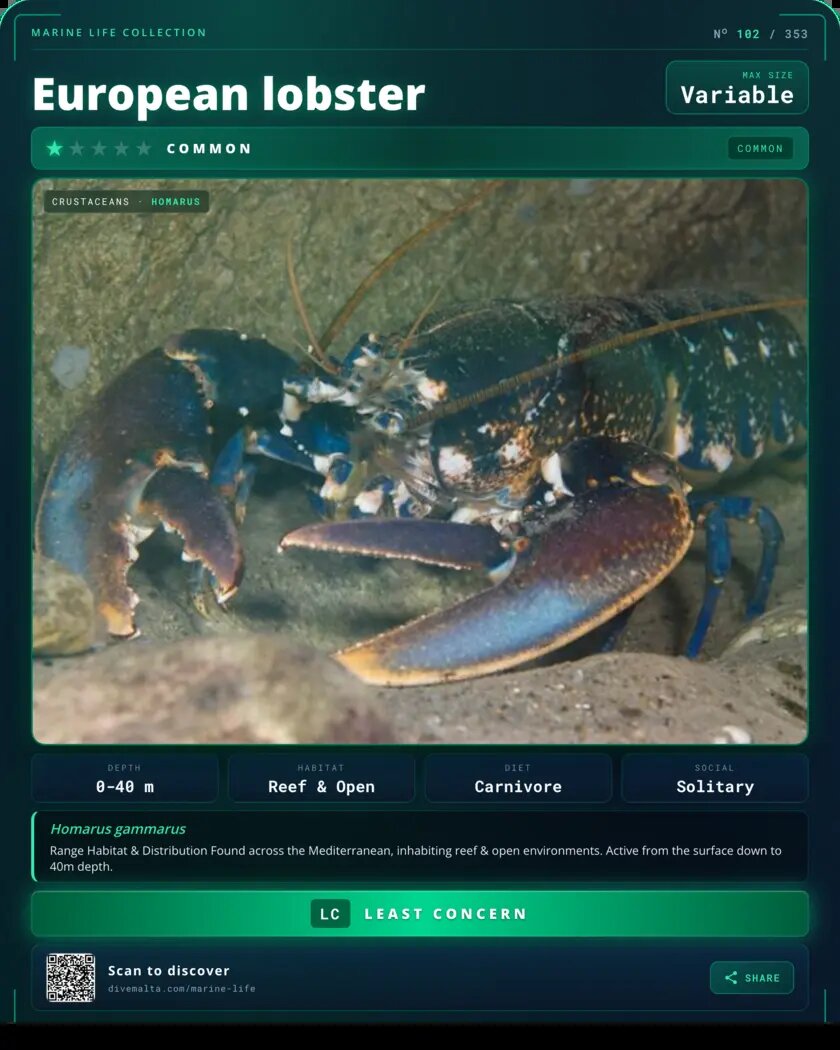
European lobster species card

Behaviour & Diet

Feeding Strategy

Nocturnal predator that hunts crabs, molluscs, starfish, and polychaete worms. It uses its larger crusher claw to break open hard-shelled prey and its slender cutter claw to tear flesh.

Nocturnal predator

Reproduction

Females carry thousands of fertilised eggs glued to their pleopods for up to 12 months before hatching. Larvae pass through several planktonic stages before settling on the seabed.

Egg carrier

Behaviour & Defence

Possesses powerful claws capable of delivering a crushing bite to deter predators. It retreats into rocky crevices and can autotomise a trapped limb, regenerating it over successive moults.

Crushing claws

Where to Encounter in Malta

The following dive sites offer strong habitat match for Homarus gammarus. All are accessible on a guided dive with diveshack.

5-30m
North Malta

Cirkewwa

Rocky reef with caves, arches and ledges hosting a rich diversity of reef species.

View dive site ›
5-50m
Gozo

Blue Hole

One of the Med's most famous reef dive sites. Rocky walls and archways covered in life.

View dive site ›
18-36m
South Malta

Um El Faroud

The wreck lies on a sandy bottom surrounded by rocky reef -- a diverse habitat attracting reef species.

View dive site ›
IUCN Red List Least Concern

Conservation Status

This species is assessed as Least Concern on the IUCN Red List. Mediterranean populations face ongoing pressure from fishing activity, habitat degradation, and climate-driven changes to prey availability.

Source: iNaturalist Guide #888
by Lesley Clements (CC BY-SA)
diveshack Mediterranean Marine Life guide