Depth
Paramuricea · Cnidarians (Jellyfish, Anemones & Corals)

Violescent Sea-whip

Paramuricea clavata

0-40m
Depth Range
Variable
Max Size
Mediterranean
Distribution
0-40m
Depth Range
Variable
Max Size
Reef & Open
Habitat
Carnivore
Diet
Solitary
Social
LC
IUCN Status
Kingdom Animalia
Phylum Cnidaria
Genus Paramuricea
Species clavata

Identification & Biology

  • IdentificationA large, tree-like gorgonian with stout, rigid branches arranged in a flat, fan-shaped plane. The living tissue is deep red to violet-purple, with tiny white polyps covering the branches. The skeleton is tough and flexible.
  • SizeColony height up to 1.5 m. Fan width up to 1 m. One of the largest gorgonians in the Mediterranean.
  • Social HabitColonial. Grows oriented perpendicular to the prevailing current. Very slow-growing, with large colonies potentially over a century old.
  • HabitatRocky walls, overhangs, and current-swept slopes. Requires hard substrate and strong water flow.
  • Depth15 to 200 m. Most common between 25 and 80 m.
  • Feeds OnPlankton and suspended organic particles captured by the polyps.
  • DistributionMediterranean Sea. An endemic Mediterranean species. Present in Maltese waters on deeper rocky walls.
  • DescriptionParamuricea clavata is the most impressive gorgonian sea fan in the Mediterranean. Large, old colonies on deep walls are among the most striking sights a diver can encounter. The species has suffered mass mortality events linked to marine heatwaves, with die-offs recorded during the hot summers of 1999, 2003, and subsequent years. It is now considered an indicator of climate change impacts on Mediterranean marine life.

Habitat & Distribution

Found across the Mediterranean, inhabiting reef & open environments. Active from the surface down to 40m depth.

Where Malta divers have spotted this species

Loading…

Sightings are logged by divers using our What Did You See? dive-log tool. View the full live sightings map.

Detail

Preferred Environment

Reef & Open habitats, typically at depths of 0-40m. Most commonly encountered by divers at the shallower end of its range.

Encounter Tips

Best approached slowly and calmly. Avoid casting shadows directly over the animal. Neutral buoyancy and patience increase encounter success significantly.
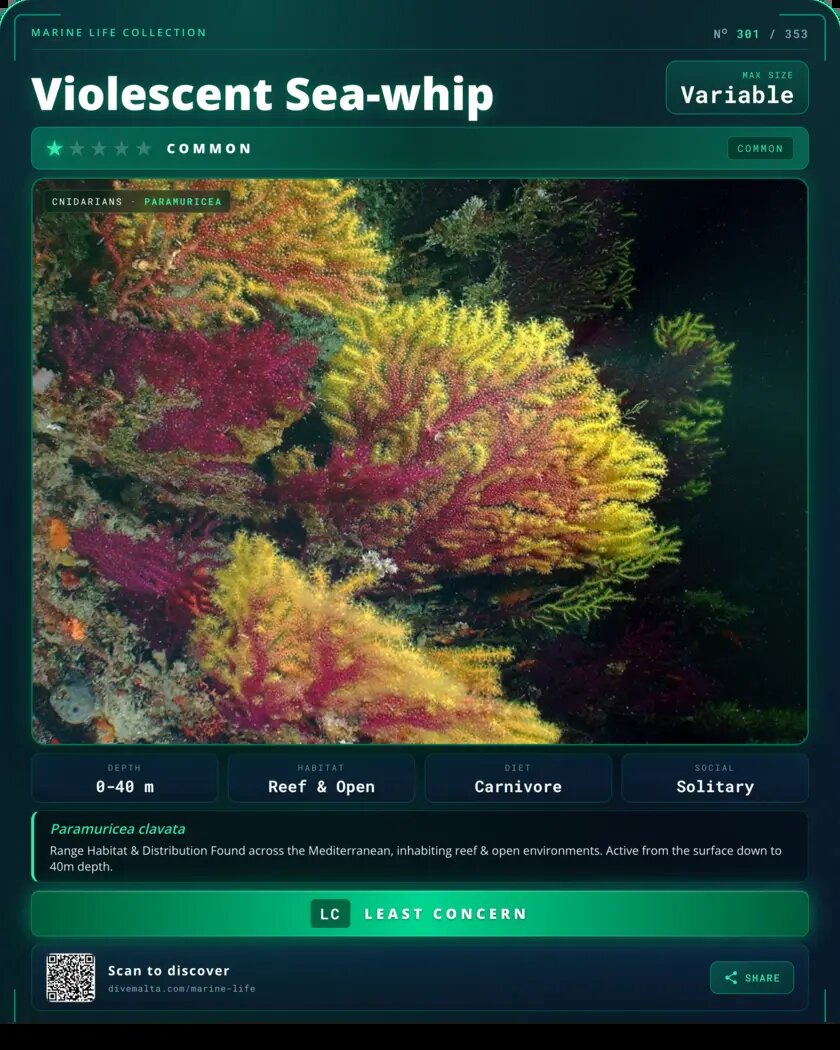
Violescent Sea-whip species card

Behaviour & Diet

Feeding Strategy

Polyps extend into the current to capture zooplankton and fine suspended particles. Colonies orient perpendicular to the prevailing water flow for maximum food interception.

Suspension feeder

Reproduction

A gonochoric species with separate male and female colonies. Fertilisation is internal, and planula larvae are released in late summer after a brooding period.

Internal brooding

Behaviour & Defence

The flexible, horny skeleton (gorgonin) bends with surge and current rather than snapping. Contains secondary metabolites that discourage predation and biofouling.

Flexible skeleton

Where to Encounter in Malta

The following dive sites offer strong habitat match for Paramuricea clavata. All are accessible on a guided dive with diveshack.

5-30m
North Malta

Cirkewwa

Rocky reef with caves, arches and ledges hosting a rich diversity of reef species.

View dive site ›
5-50m
Gozo

Blue Hole

One of the Med's most famous reef dive sites. Rocky walls and archways covered in life.

View dive site ›
18-36m
South Malta

Um El Faroud

The wreck lies on a sandy bottom surrounded by rocky reef -- a diverse habitat attracting reef species.

View dive site ›
IUCN Red List Least Concern

Conservation Status

This species is assessed as Least Concern on the IUCN Red List. Mediterranean populations face ongoing pressure from fishing activity, habitat degradation, and climate-driven changes to prey availability.

Source: iNaturalist Guide #888
by Lesley Clements (CC BY-SA)
diveshack Mediterranean Marine Life guide