Depth
Pelagia · Cnidarians (Jellyfish, Anemones & Corals)

Portuguese man o'war

Pelagia noctiluca

0-40m
Depth Range
Variable
Max Size
Mediterranean
Distribution
0-40m
Depth Range
Variable
Max Size
Reef & Open
Habitat
Carnivore
Diet
Solitary
Social
LC
IUCN Status
Kingdom Animalia
Phylum Cnidaria
Genus Pelagia
Species noctiluca

Identification & Biology

  • IdentificationA small, free-swimming jellyfish with a mushroom-shaped, translucent bell that pulses to propel it through the water. The bell is spotted with pink to mauve-purple bioluminescent spots. Long, thin stinging tentacles trail behind.
  • SizeBell diameter up to 12 cm. Tentacles can trail up to 2 m.
  • Social HabitCan be solitary or in massive swarms numbering millions. One of the most common stinging jellyfish in the Mediterranean. Bioluminescent, producing flashes of light at night.
  • HabitatOpen water (pelagic). Approaches coastlines seasonally, sometimes in enormous numbers. Often concentrated by currents and wind.
  • Depth0 to 300 m. Found throughout the water column, migrating vertically.
  • Feeds OnSmall fish, fish eggs, crustaceans, and other plankton caught on its stinging tentacles.
  • DistributionWorldwide in warm and temperate oceans. Very common in the Mediterranean, including Maltese waters.
  • DescriptionPelagia noctiluca (the mauve stinger) is the most common stinging jellyfish in Maltese waters and the species responsible for most jellyfish stings reported by swimmers. It can form enormous blooms that close beaches during summer months. The sting causes a burning sensation and a red rash that can last several days. It is bioluminescent, producing a beautiful mauve glow when disturbed in the water at night.

Habitat & Distribution

Found across the Mediterranean, inhabiting reef & open environments. Active from the surface down to 40m depth.

Where Malta divers have spotted this species

Loading…

Sightings are logged by divers using our What Did You See? dive-log tool. View the full live sightings map.

Detail

Preferred Environment

Reef & Open habitats, typically at depths of 0-40m. Most commonly encountered by divers at the shallower end of its range.

Encounter Tips

Best approached slowly and calmly. Avoid casting shadows directly over the animal. Neutral buoyancy and patience increase encounter success significantly.
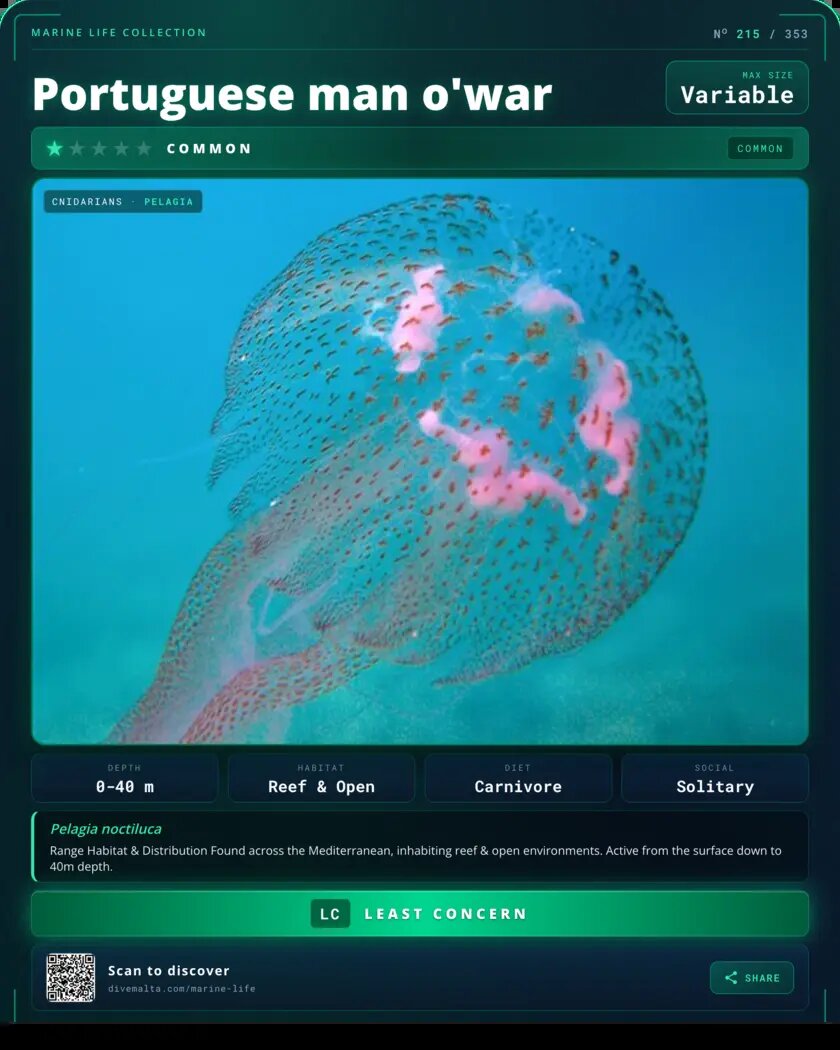
Portuguese man o'war species card

Behaviour & Diet

Feeding Strategy

Trails tentacles up to 10 m below the surface to capture fish, crustaceans and other plankton with powerful nematocysts. Venom immobilises prey, which is digested by specialised gastrozooids.

Venomous predator

Reproduction

A colonial siphonophore that reproduces asexually by budding to grow the colony. Gonozooids within the colony release eggs and sperm for sexual reproduction.

Budding

Behaviour & Defence

Possesses one of the most potent stings of any cnidarian, capable of causing severe pain and systemic symptoms in humans. The gas-filled pneumatophore keeps the colony at the surface, using wind for evasive drift.

Potent venom

Where to Encounter in Malta

The following dive sites offer strong habitat match for Pelagia noctiluca. All are accessible on a guided dive with diveshack.

5-30m
North Malta

Cirkewwa

Rocky reef with caves, arches and ledges hosting a rich diversity of reef species.

View dive site ›
5-50m
Gozo

Blue Hole

One of the Med's most famous reef dive sites. Rocky walls and archways covered in life.

View dive site ›
18-36m
South Malta

Um El Faroud

The wreck lies on a sandy bottom surrounded by rocky reef -- a diverse habitat attracting reef species.

View dive site ›
IUCN Red List Least Concern

Conservation Status

This species is assessed as Least Concern on the IUCN Red List. Mediterranean populations face ongoing pressure from fishing activity, habitat degradation, and climate-driven changes to prey availability.

Source: iNaturalist Guide #888
by Lesley Clements (CC BY-SA)
diveshack Mediterranean Marine Life guide