Depth
Balanophyllia · Cnidarians (Jellyfish, Anemones & Corals)

Pig-tooth Coral

Balanophyllia europaea

0-40m
Depth Range
Variable
Max Size
Mediterranean
Distribution
0-40m
Depth Range
Variable
Max Size
Reef & Open
Habitat
Carnivore
Diet
Solitary
Social
LC
IUCN Status
Kingdom Animalia
Phylum Cnidaria
Genus Balanophyllia
Species europaea

Identification & Biology

  • IdentificationA small, solitary stony coral with an oval, calcareous skeleton and a fleshy, translucent polyp that expands to form a raised dome when feeding. The skeleton is smooth and brownish. The expanded polyp is green to golden-brown.
  • SizeSkeleton diameter up to 1.5 cm. Height up to 1 cm. A very small species.
  • Social HabitSolitary but often found in dense groups on suitable rock surfaces. One of the few reef-building corals that occur in the Mediterranean.
  • HabitatShallow, sunlit rocky surfaces. Requires light for the symbiotic algae (zooxanthellae) living in its tissues.
  • Depth0 to 50 m. Most common between 1 and 20 m in well-lit positions.
  • Feeds OnPlankton captured by tentacles, plus sugars produced by symbiotic zooxanthellae algae living within its tissues (photosynthesis).
  • DistributionMediterranean Sea. An endemic Mediterranean species. Present in Maltese waters.
  • DescriptionBalanophyllia europaea is a tiny but significant species as one of the few zooxanthellate (algae-hosting) corals native to the Mediterranean. Each polyp contains symbiotic algae that produce food through photosynthesis, just like tropical reef corals. While it does not build reefs, it is an important indicator of water temperature, and researchers are studying it to understand how Mediterranean marine life may respond to warming seas.

Habitat & Distribution

Found across the Mediterranean, inhabiting reef & open environments. Active from the surface down to 40m depth.

Where Malta divers have spotted this species

Loading…

Sightings are logged by divers using our What Did You See? dive-log tool. View the full live sightings map.

Detail

Preferred Environment

Reef & Open habitats, typically at depths of 0-40m. Most commonly encountered by divers at the shallower end of its range.

Encounter Tips

Best approached slowly and calmly. Avoid casting shadows directly over the animal. Neutral buoyancy and patience increase encounter success significantly.
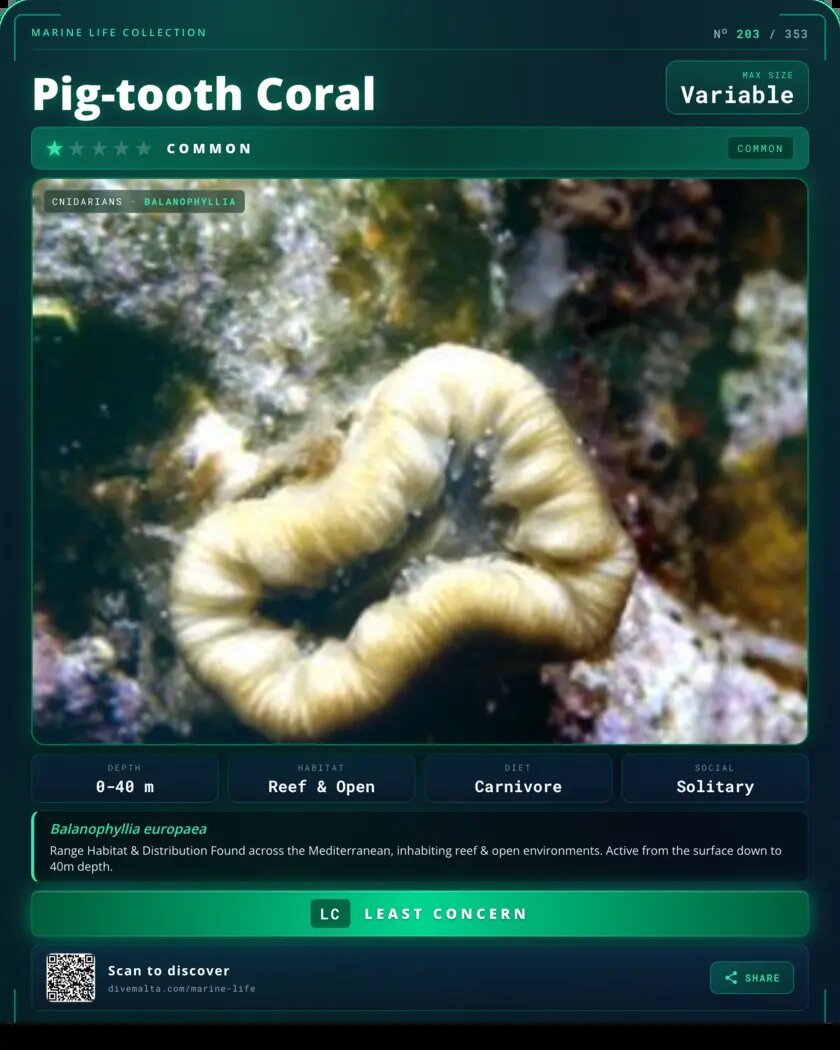
Pig-tooth Coral species card

Behaviour & Diet

Feeding Strategy

Extends its tentacles at night to catch zooplankton and small suspended organisms. During the day the tentacles retract, exposing the characteristic skeletal teeth.

Nocturnal predator

Reproduction

A gonochoric species that reproduces sexually by releasing eggs and sperm into the water column. Larvae are planktonic before settling on shaded, hard substrates.

Broadcast spawner

Behaviour & Defence

The dense calcium carbonate skeleton protects the soft polyp tissue. Retraction of the fleshy polyp deep into the calice shields it from fish grazing and physical damage.

Skeletal armour

Where to Encounter in Malta

The following dive sites offer strong habitat match for Balanophyllia europaea. All are accessible on a guided dive with diveshack.

5-30m
North Malta

Cirkewwa

Rocky reef with caves, arches and ledges hosting a rich diversity of reef species.

View dive site ›
5-50m
Gozo

Blue Hole

One of the Med's most famous reef dive sites. Rocky walls and archways covered in life.

View dive site ›
18-36m
South Malta

Um El Faroud

The wreck lies on a sandy bottom surrounded by rocky reef -- a diverse habitat attracting reef species.

View dive site ›
IUCN Red List Least Concern

Conservation Status

This species is assessed as Least Concern on the IUCN Red List. Mediterranean populations face ongoing pressure from fishing activity, habitat degradation, and climate-driven changes to prey availability.

Source: iNaturalist Guide #888
by Lesley Clements (CC BY-SA)
diveshack Mediterranean Marine Life guide