Depth
Antipathella · Marine Life

Antipathella Subpinnata

Antipathella subpinnata

0-40m
Depth Range
Variable
Max Size
Mediterranean
Distribution
0-40m
Depth Range
Variable
Max Size
Reef & Open
Habitat
Carnivore
Diet
Solitary
Social
LC
IUCN Status
Kingdom Animalia
Genus Antipathella
Species subpinnata

Identification & Biology

  • IdentificationA tree-like or feather-shaped deep-water coral with slender, flexible branches arranged in a single plane, giving it a feather-like form. Pale brown to golden when alive, with tiny white polyps. The skeleton beneath is hard, black, and horn-like.
  • SizeColony height up to 1 m. Individual branches are slender and flexible.
  • Social HabitColonial. Grows on rocky walls and overhangs in areas with strong currents. Slow-growing and long-lived.
  • HabitatDeep rocky walls, overhangs, and cave entrances with good current flow. Requires hard substrate for attachment.
  • Depth30 to 200 m. Most commonly encountered on deeper technical dives.
  • Feeds OnPlankton and suspended organic particles captured by the tiny polyps on each branch.
  • DistributionMediterranean Sea and adjacent eastern Atlantic. Present in deeper Maltese waters.
  • DescriptionAntipathella subpinnata is a black coral, named for the dark, horn-like skeleton beneath its living tissue. Black corals are among the slowest-growing and longest-lived marine animals, with some species reaching ages of over 4,000 years. In Malta, this species is found on deeper walls and overhangs. It is protected under Annex III of the Barcelona Convention and must not be collected or disturbed.

Habitat & Distribution

Found across the Mediterranean, inhabiting reef & open environments. Active from the surface down to 40m depth.

Where Malta divers have spotted this species

Loading…

Sightings are logged by divers using our What Did You See? dive-log tool. View the full live sightings map.

Detail

Preferred Environment

Reef & Open habitats, typically at depths of 0-40m. Most commonly encountered by divers at the shallower end of its range.

Encounter Tips

Best approached slowly and calmly. Avoid casting shadows directly over the animal. Neutral buoyancy and patience increase encounter success significantly.
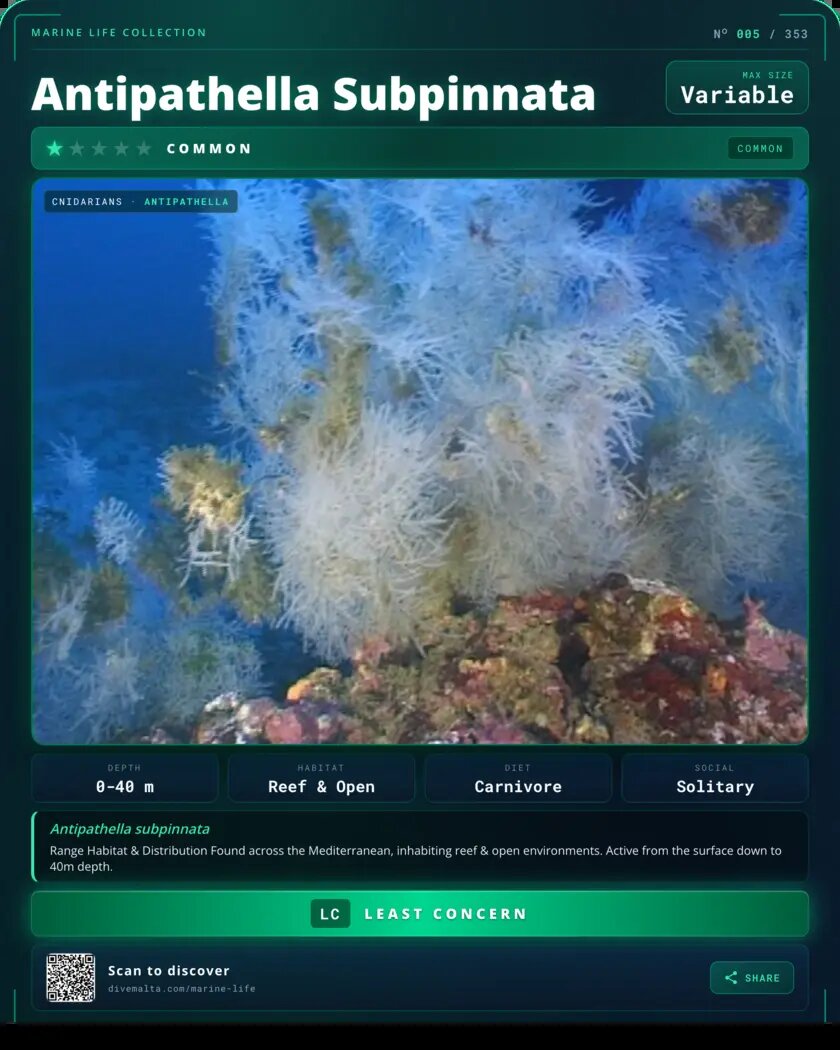
Antipathella Subpinnata species card

Behaviour & Diet

Feeding Strategy

Polyps capture fine zooplankton and suspended organic particles from the current using tentacles armed with nematocysts. Colonies orient perpendicular to the prevailing flow to maximise food capture.

Suspension feeder

Reproduction

A gonochoric species with separate male and female colonies. Fertilisation is internal, and planula larvae are brooded briefly before release to settle on hard substrate.

Internal brooding

Behaviour & Defence

The flexible, proteinaceous skeleton bends with currents rather than breaking. Slow growth and deep habitat reduce exposure to most predators, though some nudibranchs feed on its polyps.

Flexible skeleton

Where to Encounter in Malta

The following dive sites offer strong habitat match for Antipathella subpinnata. All are accessible on a guided dive with diveshack.

5-30m
North Malta

Cirkewwa

Rocky reef with caves, arches and ledges hosting a rich diversity of reef species.

View dive site ›
5-50m
Gozo

Blue Hole

One of the Med's most famous reef dive sites. Rocky walls and archways covered in life.

View dive site ›
18-36m
South Malta

Um El Faroud

The wreck lies on a sandy bottom surrounded by rocky reef -- a diverse habitat attracting reef species.

View dive site ›
IUCN Red List Least Concern

Conservation Status

This species is assessed as Least Concern on the IUCN Red List. Mediterranean populations face ongoing pressure from fishing activity, habitat degradation, and climate-driven changes to prey availability.

Source: iNaturalist Guide #888
by Lesley Clements (CC BY-SA)
diveshack Mediterranean Marine Life guide