Cerianthus membranaceus
Cnidarian
Range
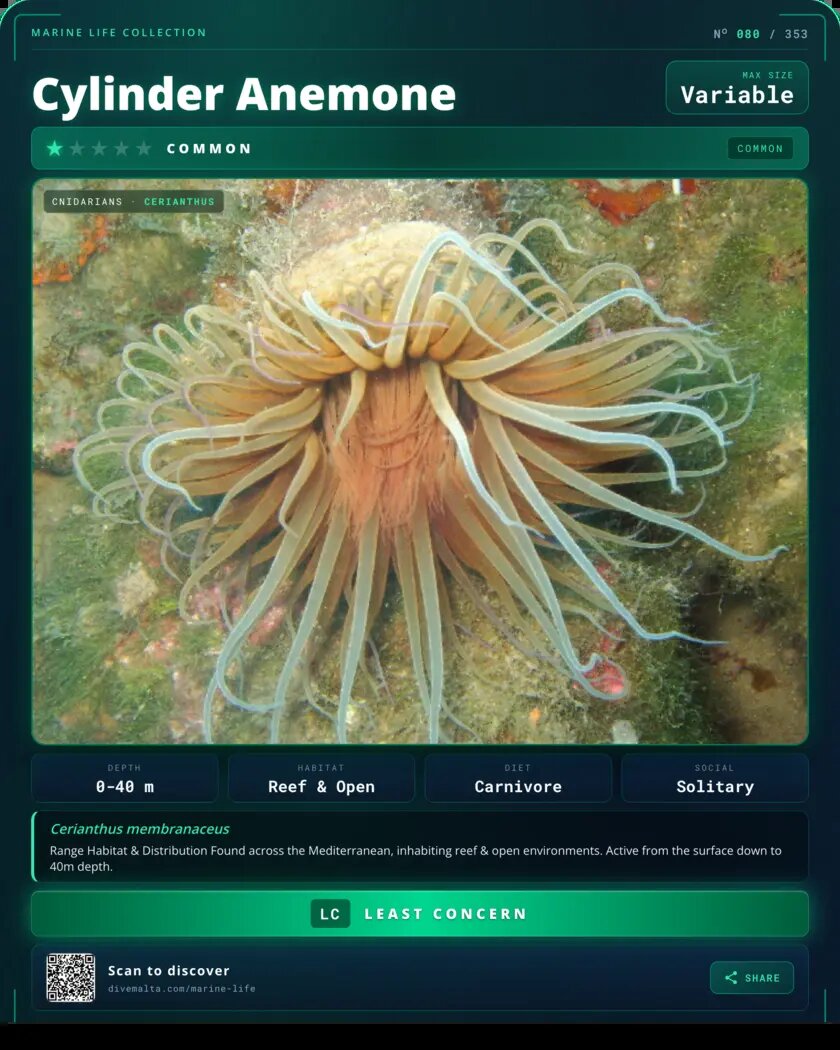
Found across the Mediterranean, inhabiting reef & open environments. Active from the surface down to 40m depth.
Sightings are logged by divers using our What Did You See? dive-log tool. View the full live sightings map.
Reef & Open habitats, typically at depths of 0-40m. Most commonly encountered by divers at the shallower end of its range.
Best approached slowly and calmly. Avoid casting shadows directly over the animal. Neutral buoyancy and patience increase encounter success significantly.
Biology
Extends a wide crown of long tentacles at night to trap passing plankton and small invertebrates. During the day it often retracts partially into its buried tube.
Nocturnal predatorReproduces sexually by releasing gametes into the water column. Fertilised eggs develop into planula larvae that drift before settling on soft substrate to form new tubes.
Broadcast spawnerWithdraws rapidly into its tough parchment-like tube when disturbed, pulling the entire tentacle crown below the sediment surface. The tube itself can extend over 40 cm into the substrate.
Rapid retractionDive with diveshack
The following dive sites offer strong habitat match for Cerianthus membranaceus. All are accessible on a guided dive with diveshack.
Rocky reef with caves, arches and ledges hosting a rich diversity of reef species.
View dive site ›One of the Med's most famous reef dive sites. Rocky walls and archways covered in life.
View dive site ›The wreck lies on a sandy bottom surrounded by rocky reef -- a diverse habitat attracting reef species.
View dive site ›This species is assessed as Least Concern on the IUCN Red List. Mediterranean populations face ongoing pressure from fishing activity, habitat degradation, and climate-driven changes to prey availability.