Depth
Actinia · Cnidarians (Jellyfish, Anemones & Corals)

Beadlet Anemone

Actinia equina

0-40m
Depth Range
Variable
Max Size
Mediterranean
Distribution
0-40m
Depth Range
Variable
Max Size
Rocky Reef
Habitat
Carnivore
Diet
Solitary
Social
LC
IUCN Status
Kingdom Animalia
Phylum Cnidaria
Genus Actinia
Species equina

Identification & Biology

  • IdentificationA small, robust anemone with a smooth column and a ring of up to 192 short, thick tentacles. Most commonly deep red, but also found in green, orange, brown, and strawberry (red with green spots) colour forms. When exposed at low water, the tentacles retract and the animal resembles a smooth, shiny blob.
  • SizeColumn diameter up to 5 cm. Height up to 5 cm when extended.
  • Social HabitSolitary but often found in dense aggregations. Highly territorial and aggressive toward other anemones, using specialised stinging structures (acrorhagi) on the column to attack neighbours that encroach on their territory.
  • HabitatRocky intertidal zone, tide pools, and shallow subtidal rocks. One of the most characteristic animals of Mediterranean rocky shores.
  • DepthIntertidal to 10 m. Most common in the splash and intertidal zones.
  • Feeds OnSmall fish, shrimps, crabs, and other invertebrates that blunder into the tentacles. Also captures mussels and organic particles.
  • DistributionEastern Atlantic from Scandinavia to West Africa, and throughout the Mediterranean Sea. Abundant on all Maltese rocky shores.
  • DescriptionActinia equina is one of the toughest animals on the Mediterranean shoreline. It tolerates hours of exposure to air and direct sun at low water, retracting its tentacles and relying on the moisture sealed inside its column. The territorial battles between adjacent individuals, conducted with specialised stinging weapons, are one of the most studied examples of intraspecific aggression in marine invertebrates.

Habitat & Distribution

Found across the Mediterranean, inhabiting rocky reef environments. Active from the surface down to 40m depth.

Where Malta divers have spotted this species

Loading…

Sightings are logged by divers using our What Did You See? dive-log tool. View the full live sightings map.

Detail

Preferred Environment

Rocky Reef habitats, typically at depths of 0-40m. Most commonly encountered by divers at the shallower end of its range.

Encounter Tips

Best approached slowly and calmly. Avoid casting shadows directly over the animal. Neutral buoyancy and patience increase encounter success significantly.
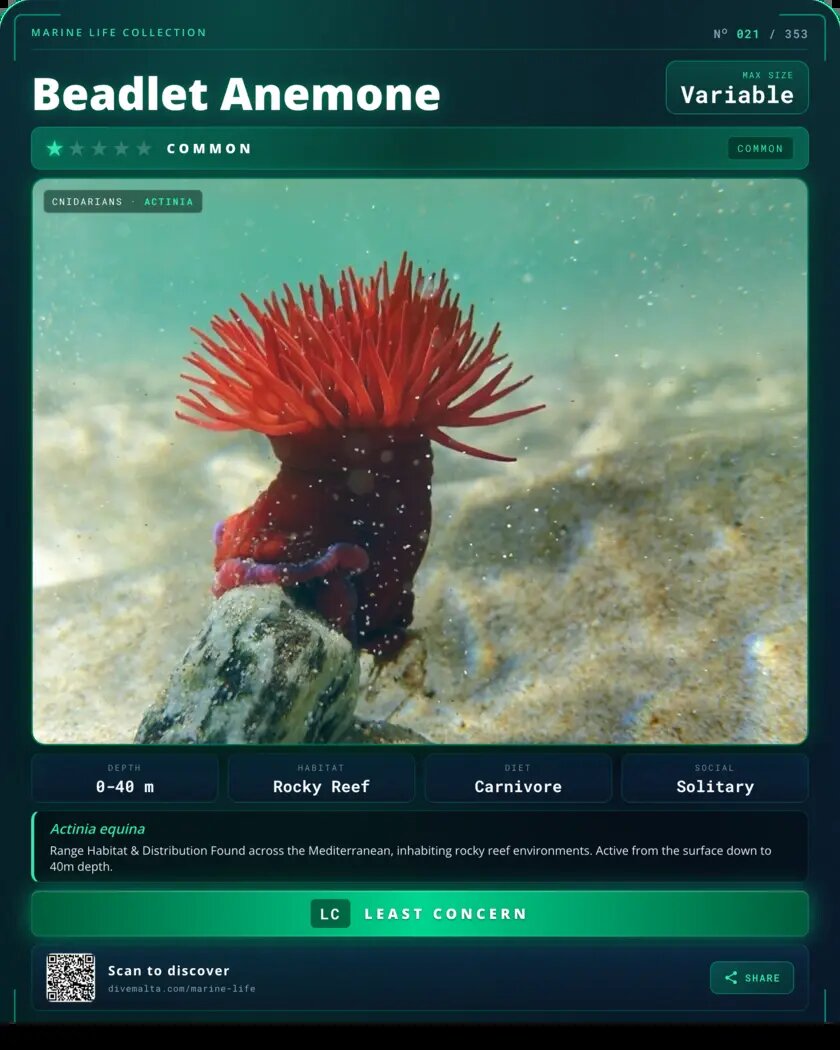
Beadlet Anemone species card

Behaviour & Diet

Feeding Strategy

An opportunistic carnivore that captures small fish, shrimp and other invertebrates using tentacles armed with nematocysts. Prey is passed to the central mouth for digestion.

Ambush predator

Reproduction

Reproduces both sexually and asexually through viviparity, brooding larvae internally before releasing fully formed juveniles from the mouth. This is unusual among anemones.

Live brooding

Behaviour & Defence

Inflates bright blue marginal acrorhagi, specialised stinging structures, to attack encroaching anemones. It can also retract fully into a smooth blob when exposed or disturbed.

Stinging acrorhagi

Where to Encounter in Malta

The following dive sites offer strong habitat match for Actinia equina. All are accessible on a guided dive with diveshack.

5-30m
North Malta

Cirkewwa

Rocky reef with caves, arches and ledges hosting a rich diversity of reef species.

View dive site ›
5-50m
Gozo

Blue Hole

One of the Med's most famous reef dive sites. Rocky walls and archways covered in life.

View dive site ›
18-36m
South Malta

Um El Faroud

The wreck lies on a sandy bottom surrounded by rocky reef -- a diverse habitat attracting reef species.

View dive site ›
IUCN Red List Least Concern

Conservation Status

This species is assessed as Least Concern on the IUCN Red List. Mediterranean populations face ongoing pressure from fishing activity, habitat degradation, and climate-driven changes to prey availability.

Source: iNaturalist Guide #888
by Lesley Clements (CC BY-SA)
diveshack Mediterranean Marine Life guide