Depth
Rhizostoma · Cnidarians (Jellyfish, Anemones & Corals)

Barrel Jellyfish

Rhizostoma pulmo

0-40m
Depth Range
Variable
Max Size
Mediterranean
Distribution
0-40m
Depth Range
Variable
Max Size
Reef & Open
Habitat
Carnivore
Diet
Solitary
Social
LC
IUCN Status
Kingdom Animalia
Phylum Cnidaria
Genus Rhizostoma
Species pulmo

Identification & Biology

  • IdentificationThe largest jellyfish in the Mediterranean, with a massive dome-shaped bell that is pale blue to white, sometimes with a purple or blue tinge at the edges. Eight thick, frilly oral arms hang below the bell instead of true trailing tentacles. No long stinging tentacles.
  • SizeBell diameter up to 90 cm. Weight up to 35 kg.
  • Social HabitCan be solitary or in large groups (blooms), especially in spring and early summer. Drifts passively with currents. Young fish often shelter among the oral arms.
  • HabitatOpen water (pelagic). Drifts in coastal waters, bays, and harbours. Often washed ashore during onshore winds.
  • Depth0 to 40 m. Found at the surface and in the upper water column.
  • Feeds OnPlankton, particularly small crustaceans and fish larvae, trapped in mucus on the oral arms.
  • DistributionEastern Atlantic from the North Sea to West Africa, and throughout the Mediterranean Sea. Seasonally common in Maltese waters.
  • DescriptionRhizostoma pulmo is a gentle giant that poses virtually no sting risk to humans. Its sting is too weak to penetrate human skin. Large blooms can appear in Maltese bays during spring and summer, sometimes numbering hundreds of individuals. Small fish, particularly juvenile jacks, often shelter in the protection of its bell. One of the most impressive sights when encountered in clear blue water.

Habitat & Distribution

Found across the Mediterranean, inhabiting reef & open environments. Active from the surface down to 40m depth.

Where Malta divers have spotted this species

Loading…

Sightings are logged by divers using our What Did You See? dive-log tool. View the full live sightings map.

Detail

Preferred Environment

Reef & Open habitats, typically at depths of 0-40m. Most commonly encountered by divers at the shallower end of its range.

Encounter Tips

Best approached slowly and calmly. Avoid casting shadows directly over the animal. Neutral buoyancy and patience increase encounter success significantly.
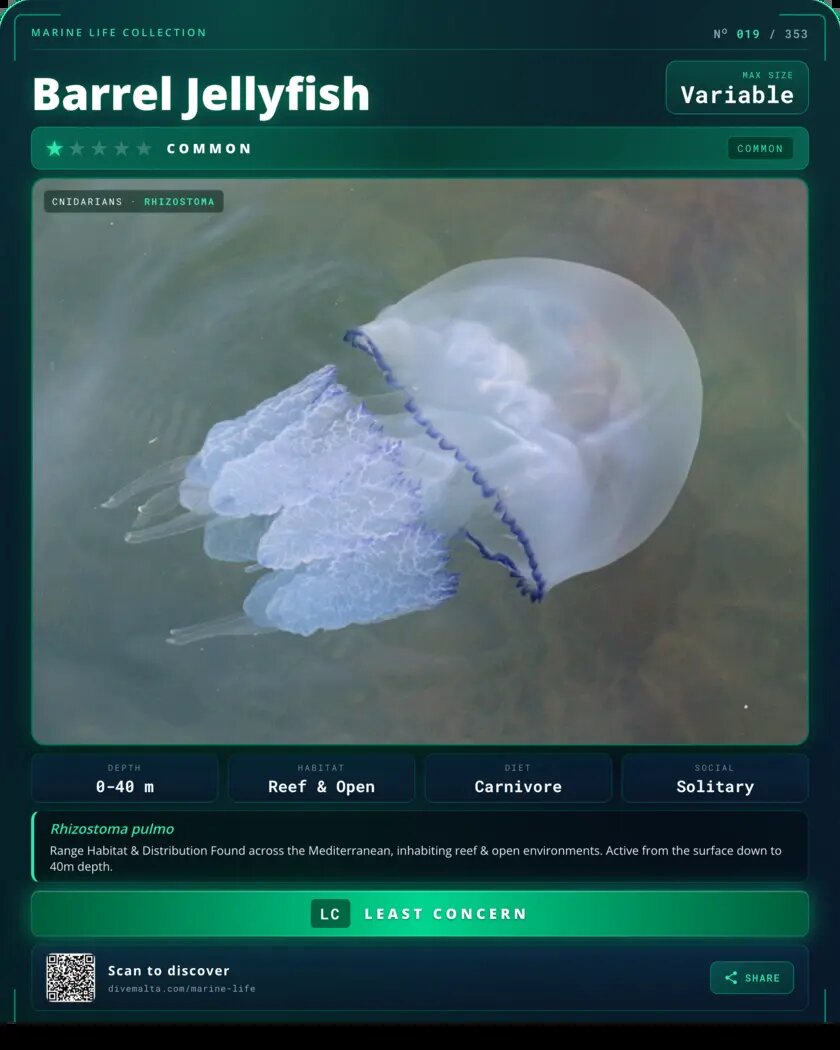
Barrel Jellyfish species card

Behaviour & Diet

Feeding Strategy

Feeds on plankton filtered from the water column using eight thick oral arms lined with stinging cells. It traps tiny organisms in mucus before transporting them to the mouth.

Plankton feeder

Reproduction

Reproduces sexually, releasing eggs and sperm into the water where fertilisation occurs. Larvae settle on the seabed as polyps before budding into juvenile medusae (ephyrae) in spring.

Broadcast spawner

Behaviour & Defence

Its sheer size, up to 90 cm across the bell, deters most predators. The sting is mild to humans but effective against smaller marine organisms.

Mild sting

Where to Encounter in Malta

The following dive sites offer strong habitat match for Rhizostoma pulmo. All are accessible on a guided dive with diveshack.

5-30m
North Malta

Cirkewwa

Rocky reef with caves, arches and ledges hosting a rich diversity of reef species.

View dive site ›
5-50m
Gozo

Blue Hole

One of the Med's most famous reef dive sites. Rocky walls and archways covered in life.

View dive site ›
18-36m
South Malta

Um El Faroud

The wreck lies on a sandy bottom surrounded by rocky reef -- a diverse habitat attracting reef species.

View dive site ›
IUCN Red List Least Concern

Conservation Status

This species is assessed as Least Concern on the IUCN Red List. Mediterranean populations face ongoing pressure from fishing activity, habitat degradation, and climate-driven changes to prey availability.

Source: iNaturalist Guide #888
by Lesley Clements (CC BY-SA)
diveshack Mediterranean Marine Life guide