Depth
Myriapora · Bryozoans (Moss Animals)

False Coral

Myriapora truncata

0-40m
Depth Range
Variable
Max Size
Mediterranean
Distribution
0-40m
Depth Range
Variable
Max Size
Reef & Open
Habitat
Carnivore
Diet
Solitary
Social
LC
IUCN Status
Kingdom Animalia
Phylum Bryozoa
Genus Myriapora
Species truncata

Identification & Biology

  • IdentificationA bryozoan colony that forms erect, branching structures resembling small, stiff coral. Bright orange to red, with a rough, porous surface. Each branch is composed of hundreds of tiny individual zooids (colonial animals) housed in calcareous boxes.
  • SizeColony height up to 8 cm. Branches are thick and stiff.
  • Social HabitColonial. Forms erect, branching growths on hard substrates. Each tiny zooid in the colony extends a ring of tentacles (lophophore) to filter feed.
  • HabitatRocky walls, overhangs, and cave entrances. Prefers shaded positions with good water flow.
  • Depth5 to 80 m. Common between 10 and 50 m.
  • Feeds OnPlankton, bacteria, and suspended organic particles filtered from the water by the tiny tentacle crowns of individual zooids.
  • DistributionMediterranean Sea and adjacent eastern Atlantic. Common in Maltese waters.
  • DescriptionMyriapora truncata is often mistaken for a coral by divers, but it is actually a bryozoan, a colony of thousands of tiny filter-feeding animals. Its bright orange colour and branching growth form make it one of the more noticeable bryozoans in the Mediterranean. The colony is fragile and brittle when dry. It is commonly found on shaded walls alongside other colourful encrusting organisms.

Habitat & Distribution

Found across the Mediterranean, inhabiting reef & open environments. Active from the surface down to 40m depth.

Where Malta divers have spotted this species

Loading…

Sightings are logged by divers using our What Did You See? dive-log tool. View the full live sightings map.

Detail

Preferred Environment

Reef & Open habitats, typically at depths of 0-40m. Most commonly encountered by divers at the shallower end of its range.

Encounter Tips

Best approached slowly and calmly. Avoid casting shadows directly over the animal. Neutral buoyancy and patience increase encounter success significantly.
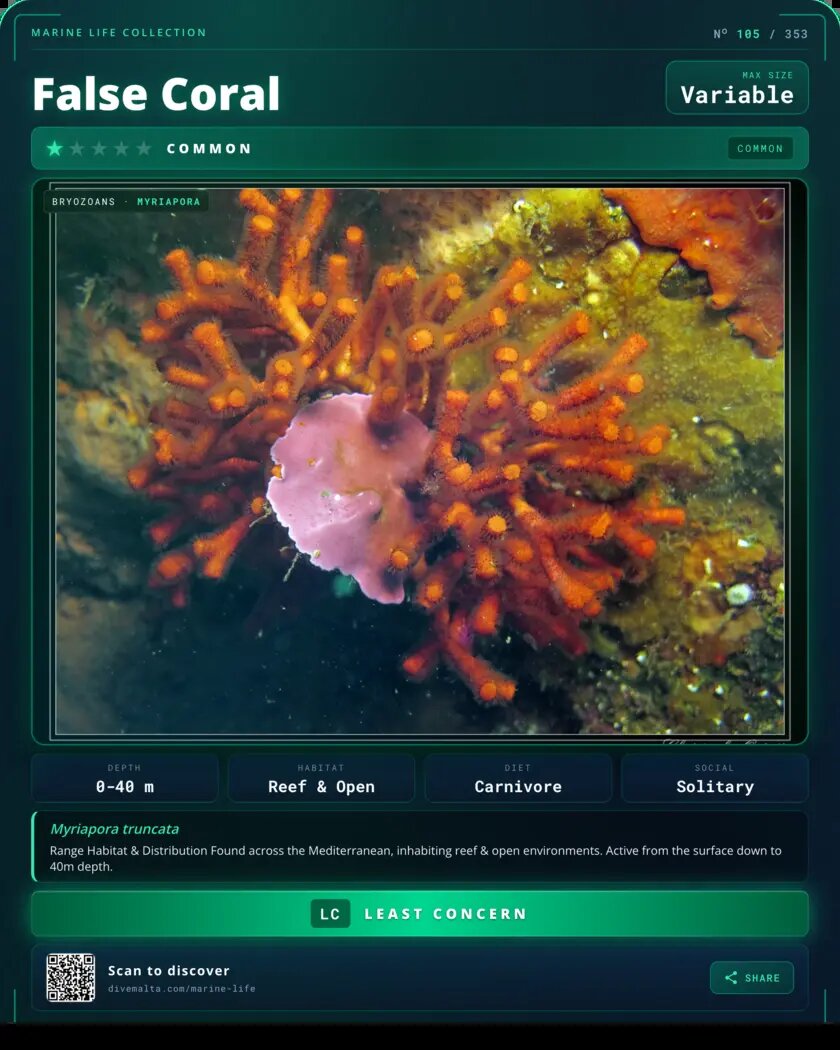
False Coral species card

Behaviour & Diet

Feeding Strategy

Each zooid in the colony extends a lophophore, a horseshoe-shaped ring of ciliated tentacles, to filter phytoplankton and bacteria from the water. Beating cilia create feeding currents.

Filter feeder

Reproduction

Reproduces sexually, brooding larvae in specialised ovicells on the colony surface. Released larvae settle on nearby hard substrate. Colonies also grow by asexual budding of new zooids.

Brooding

Behaviour & Defence

The calcified, rigid skeleton makes the colony unpalatable and hard to consume. Chemical compounds in the tissues further deter predation by nudibranchs and other grazers.

Calcified skeleton

Where to Encounter in Malta

The following dive sites offer strong habitat match for Myriapora truncata. All are accessible on a guided dive with diveshack.

5-30m
North Malta

Cirkewwa

Rocky reef with caves, arches and ledges hosting a rich diversity of reef species.

View dive site ›
5-50m
Gozo

Blue Hole

One of the Med's most famous reef dive sites. Rocky walls and archways covered in life.

View dive site ›
18-36m
South Malta

Um El Faroud

The wreck lies on a sandy bottom surrounded by rocky reef -- a diverse habitat attracting reef species.

View dive site ›
IUCN Red List Least Concern

Conservation Status

This species is assessed as Least Concern on the IUCN Red List. Mediterranean populations face ongoing pressure from fishing activity, habitat degradation, and climate-driven changes to prey availability.

Source: iNaturalist Guide #888
by Lesley Clements (CC BY-SA)
diveshack Mediterranean Marine Life guide