Depth
Pseudocaranx · Bony Fish

White Trevally

Pseudocaranx dentex

10-200m
Depth Range
120cm
Max Size
Mediterranean
Distribution
10-200m
Depth Range
120cm
Max Size
Reef / Pelagic
Habitat
Carnivore
Diet
Small groups
Social
LC
IUCN Status
Low
Sighting Likelihood
KingdomAnimalia
PhylumChordata
ClassActinopterygii
GenusPseudocaranx
Speciesdentex

Identification & Biology

  • IdentificationDeep, compressed body with a silvery body and a yellowish or golden lateral stripe. Steep forehead and small mouth. Scutes present along the rear portion of the lateral line. Dark spot on the gill cover.
  • SizeUp to 122 cm total length, commonly 30 to 60 cm.
  • Social HabitSchooling species that forms groups near reefs, wrecks, and offshore structures.
  • HabitatCoastal and offshore waters near hard substrates.
  • Depth5 to 200 m, most common between 10 and 50 m.
  • Feeds OnSmall fish, crustaceans, and cephalopods.
  • DistributionWorldwide in tropical and warm temperate seas, including the Mediterranean Sea.
  • DescriptionA handsome, silvery jack with a distinctive golden stripe. White trevally school near reefs and wrecks, providing another fast-moving pelagic presence at Mediterranean dive sites. Less common than greater amberjack but an equally welcome sight.

Habitat & Distribution

Occurs over rocky reefs, seamounts, and offshore banks from 10 m down to 200 m. Juveniles are more coastal, while adults move to deeper offshore habitats.

Where Malta divers have spotted this species

Loading…

Sightings are logged by divers using our What Did You See? dive-log tool. View the full live sightings map.

Detail

Preferred Environment

Prefers rocky reef environments and areas where strong currents create upwellings. Found around underwater pinnacles and walls in the Mediterranean.

Encounter Tips

Best approached slowly and calmly. Avoid casting shadows directly over the animal. Neutral buoyancy and patience increase encounter success significantly.
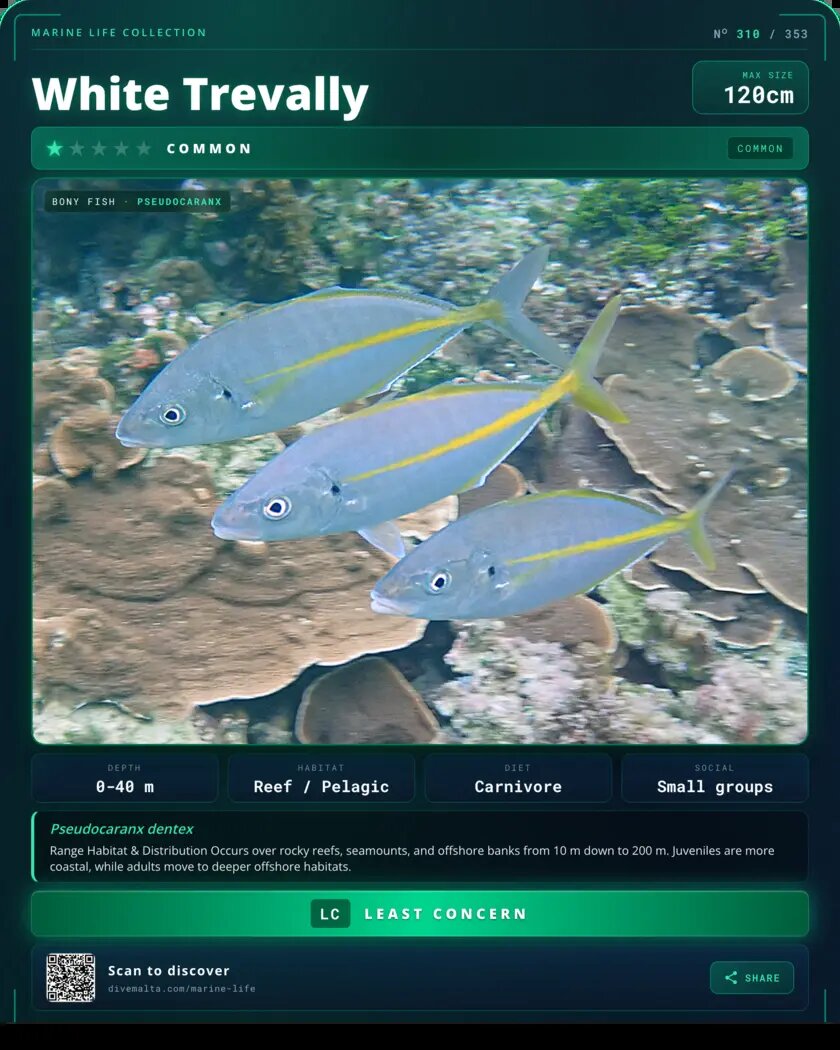
White Trevally species card

Behaviour & Diet

Feeding Strategy

Hunts small fish, cephalopods, and benthic crustaceans near the seabed and in mid-water. Uses its strong jaws to crush hard-shelled prey items.

Active predator

Reproduction

Spawns in open water during the warmer months. Eggs are pelagic and juveniles grow in shallow nursery areas before moving to deeper reef habitats.

Pelagic spawner

Behaviour & Defence

Relies on speed and agility to avoid predators. Adults have few natural threats due to their size and muscular build.

Speed & size

Where to Encounter in Malta

Dive sites where Pseudocaranx dentex may be encountered will be added as sighting data is collected.

IUCN Red List Least Concern

Conservation Status

This species is assessed as Least Concern on the IUCN Red List. Mediterranean populations face ongoing pressure from fishing activity, habitat degradation, and climate-driven changes.

Source: IUCN Red List
diveshack Mediterranean Marine Life guide