Depth
Campogramma · Bony Fish

Vadigo

Campogramma glaycos

0-200m
Depth Range
60cm
Max Size
Mediterranean
Distribution
0-200m
Depth Range
60cm
Max Size
Pelagic
Habitat
Carnivore
Diet
Small groups
Social
LC
IUCN Status
Rare
Sighting Likelihood
Kingdom Animalia
Phylum Chordata
Class Actinopterygii
Genus Campogramma
Species glaycos

Identification & Biology

  • IdentificationLarge, elongated body with a steel-blue to dark blue back and silver flanks. A distinctive dark mark or blotch behind the gill cover. Deeply forked tail. Long, pointed pectoral fins.
  • SizeUp to 60 cm total length, commonly 25 to 40 cm.
  • Social HabitUsually solitary or in small groups near offshore structures.
  • HabitatOpen water near reefs, drop-offs, and offshore structures.
  • Depth10 to 100 m, most common between 20 and 60 m.
  • Feeds OnSmall fish and crustaceans caught in midwater.
  • DistributionEastern Atlantic from Portugal to Angola, including the Mediterranean Sea.
  • DescriptionAn uncommon, deep-bodied carangid that is a memorable find at Mediterranean dive sites. It patrols near offshore structures and drop-offs, sometimes in the company of other jacks and amberjack. Less well-known than the leerfish or greater amberjack but equally impressive when encountered.

Habitat & Distribution

A pelagic-to-demersal species found from the surface to around 200 metres, usually over or near continental shelf edges and offshore reefs. In the Mediterranean, it favours areas with strong currents and clear water.

Where Malta divers have spotted this species

Loading…

Sightings are logged by divers using our What Did You See? dive-log tool. View the full live sightings map.

Detail

Preferred Environment

Prefers open water near steep drop-offs, rocky headlands and offshore pinnacles. Juveniles are sometimes found closer to shore under floating debris or near harbour walls.

Encounter Tips

Best approached slowly and calmly. Avoid casting shadows directly over the animal. Neutral buoyancy and patience increase encounter success significantly.
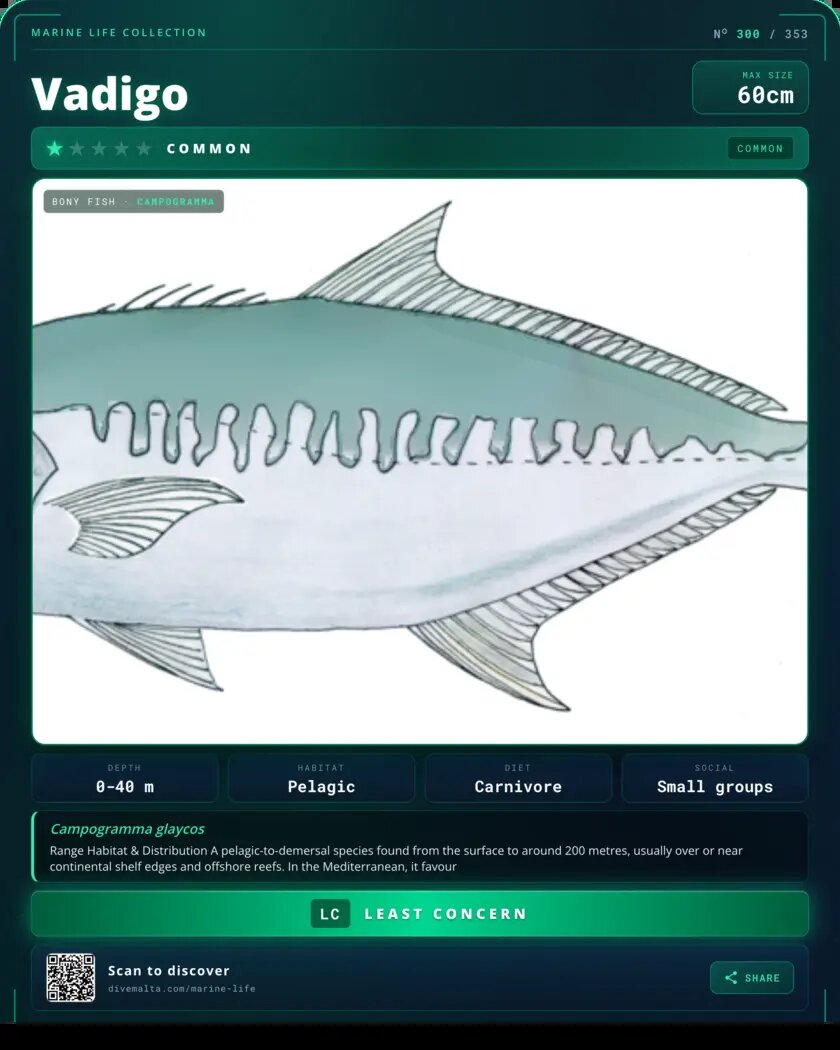
Vadigo species card

Behaviour & Diet

Feeding Strategy

A fast, aggressive predator that chases down small schooling fish and cephalopods. Hunts alone or in small groups, using bursts of speed to ambush prey.

Pursuit Predator

Reproduction

Spawns in open water during the warmer months. Little is known about specific reproductive behaviour in Mediterranean populations, but eggs and larvae are pelagic.

Open-Water Spawner

Behaviour & Defence

Relies on speed and agility to escape larger predators. Often stays close to structure or reef edges that provide escape routes into deeper water.

Speed & Agility

Where to Encounter in Malta

Dive sites where Campogramma glaycos may be encountered will be added as sighting data is collected.

IUCN Red List Least Concern

Conservation Status

This species is assessed as Least Concern on the IUCN Red List. Mediterranean populations face ongoing pressure from fishing activity, habitat degradation, and climate-driven changes.

Source: IUCN Red List
diveshack Mediterranean Marine Life guide