Depth
Alosa · Bony Fish

Twaite Shad

Alosa fallax

0-200m
Depth Range
55cm
Max Size
Mediterranean
Distribution
0-200m
Depth Range
55cm
Max Size
Pelagic
Habitat
Planktivore
Diet
Schooling
Social
LC
IUCN Status
Rare
Sighting Likelihood
Kingdom Animalia
Phylum Chordata
Class Actinopterygii
Genus Alosa
Species fallax

Identification & Biology

  • IdentificationElongated, compressed body with a blue-green back and bright silver flanks. A row of 6 to 10 dark spots runs along the upper flank behind the gill cover. Keeled belly. Large, readily shed scales.
  • SizeUp to 60 cm total length, commonly 25 to 40 cm.
  • Social HabitSchooling species that forms large aggregations in coastal waters and migrates into rivers to spawn.
  • HabitatCoastal marine waters, estuaries, and rivers. An anadromous species that enters freshwater to breed.
  • DepthSurface to 100 m in the marine phase, shallow water in rivers.
  • Feeds OnSmall fish, crustaceans, and zooplankton.
  • DistributionEastern Atlantic from Norway to Morocco, including the Mediterranean Sea.
  • DescriptionA migratory fish that spends most of its life in coastal marine waters before ascending rivers to spawn. The twaite shad was once far more abundant but has declined dramatically due to pollution, dam construction, and overfishing. Conservation efforts to restore river spawning access are underway in several Mediterranean countries.

Habitat & Distribution

An anadromous species found in coastal and open waters across the Mediterranean and eastern Atlantic. Adults inhabit pelagic zones over continental shelves before migrating into estuaries and rivers to breed.

Where Malta divers have spotted this species

Loading…

Sightings are logged by divers using our What Did You See? dive-log tool. View the full live sightings map.

Detail

Preferred Environment

Prefers clean, well-oxygenated coastal waters and estuarine zones. In the Mediterranean, adults are encountered over sandy and muddy substrates near river mouths and in open water.

Encounter Tips

Best approached slowly and calmly. Avoid casting shadows directly over the animal. Neutral buoyancy and patience increase encounter success significantly.
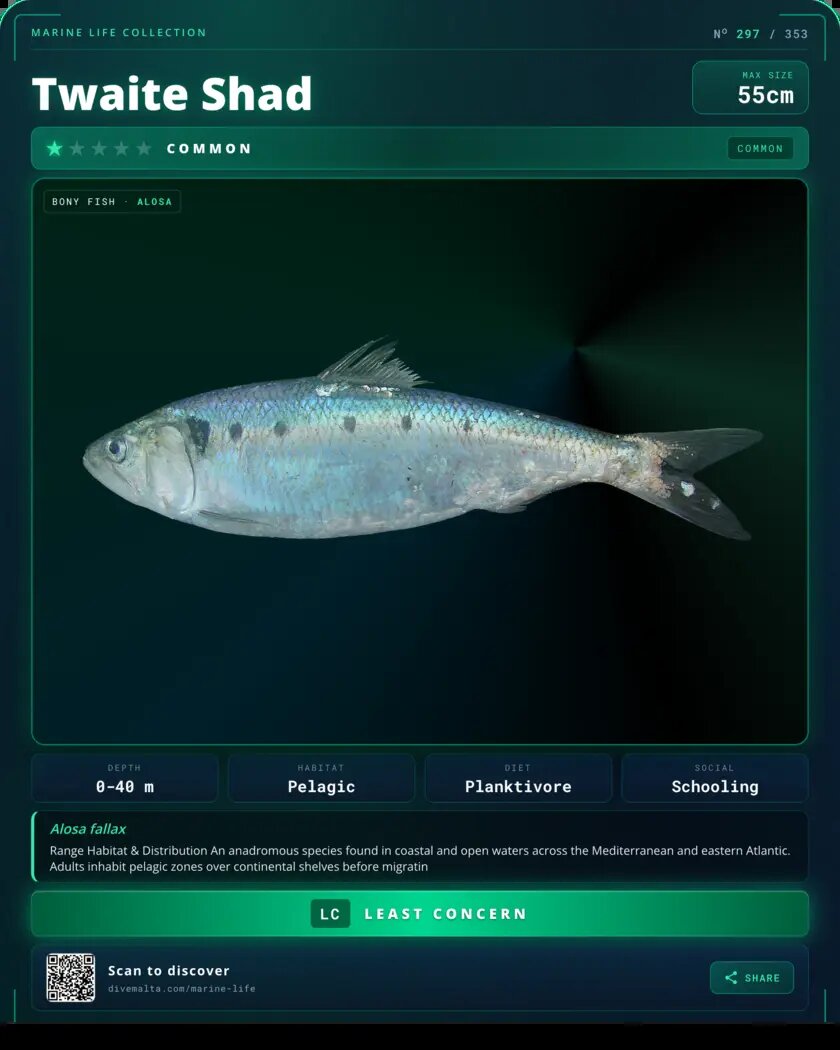
Twaite Shad species card

Behaviour & Diet

Feeding Strategy

Feeds primarily on zooplankton, small crustaceans, and fish larvae filtered from the water column.

Filter feeder

Reproduction

Anadromous spawner that migrates from the sea into freshwater rivers during spring. Eggs are deposited over gravel beds in flowing water.

Anadromous

Behaviour & Defence

Relies on schooling behaviour and speed to evade predators. The reflective silver flanks help confuse attackers in open water.

Schooling escape

Where to Encounter in Malta

Dive sites where Alosa fallax may be encountered will be added as sighting data is collected.

IUCN Red List Least Concern

Conservation Status

This species is assessed as Least Concern on the IUCN Red List. Mediterranean populations face ongoing pressure from fishing activity, habitat degradation, and climate-driven changes.

Source: IUCN Red List
diveshack Mediterranean Marine Life guide