Depth
Lipophrys · Bony Fish

Striped Blenny

Lipophrys trigloides

0-8m
Depth Range
9cm
Max Size
Mediterranean
Distribution
0-8m
Depth Range
9cm
Max Size
Rocky shore
Habitat
Herbivore
Diet
Solitary
Social
LC
IUCN Status
Moderate
Sighting Likelihood
Kingdom Animalia
Phylum Chordata
Class Actinopterygii
Genus Lipophrys
Species trigloides

Identification & Biology

  • IdentificationSmall blenny with a somewhat elongated body. Olive-brown body with a pattern of lighter and darker horizontal stripes. Simple, unbranched orbital tentacles. Thick lips.
  • SizeUp to 8 cm total length, commonly 4 to 6 cm.
  • Social HabitSolitary and territorial on rocky surfaces.
  • HabitatRocky intertidal and shallow subtidal zones. Found on exposed rock surfaces in the wave zone.
  • Depth0 to 10 m, predominantly intertidal to 3 m.
  • Feeds OnAlgae and small invertebrates from rock surfaces.
  • DistributionEastern Atlantic from the British Isles to Morocco, including the Mediterranean Sea.
  • DescriptionA small, striped blenny of the shallow rocky coast. It is common in the intertidal zone and rock pools, where it clings to exposed rock surfaces and dashes between pools. Less conspicuous than some other blennies due to its subdued colouration.

Habitat & Distribution

An intertidal and very shallow subtidal species found on wave-exposed rocky shores around the Mediterranean. Most commonly encountered in rock pools and on wave-washed boulders.

Where Malta divers have spotted this species

Loading…

Sightings are logged by divers using our What Did You See? dive-log tool. View the full live sightings map.

Detail

Preferred Environment

Inhabits the intertidal zone and the first few metres of subtidal rocky habitat. Prefers wave-exposed surfaces with good algal growth.

Encounter Tips

Best approached slowly and calmly. Avoid casting shadows directly over the animal. Neutral buoyancy and patience increase encounter success significantly.
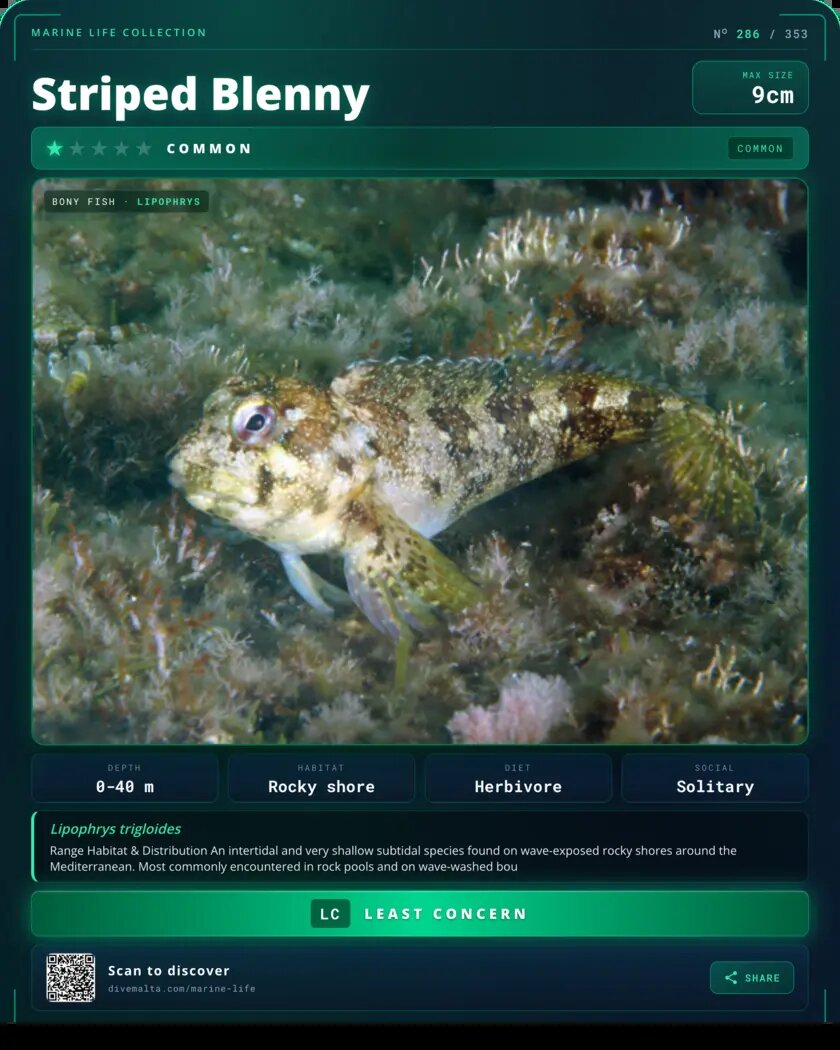
Striped Blenny species card

Behaviour & Diet

Feeding Strategy

Primarily herbivorous, scraping algae and biofilm from rock surfaces with its specialised comb-like teeth.

Algal grazer

Reproduction

Males defend small territories on rocky surfaces. Eggs are laid in crevices or under stones and guarded by the male until hatching.

Rock spawner

Behaviour & Defence

Well camouflaged against the rocky substrate. Darts into crevices at the first sign of danger, relying on speed and knowledge of local shelter.

Crevice escape

Where to Encounter in Malta

Dive sites where Lipophrys trigloides may be encountered will be added as sighting data is collected.

IUCN Red List Least Concern

Conservation Status

This species is assessed as Least Concern on the IUCN Red List. Mediterranean populations face ongoing pressure from fishing activity, habitat degradation, and climate-driven changes.

Source: IUCN Red List
diveshack Mediterranean Marine Life guide