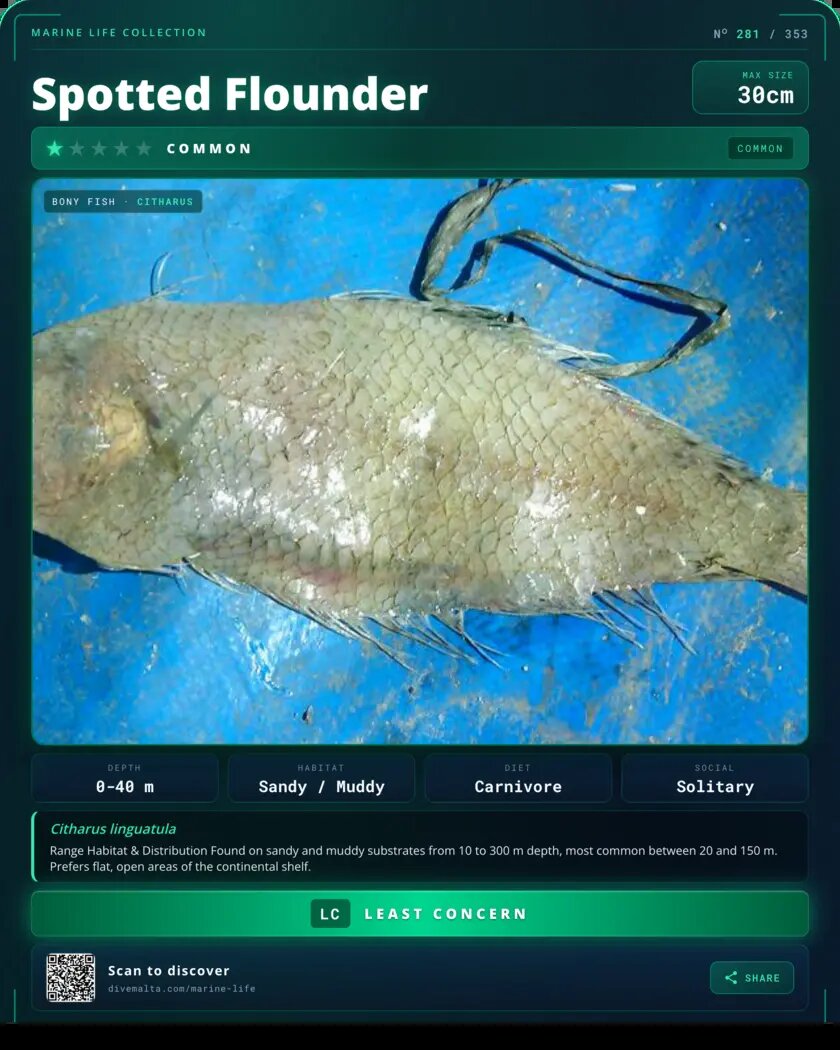
Citharus linguatula
Bony Fish
Range
Found on sandy and muddy substrates from 10 to 300 m depth, most common between 20 and 150 m. Prefers flat, open areas of the continental shelf.
Sightings are logged by divers using our What Did You See? dive-log tool. View the full live sightings map.
Favours soft sediment plains where it can partially bury itself for camouflage. Common on sandy bays, harbour approaches, and open shelf habitats.
Best approached slowly and calmly. Avoid casting shadows directly over the animal. Neutral buoyancy and patience increase encounter success significantly.
Biology
Ambushes small fish, crustaceans, and worms from its concealed position on the seabed. Strikes rapidly when prey passes within range.
Lie-and-wait predatorSpawns from winter to spring in coastal waters. Pelagic eggs hatch into symmetrical larvae that undergo metamorphosis, with one eye migrating to the upper side.
Metamorphic larvaeRelies almost entirely on camouflage, burying in sediment with only its eyes exposed. Can rapidly change skin shading to match surrounding substrate.
Burial camouflageDive with diveshack
Dive sites where Citharus linguatula may be encountered will be added as sighting data is collected.
This species is assessed as Least Concern on the IUCN Red List. Mediterranean populations face ongoing pressure from fishing activity, habitat degradation, and climate-driven changes.