Depth
Aphanius · Bony Fish

South European Toothcarp

Aphanius fasciatus

0-5m
Depth Range
7cm
Max Size
Mediterranean
Distribution
0-5m
Depth Range
7cm
Max Size
Brackish
Habitat
Omnivore
Diet
Small groups
Social
LC
IUCN Status
Rare
Sighting Likelihood
Kingdom Animalia
Phylum Chordata
Class Actinopterygii
Genus Aphanius
Species fasciatus

Identification & Biology

  • IdentificationVery small, stocky fish with a rounded body and upturned mouth. Males are brightly coloured with blue-green flanks and vertical dark bars. Females are plain olive-brown.
  • SizeUp to 7 cm total length, commonly 3 to 5 cm.
  • Social HabitSchooling species found in shallow, often brackish water. Males display bright colours to attract females.
  • HabitatCoastal lagoons, salt marshes, brackish pools, and freshwater springs near the coast. Tolerates extreme salinities.
  • Depth0 to 2 m, almost exclusively in very shallow water.
  • Feeds OnAlgae, small crustaceans, insect larvae, and organic detritus.
  • DistributionMediterranean region. Found in scattered coastal wetlands around the Mediterranean Sea.
  • DescriptionA tiny killifish of Mediterranean coastal wetlands that is one of the most threatened fish species in the region. Many populations have been wiped out by coastal development, pollution, and the introduction of the invasive mosquitofish. Surviving populations are strictly protected. In Malta, it is found in a few remaining brackish pools.

Habitat & Distribution

Inhabits shallow coastal lagoons, salt marshes, and brackish water bodies around the Mediterranean. Tolerates extreme salinity and temperature variations that most fish cannot survive.

Where Malta divers have spotted this species

Loading…

Sightings are logged by divers using our What Did You See? dive-log tool. View the full live sightings map.

Detail

Preferred Environment

Found in very shallow, warm brackish pools and coastal lagoons with muddy or sandy bottoms. Often encountered in saline wetlands and salt pans where few other fish species can persist.

Encounter Tips

Best approached slowly and calmly. Avoid casting shadows directly over the animal. Neutral buoyancy and patience increase encounter success significantly.
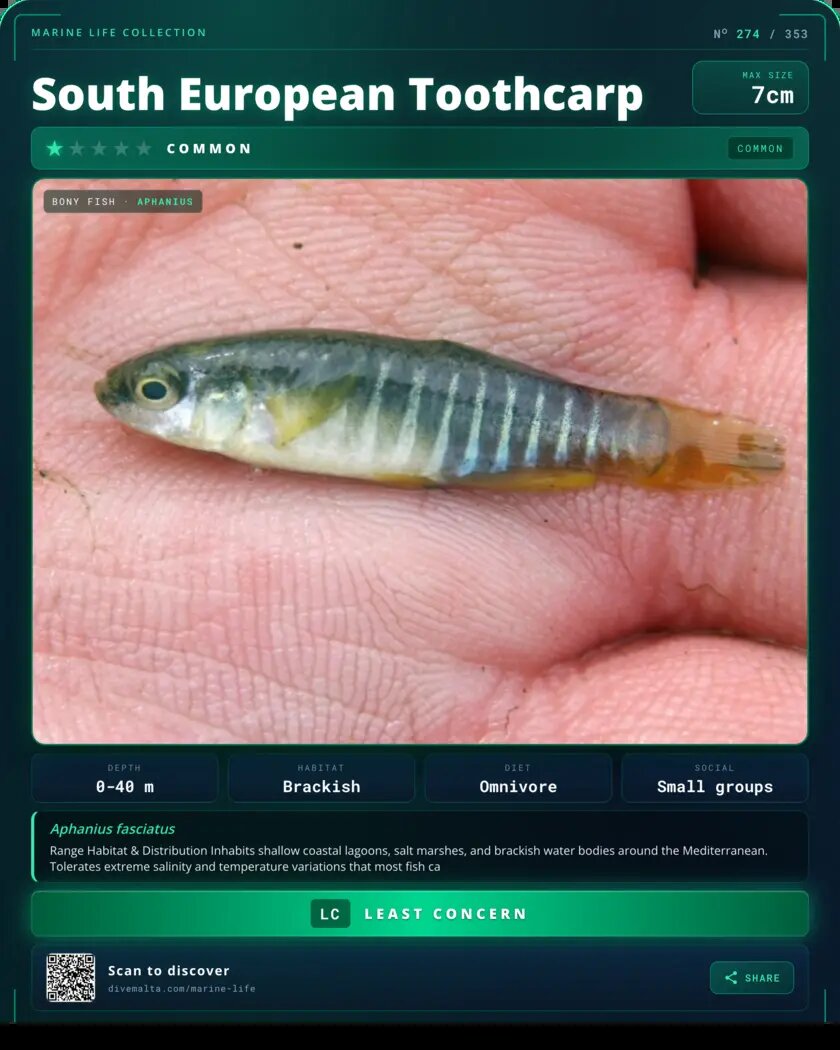
South European Toothcarp species card

Behaviour & Diet

Feeding Strategy

An omnivorous feeder that consumes algae, detritus, small invertebrates, and mosquito larvae from the water surface and substrate.

Omnivore

Reproduction

Spawns in warm, shallow brackish water from late spring to early autumn. Eggs are attached to submerged vegetation and hatch within a few days.

Brackish spawner

Behaviour & Defence

Relies on camouflage among vegetation and rapid darting movements to escape predators. Males become territorial during breeding.

Territorial

Where to Encounter in Malta

Dive sites where Aphanius fasciatus may be encountered will be added as sighting data is collected.

IUCN Red List Least Concern

Conservation Status

This species is assessed as Least Concern on the IUCN Red List. Mediterranean populations face ongoing pressure from fishing activity, habitat degradation, and climate-driven changes.

Source: IUCN Red List
diveshack Mediterranean Marine Life guide