Depth
Gobius · Bony Fish

Slender Goby

Gobius geniporus

0-30m
Depth Range
Variable
Max Size
Mediterranean
Distribution
0-30m
Depth Range
Variable
Max Size
Sandy / Muddy
Habitat
Carnivore
Diet
Solitary
Social
LC
IUCN Status
High
Sighting Likelihood
Kingdom Animalia
Phylum Chordata
Class Actinopterygii
Genus Gobius
Species geniporus

Identification & Biology

  • IdentificationElongated, slender goby with a pointed snout. Sandy to grey body with faint darker markings. A dark spot at the base of the pectoral fin. Head is relatively narrow compared to other gobies.
  • SizeUp to 16 cm total length, commonly 8 to 12 cm.
  • Social HabitSolitary and territorial on sandy patches near rocky structures.
  • HabitatSandy areas adjacent to rocky reefs and boulder fields. Often on sand patches between rocks.
  • Depth5 to 40 m, most common between 10 and 25 m.
  • Feeds OnSmall crustaceans, worms, and benthic invertebrates found on sandy substrates.
  • DistributionMediterranean Sea. An endemic species.
  • DescriptionA common, sandy-coloured goby that frequents the sand patches between reef structures. Its slender build and pointed snout distinguish it from the more robust rock-dwelling gobies. Divers often see it perched on open sand, where it watches alertly before darting to the nearest rock cover.

Habitat & Distribution

Found across the Mediterranean, inhabiting sandy / muddy environments. Active from the surface down to 30m depth.

Where Malta divers have spotted this species

Loading…

Sightings are logged by divers using our What Did You See? dive-log tool. View the full live sightings map.

Detail

Preferred Environment

Sandy / Muddy habitats, typically at depths of 0-30m. Most commonly encountered by divers at the shallower end of its range.

Encounter Tips

Best approached slowly and calmly. Avoid casting shadows directly over the animal. Neutral buoyancy and patience increase encounter success significantly.
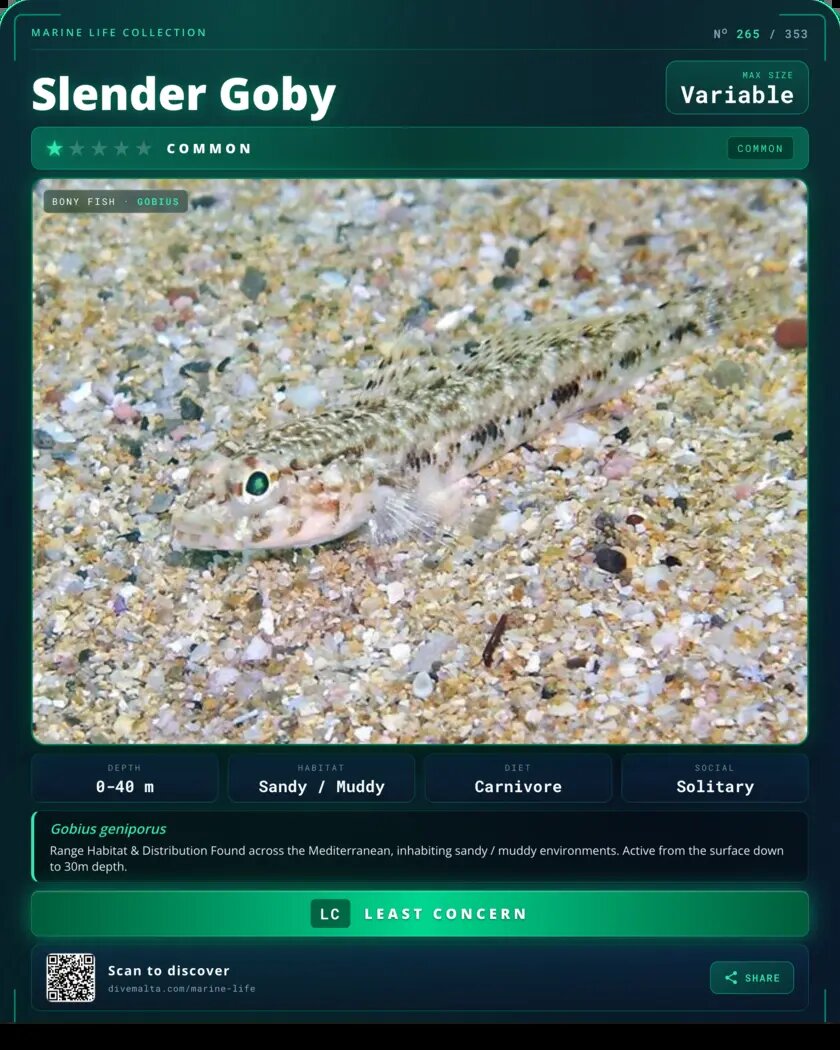
Slender Goby species card

Behaviour & Diet

Feeding Strategy

Feeds on minute benthic invertebrates, copepods and organic particles found on sandy and muddy substrates.

Micro predator

Reproduction

Males guard eggs deposited inside burrows or beneath stones. Parental care continues until the larvae hatch.

Egg guarder

Behaviour & Defence

Near-transparent, elongated body provides excellent camouflage over sandy and silty bottoms. Remains motionless to avoid detection.

Camouflage

Where to Encounter in Malta

The following dive sites offer strong habitat match for Gobius geniporus. All are accessible on a guided dive with diveshack.

3-18m
Comino

Blue Lagoon

Extensive sandy floor with excellent visibility. A prime habitat for benthic species that shelter in the sandy channels.

View dive site ›
5-22m
South Malta

Ghar Lapsi

Sheltered cove with sandy patches between rocky outcrops. The sandy areas at 8-15m are rich in benthic marine life.

View dive site ›
8-30m
North Malta

Cirkewwa

Sandy channels flanking the reef system provide excellent habitat for bottom-dwelling species.

View dive site ›
IUCN Red List Least Concern

Conservation Status

This species is assessed as Least Concern on the IUCN Red List. Mediterranean populations face ongoing pressure from fishing activity, habitat degradation, and climate-driven changes to prey availability.

Source: iNaturalist Guide #888
by Lesley Clements (CC BY-SA)
diveshack Mediterranean Marine Life guide