Depth
Gadiculus · Bony Fish

Silvery Pout

Gadiculus argenteus

100-600m
Depth Range
15cm
Max Size
Mediterranean
Distribution
100-600m
Depth Range
15cm
Max Size
Bathypelagic
Habitat
Planktivore
Diet
Large schools
Social
LC
IUCN Status
Rare
Sighting Likelihood
KingdomAnimalia
PhylumChordata
ClassActinopterygii
GenusGadiculus
Speciesargenteus

Identification & Biology

  • IdentificationVery small, cod-like fish with large eyes, a single chin barbel, and a silvery body. Two dorsal fins and one anal fin. Translucent body with a silvery sheen.
  • SizeUp to 15 cm total length, commonly 8 to 12 cm.
  • Social HabitSchooling species in deep water, forming large aggregations near the seabed.
  • HabitatDeep-water muddy and sandy bottoms on the continental shelf and slope.
  • Depth100 to 1,000 m, most common between 200 and 600 m.
  • Feeds OnSmall crustaceans and zooplankton near the seabed.
  • DistributionEastern Atlantic from Norway to West Africa, including the Mediterranean Sea.
  • DescriptionA tiny, deep-water relative of the cod that is far too deep for recreational divers to encounter. Despite its small size, it occurs in enormous numbers on the continental slope and is an important prey species for larger deep-water predators.

Habitat & Distribution

Found over continental slopes and deep basins between 100 and 600 metres throughout the Mediterranean. Common in Maltese deep waters and an important component of the deep-sea food web.

Where Malta divers have spotted this species

Loading…

Sightings are logged by divers using our What Did You See? dive-log tool. View the full live sightings map.

Detail

Preferred Environment

Mid-water above soft muddy slopes and deep basins. Performs diel vertical migrations, rising closer to the surface at night.

Encounter Tips

Best approached slowly and calmly. Avoid casting shadows directly over the animal. Neutral buoyancy and patience increase encounter success significantly.
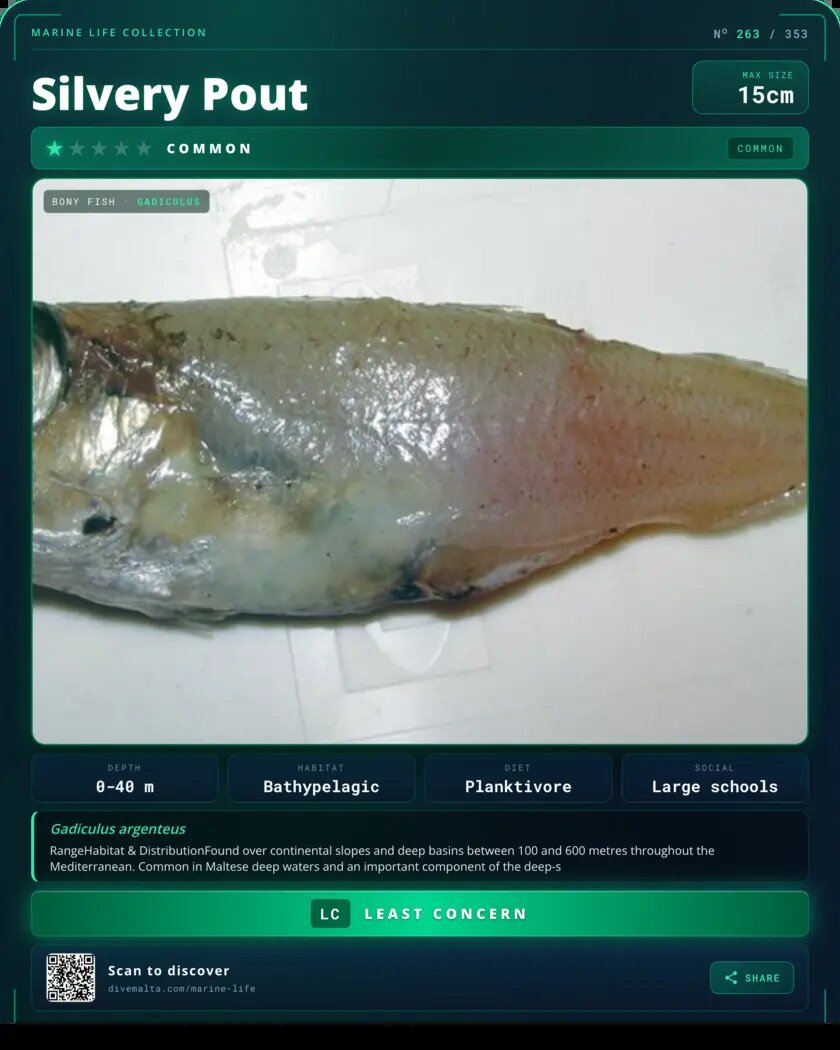
Silvery Pout species card

Where to Encounter in Malta

Dive sites where Gadiculus argenteus may be encountered will be added as sighting data is collected.

IUCN Red ListLeast Concern

Conservation Status

This species is assessed as Least Concern on the IUCN Red List. Mediterranean populations face ongoing pressure from fishing activity, habitat degradation, and climate-driven changes.

Source: IUCN Red List
diveshack Mediterranean Marine Life guide