Depth
Alepes · Bony Fish

Shrimp Scad

Alepes djedaba

0-50m
Depth Range
40cm
Max Size
Mediterranean
Distribution
0-50m
Depth Range
40cm
Max Size
Coastal pelagic
Habitat
Carnivore
Diet
Schooling
Social
LC
IUCN Status
Rare
Sighting Likelihood
Kingdom Animalia
Phylum Chordata
Class Actinopterygii
Genus Alepes
Species djedaba

Identification & Biology

  • IdentificationElongated, compressed body with a blue-green back and silver flanks. A prominent yellow stripe runs along the midline. Black spot on the gill cover. Enlarged scutes along the rear lateral line.
  • SizeUp to 40 cm total length, commonly 15 to 25 cm.
  • Social HabitHighly gregarious, forming large pelagic schools in coastal and offshore waters.
  • HabitatPelagic in coastal waters, often near the bottom.
  • Depth5 to 100 m, most common between 10 and 50 m.
  • Feeds OnSmall crustaceans, zooplankton, and small fish.
  • DistributionIndo-Pacific origin. A Lessepsian migrant now established in the eastern Mediterranean and spreading westward.
  • DescriptionAn Indo-Pacific jack that entered the Mediterranean through the Suez Canal and is now spreading westward. Its increasing abundance in Maltese waters reflects the ongoing tropicalization of the Mediterranean. Divers may encounter schools of shrimp scad near the coast.

Habitat & Distribution

A coastal pelagic species found in shallow to moderately deep waters, typically above 50 metres. In the Mediterranean, it is most common in the warmer eastern basin, where it schools over sandy bottoms and around harbour structures.

Where Malta divers have spotted this species

Loading…

Sightings are logged by divers using our What Did You See? dive-log tool. View the full live sightings map.

Detail

Preferred Environment

Prefers warm, clear coastal waters near sandy and rocky substrates. Frequently encountered around jetties, harbour walls and over open sandy flats close to shore.

Encounter Tips

Best approached slowly and calmly. Avoid casting shadows directly over the animal. Neutral buoyancy and patience increase encounter success significantly.
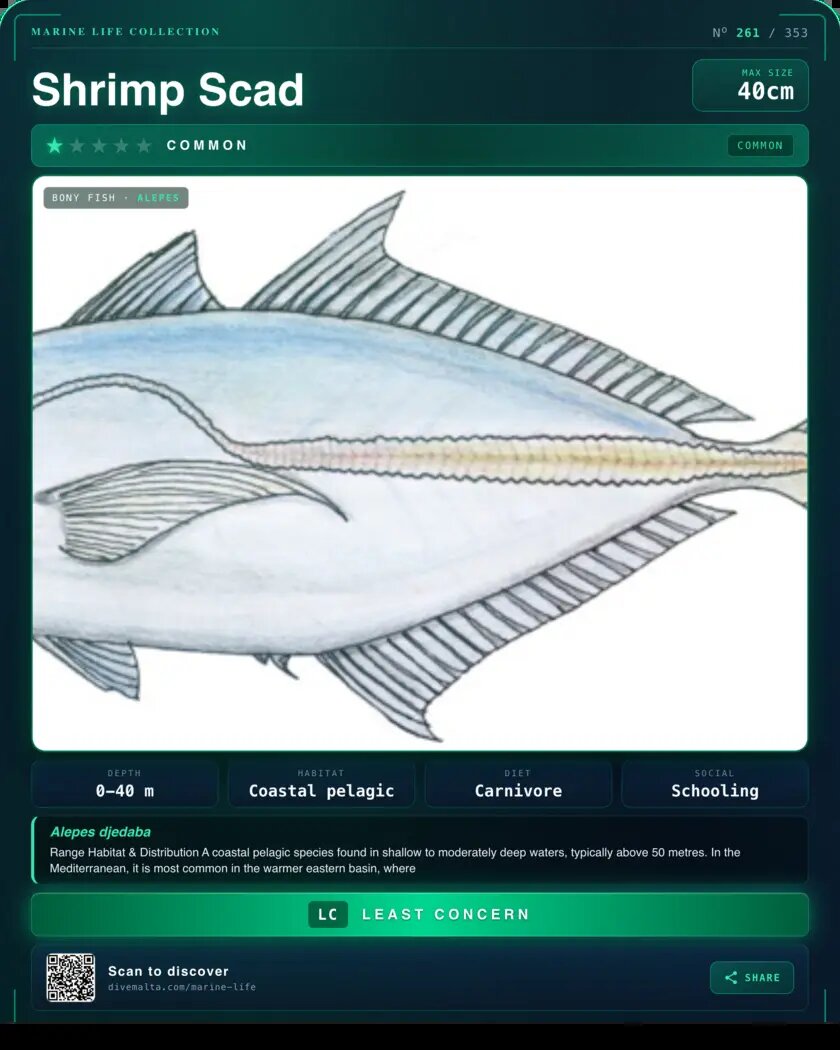
Shrimp Scad species card

Behaviour & Diet

Feeding Strategy

Preys on small fish, shrimp and planktonic crustaceans, hunting actively in mid-water. Its common name reflects its particular fondness for shrimp-like prey.

Active Predator

Reproduction

Spawns in warm coastal waters during summer. Eggs are pelagic, and larvae develop rapidly in the plankton-rich surface layers.

Summer Spawner

Behaviour & Defence

Uses speed and tight schooling to evade predators. The reflective silvery flanks create a shimmering effect that confuses attackers targeting individual fish.

Speed & Silver Flash

Where to Encounter in Malta

Dive sites where Alepes djedaba may be encountered will be added as sighting data is collected.

IUCN Red List Least Concern

Conservation Status

This species is assessed as Least Concern on the IUCN Red List. Mediterranean populations face ongoing pressure from fishing activity, habitat degradation, and climate-driven changes.

Source: IUCN Red List
diveshack Mediterranean Marine Life guide